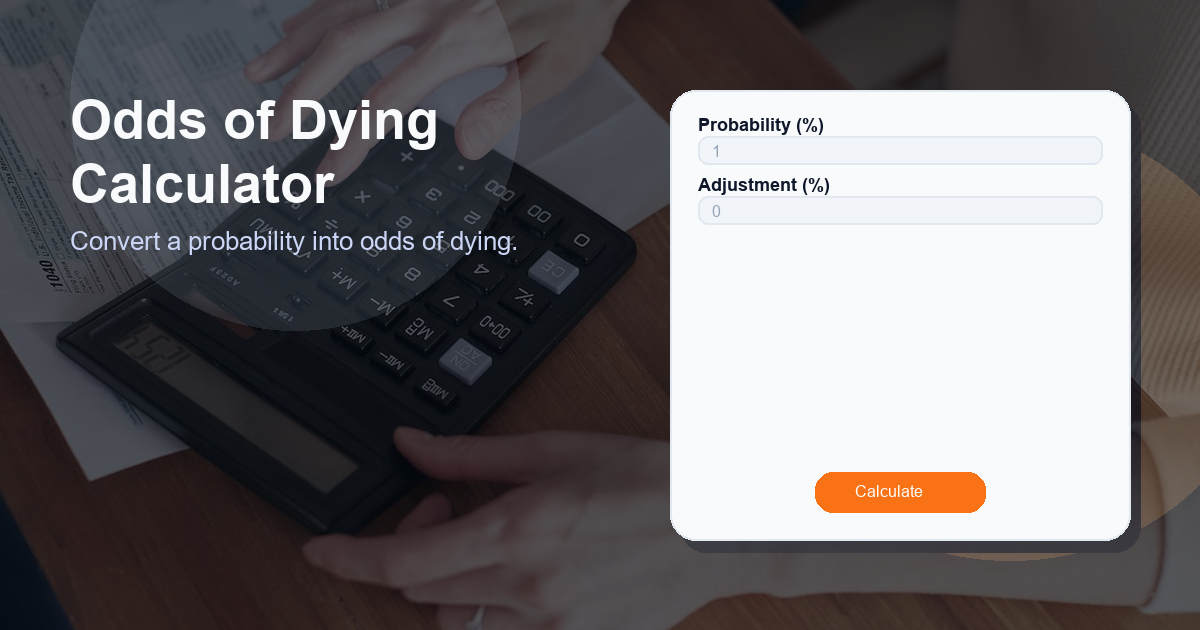
Odds of Dying Calculator
Description: Convert a probability into odds of dying. Use the Odds of Dying Calculator to transform a percentage probability (with an optional adjustment) into an easy-to-understand “1 in X” odds format.
What this Odds of Dying Calculator does
The Odds of Dying Calculator takes two simple inputs—Probability (%) and Adjustment (%)—and converts them into a clear, relatable odds statement labeled Odds (1 in X). Instead of interpreting small percentages or fractional probabilities, the tool expresses risk as “one in X people,” which is often easier to grasp.
This calculator is useful for:
- Translating percentages into odds for clearer communication of risk.
- Comparing risks across activities, illnesses, or outcomes by using a standardized “1 in X” metric.
- Adjusting a base probability to account for mitigating factors, uncertainty, or population differences using the Adjustment (%) input.
How to use the Odds of Dying Calculator
Using the Odds of Dying Calculator is straightforward. Follow these steps:
- Enter Probability (%): Type the initial probability of the event occurring, expressed as a percentage. Example: 0.5 for 0.5%.
- Enter Adjustment (%): Add or subtract a percentage to account for extra risk factors, improved safety, or uncertainty. Example: +0.1 to slightly increase risk, or -0.1 to decrease it.
- Apply the formula (explained below) to convert to odds and produce the result labeled Odds (1 in X).
- Read the result as: “There is a 1 in X chance of dying,” where X is the number calculated by the tool.
Example walkthrough:
- Probability: 0.5%
- Adjustment: 0%
- Combined probability: 0.5%
- Odds (1 in X): If the calculator returns 1 in 199, that means one death is expected for every 199 similar occurrences, on average.
How the Odds of Dying Calculator formula works
The calculator uses the following formula with percentages:
Formula: (probability_percent + adjustment) / (100 – (probability_percent + adjustment))
This expresses the odds ratio as probability-to-non-probability. To convert that ratio into the more familiar “1 in X” format, compute the inverse of the ratio of the event probability to the event not occurring. In practical terms:
- Let p = probability_percent + adjustment (in percent units).
- The ratio returned by the formula is: p / (100 – p).
- To produce the Odds (1 in X) label, compute X = (100 – p) / p.
Worked example 1:
- Probability = 0.5%, Adjustment = 0%
- p = 0.5
- Odds ratio = 0.5 / (100 – 0.5) = 0.5 / 99.5 ≈ 0.005025
- Odds (1 in X): X = (100 – 0.5) / 0.5 = 99.5 / 0.5 = 199 → “1 in 199”
Worked example 2 with an adjustment:
- Probability = 2%, Adjustment = 1%
- p = 3
- Odds ratio = 3 / 97 ≈ 0.03093
- Odds (1 in X): X = 97 / 3 ≈ 32.33 → “1 in 32.3”
Notes:
- If p = 0, odds are infinite (no expected deaths under the model).
- If p approaches 100, the denominator shrinks and the odds approach certainty (1 in 1).
- The calculator assumes the inputs are percentages (not decimals), so be sure to enter 1 for 1%, not 0.01.
Use cases for the Odds of Dying Calculator
The Odds of Dying Calculator is versatile and can be applied in many contexts where communicating or comparing risk matters. Common use cases include:
- Public health communication — turning mortality probabilities from studies into “1 in X” statements that are easier for the public to understand.
- Medical decision making — helping clinicians or patients compare small absolute risks when evaluating treatments or procedures.
- Safety assessments — estimating odds of fatality in workplace or transportation safety audits after applying mitigation adjustments.
- Risk comparison — comparing the odds of dying from different causes (e.g., disease A vs. disease B) by converting both to a consistent “1 in X” format.
- Insurance or actuarial studies — quickly turning percentage estimates into intuitive odds for reporting or client discussions.
Benefits of the “1 in X” format:
- Simplifies comprehension: People often find “1 in 100” easier to visualize than “1%”.
- Supports direct comparison: Two different probabilities can be compared by comparing their X values.
- Highlights rarity or frequency: Small differences in percentage can lead to substantial differences in odds, which the format exposes clearly.
Other factors to consider when calculating x
While the mathematical conversion is straightforward, several real-world considerations should influence how you use the Odds of Dying Calculator and interpret the Odds (1 in X) result:
- Quality of the input data: The calculator only reflects the accuracy of the numbers you provide. If the base probability is estimated from a small sample or biased data, the odds will be unreliable.
- Adjustment direction and magnitude: Adjustments can be used to reflect improved safety, demographic differences, or uncertainty, but arbitrary adjustments can mislead. Document the reason for any adjustment.
- Context and population: Probabilities often vary across age groups, geographies, and time. Ensure the probability applies to the target population before converting to “1 in X”.
- Confidence intervals: Consider uncertainty ranges. If the base probability has a confidence interval, convert both bounds to “1 in X” to show the range of possible odds.
- Interpretation limitations: Odds are averages over many events. An individual’s risk may differ substantially from the population average.
Frequently Asked Questions
What exactly does “Odds (1 in X)” mean?
Odds (1 in X) means that, on average, one event (e.g., one death) would occur for every X similar instances. For example, “1 in 199” means one expected death per 199 comparable cases.
Can the Adjustment (%) be negative?
Yes. Use a negative adjustment to reflect reduced risk (for example, due to protective measures). The calculator adds the adjustment to the base probability, so a negative adjustment lowers the combined probability.
Is the formula valid for large probabilities close to 100%?
Mathematically it is valid, but interpret results carefully. As the combined percentage approaches 100%, the “1 in X” value approaches 1, indicating near certainty. Very high probabilities often mean the model assumptions or population context need review.
How should I handle very small probabilities?
For very small probabilities (e.g., 0.001%), the calculator still works, but the resulting X can be very large (e.g., 1 in 100,000). Present such numbers with appropriate rounding and include confidence intervals if available.
Does this calculator account for repeated exposures or cumulative risk?
No. This calculator converts a single-event probability into odds. For repeated exposures or cumulative risks over time, you need a different calculation that models multiple events and combined probabilities.