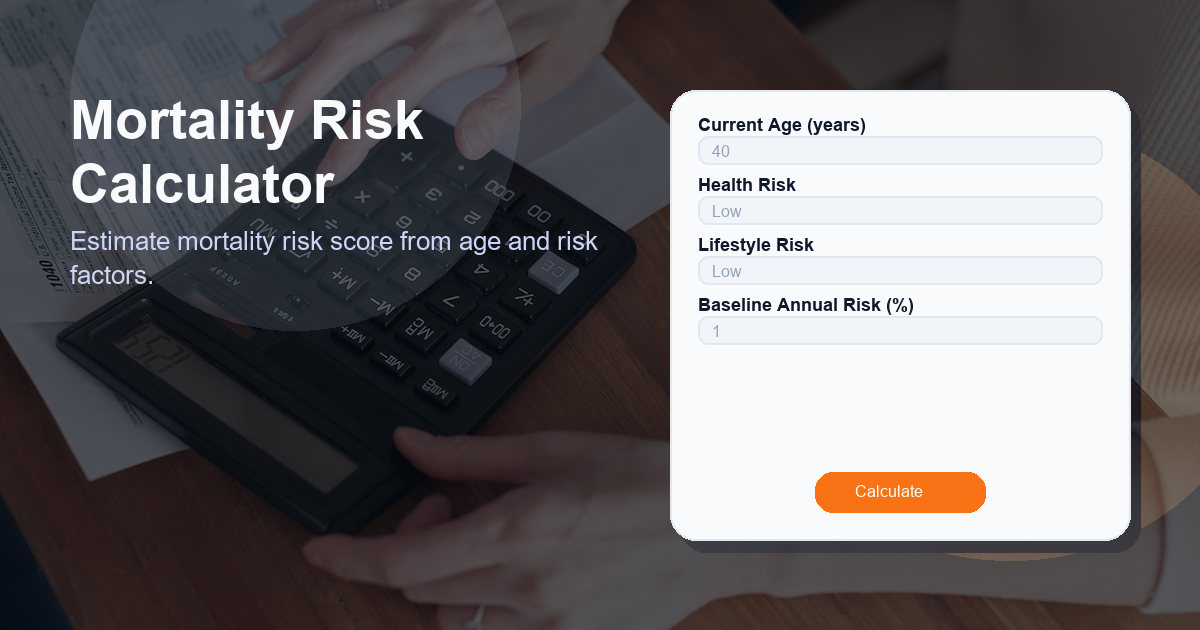
Mortality Risk Calculator
What this Mortality Risk Calculator calculator does
The Mortality Risk Calculator is a straightforward tool designed to help users estimate an individual’s annual mortality risk based on a small number of user-provided inputs: Current Age (years), Health Risk, Lifestyle Risk, and Baseline Annual Risk (%). This calculator converts those inputs into a single score labeled Estimated Annual Mortality Risk, expressed as a percentage.
The goal is to provide a quick, evidence-informed snapshot of relative risk that can be used for planning, insurance considerations, or to prompt deeper conversations with healthcare professionals. This calculator is intended for educational and planning purposes and is not a clinical diagnostic tool.
How to use the Mortality Risk Calculator calculator
Using the Mortality Risk Calculator is simple. Follow these steps to get an estimated annual mortality risk:
- Enter Current Age (years): Input the individual’s current age. Age helps you choose an appropriate Baseline Annual Risk (%) if you do not already know it.
- Set Health Risk: Provide a numeric multiplier that summarizes health-related risk factors (for example, 1.0 = average, 1.5 = 50% higher than average, 0.8 = 20% lower than average). This captures chronic conditions, severe illnesses, or strong protective health factors.
- Set Lifestyle Risk: Provide a numeric multiplier to represent lifestyle-related behaviors (for example, smoking, heavy alcohol use, sedentary lifestyle increase risk; regular exercise and healthy diet decrease risk). Use values similar to those for health risk (1.0 = average).
- Enter Baseline Annual Risk (%): Enter the baseline annual mortality rate for the age group in percent (e.g., 0.5 for 0.5% per year). If unsure, pick a recommended baseline based on age brackets (guidance below).
- Compute the Result: Apply the formula to get the Estimated Annual Mortality Risk. The calculator will produce a single percentage output you can interpret relative to baseline.
Tip: If you don’t know the exact baseline rate, use age-based tables or national life table estimates to select a reasonable starting value. The Current Age input is primarily used to guide that baseline selection and to help interpret the result in context.
How the Mortality Risk Calculator formula works
The underlying formula for this Mortality Risk Calculator is intentionally simple and transparent:
Estimated Annual Mortality Risk = baseline_rate * health_risk * lifestyle_risk
Key points about the formula:
- baseline_rate should be entered as a decimal fraction (so 1% = 0.01). It represents the average annual probability of death for a person of the specified age in a reference population.
- health_risk is a multiplicative factor that captures medical and physiological conditions relative to an average baseline (for example, severe uncontrolled disease might push this factor above 1.0).
- lifestyle_risk is a multiplicative factor representing behaviors and exposures (smoking, alcohol use, diet, exercise, occupational hazards, etc.).
Example calculation:
- Baseline annual risk (age 65) = 1.2% = 0.012
- Health risk multiplier = 1.3 (30% higher than average)
- Lifestyle risk multiplier = 1.2 (20% higher than average)
- Estimated Annual Mortality Risk = 0.012 * 1.3 * 1.2 = 0.01872 = 1.872%
Interpretation: In this example, the individual’s estimated annual risk of death is about 1.87%—roughly 50% higher than the baseline 1.2% for their age group (because 1.3 * 1.2 = 1.56).
Use cases for the Mortality Risk Calculator
This calculator has multiple practical applications when used responsibly. Common use cases include:
- Personal planning: Individuals who want to understand how health and lifestyle choices might change their short-term mortality risk.
- Insurance and underwriting (preliminary): Actuaries and underwriters may use a simple tool like this as an initial screening aid, recognizing more sophisticated models are used in formal underwriting.
- Population health modeling: Researchers or public health planners can run sensitivity analyses by varying health and lifestyle multipliers to model potential impacts at a population level.
- Preventive counseling: Health coaches and care managers can illustrate the relative effect of different lifestyle changes on annual risk in a concrete way.
- Scenario comparison: Quickly compare “what if” scenarios (e.g., smoking cessation, better disease control) to show potential reductions in annual mortality risk.
Important: for clinical decisions, treatment planning, or precise actuarial pricing, use validated clinical risk scores, professional actuarial tables, or consult experts. This calculator is best for high-level estimation and communication.
Other factors to consider when calculating x
When using the Mortality Risk Calculator, recognize that a simple multiplicative model cannot capture every nuance. Key additional factors to consider:
- Comorbidities and severity: The health_risk multiplier should reflect not only the presence of conditions, but their severity and control (e.g., well-managed diabetes vs. uncontrolled advanced disease).
- Short-term vs long-term risk: This tool estimates annual risk. Some conditions increase short-term risk dramatically (acute events), while others affect long-term mortality.
- Socioeconomic and environmental factors: Access to care, social determinants of health, and environmental exposures can change risk in ways not fully captured by simple multipliers.
- Measurement error and uncertainty: Baseline rates are estimates from population data and may not reflect an individual’s true baseline. Consider presenting a range of estimates using lower and upper multipliers.
- Age-specific baseline selection: Using age-appropriate baseline rates is critical. Younger ages have very low baseline annual risk, so multipliers may produce small absolute changes despite large relative changes.
Because the model is multiplicative, extreme multipliers can produce implausible results; use reasonable, evidence-based values and consider sensitivity checks (e.g., run the calculator with ±10-20% multipliers to see variability).
FAQ
1. What is the Mortality Risk Calculator and who should use it?
The Mortality Risk Calculator is an educational tool that estimates an individual’s annual mortality probability using a baseline rate adjusted by health and lifestyle multipliers. It is useful for personal planning, preliminary insurance screening, and population-level scenario modeling. It is not a substitute for clinical risk models or professional advice.
2. How do I choose the Baseline Annual Risk (%)?
Baseline rates come from life tables or actuarial tables and vary by age, sex, and population. If you don’t have a precise value, use publicly available life table values for the relevant age or consult a healthcare or actuarial professional. Enter the baseline as a decimal (e.g., 0.5% = 0.005).
3. What values should I use for Health Risk and Lifestyle Risk?
These are multiplicative factors where 1.0 = average. Values above 1.0 indicate higher risk and values below 1.0 indicate lower risk. Use clinical judgment or published risk multipliers when available. For transparency, document the assumptions behind each multiplier.
4. Can this calculator replace medical or actuarial assessments?
No. The Mortality Risk Calculator provides a simplified estimate. For clinical decisions, prognosis, insurance underwriting, or legal matters, rely on validated clinical tools, actuarial models, and expert consultation.
5. How should I interpret the Estimated Annual Mortality Risk?
The output is the estimated probability of death in one year expressed as a percentage. Compare it to the baseline to understand relative change (for example, 2% vs 1% baseline = double the annual risk). Use ranges to reflect uncertainty and consider long-term implications, not just a single-year snapshot.
Disclaimer: This Mortality Risk Calculator is for informational purposes only and does not replace professional medical, legal, or actuarial advice. Consult qualified professionals for decisions that require clinical or financial precision.