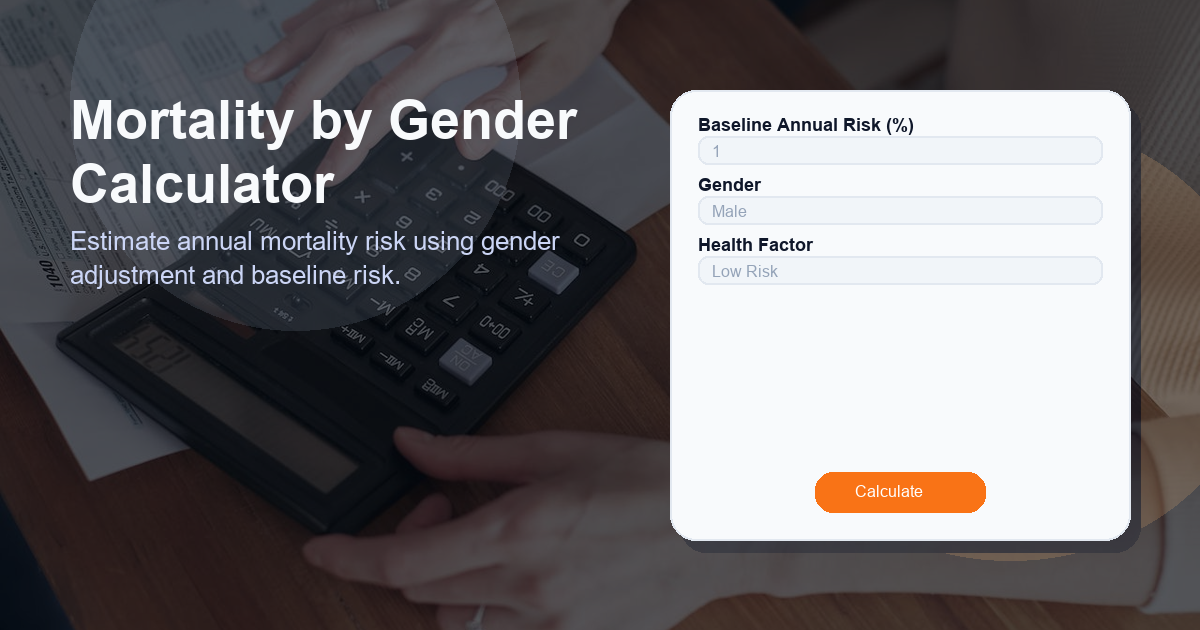
Mortality by Gender Calculator
Description: Estimate annual mortality risk using gender adjustment and baseline risk. The Mortality by Gender Calculator combines a baseline annual risk with a gender-specific adjustment and an adjustable health factor to produce an estimated Annual Mortality Risk.
What this Mortality by Gender Calculator calculator does
The Mortality by Gender Calculator provides a fast, transparent estimate of yearly mortality probability by applying two multiplicative adjustments to a chosen baseline risk. It is designed for quick comparison, sensitivity testing, and simple scenario modeling. The calculator accepts three inputs:
- Baseline Annual Risk (%) — a starting estimate of the annual probability of death (for example, population averages or an actuarial table value).
- Gender — used to select a gender adjustment factor (for instance, different relative risks for males and females).
- Health Factor — a flexible multiplier representing individual health status, comorbidities, or lifestyle (values greater than 1 increase risk; values below 1 reduce risk).
Using these inputs, the tool computes the final value labeled Annual Mortality Risk, which is the product of the three components. This provides an intuitive single-number summary of estimated annual mortality probability.
How to use the Mortality by Gender Calculator calculator
Follow these straightforward steps to use the Mortality by Gender Calculator effectively:
- Enter the Baseline Annual Risk (%) — input a percentage number (for example, 1.0 for 1%). This should reflect an appropriate baseline population or cohort annual mortality rate.
- Select Gender — choose the gender category provided by the tool. The calculator converts this choice into a numeric gender adjustment factor.
- Set the Health Factor — input a multiplier representing individual health circumstances, e.g., 0.8 for better-than-average health or 1.3 for worse-than-average health.
- Run the calculation — the calculator computes the result using the formula
baseline_risk*gender_adjustment*health_factorand displays the output under the label Annual Mortality Risk.
Important input notes:
- Baseline input as percent: Enter the baseline as a percent. The calculator will internally convert percent to a decimal for the multiplication (e.g., 1% becomes 0.01). The final output is shown as a percent for readability.
- Gender adjustment mapping: Typical example values might be Male = 1.15, Female = 0.95, but actual factors should be selected based on the data source or study you are using. The calculator allows you to change these mappings if configurable.
Example walkthrough:
- Baseline Annual Risk = 1.0%
- Gender = Male (Gender adjustment = 1.25, example value)
- Health Factor = 1.10
- Calculation: 0.01 * 1.25 * 1.10 = 0.01375 → Annual Mortality Risk = 1.375%
How the Mortality by Gender Calculator formula works
The underlying mathematical formula is straightforward and transparent:
Annual Mortality Risk = baseline_risk * gender_adjustment * health_factor
Where:
- baseline_risk = baseline annual mortality probability (entered as a percent but converted to decimal for the multiplication).
- gender_adjustment = multiplicative factor representing differential mortality effects associated with gender.
- health_factor = multiplicative modifier encapsulating individual-level health, comorbidity burden, or behavioral risk factors.
Key operational details:
- Because the formula is multiplicative, each factor scales the baseline risk proportionally. Doubling the health factor doubles the resulting risk.
- To interpret the output correctly, ensure that the baseline was chosen for a comparable population (same age range, environment, etc.).
- The result is presented as the Annual Mortality Risk (a percentage), which directly represents the estimated probability of death during one year under the modeled assumptions.
Example with conversion detail: If you enter 2% as baseline, the calculator converts that to 0.02 for the internal math. If gender_adjustment = 0.9 and health_factor = 1.2, then 0.02 * 0.9 * 1.2 = 0.0216 → 2.16% Annual Mortality Risk.
Use cases for the Mortality by Gender Calculator
The Mortality by Gender Calculator can support many practical scenarios:
- Actuarial quick checks: Fast sensitivity checks when building or reviewing life insurance pricing assumptions.
- Public health planning: Comparing gender-specific risk adjustments across scenarios to inform outreach or screening priorities.
- Clinical counseling: Helping clinicians or patients visualize how lifestyle or treated comorbidities could affect short-term mortality probability (used carefully and with context).
- Research and teaching: Demonstrating multiplicative risk modeling in epidemiology classes or pilot analyses.
- Personal risk awareness: For individuals to explore how different health behaviors and gender-related factors might change a baseline risk estimate.
Remember: this tool is meant for estimation and scenario analysis, not definitive individual prognosis. Use it as part of a broader assessment framework.
Other factors to consider when calculating mortality risk
The simple multiplicative model in the Mortality by Gender Calculator intentionally omits many complexities. Consider these additional factors before drawing strong conclusions:
- Age: Age is often the dominant predictor of mortality. Ensure baseline risk is age-specific or add an age multiplier if needed.
- Comorbidities and severity: Specific diseases (heart disease, cancer, diabetes) and their severity matter more than a single health factor can capture.
- Socioeconomic and environmental factors: Income, access to care, pollution, and living conditions can materially alter risk estimates.
- Behavioral factors: Smoking, alcohol use, diet, and physical activity are strong modifiers and can be modeled via the health_factor input.
- Data quality and calibration: Gender adjustment coefficients must come from reliable sources (peer-reviewed studies, national statistics, or actuarial tables). Mis-specified factors produce misleading results.
- Uncertainty and ranges: Provide confidence intervals or test multiple scenarios (best-case/worst-case) rather than relying on a single point estimate.
- Ethical considerations: Use caution when communicating risk estimates to individuals; provide context and avoid deterministic language.
FAQ
Q: What input format should I use for Baseline Annual Risk?
A: Enter the Baseline Annual Risk as a percentage (for example, type “1” for 1%). The calculator converts the percent to a decimal internally and presents the final Annual Mortality Risk back as a percentage.
Q: How are gender adjustment factors chosen?
A: Gender adjustment factors should be chosen from reputable data sources—epidemiological studies, national mortality tables, or actuarial datasets. The calculator accepts a numeric multiplier for each gender; example values are illustrative only.
Q: Can the Health Factor be less than 1?
A: Yes. A health factor below 1 (for example, 0.8) represents better-than-average health that reduces the baseline risk. Values above 1 represent increased risk.
Q: Is this a medical diagnostic tool?
A: No. The Mortality by Gender Calculator is an estimation and scenario tool. It is not a substitute for professional medical, actuarial, or legal advice.
Q: How should I interpret the Annual Mortality Risk output?
A: The output labeled Annual Mortality Risk is the estimated probability of death within one year under the modeled assumptions. Use it for comparison and sensitivity analysis, and consider broader context and uncertainty when making decisions.