Mortality Age Calculator
Description: Estimate a statistical mortality age based on baseline and adjustments using a simple, transparent formula.
What this Mortality Age Calculator does
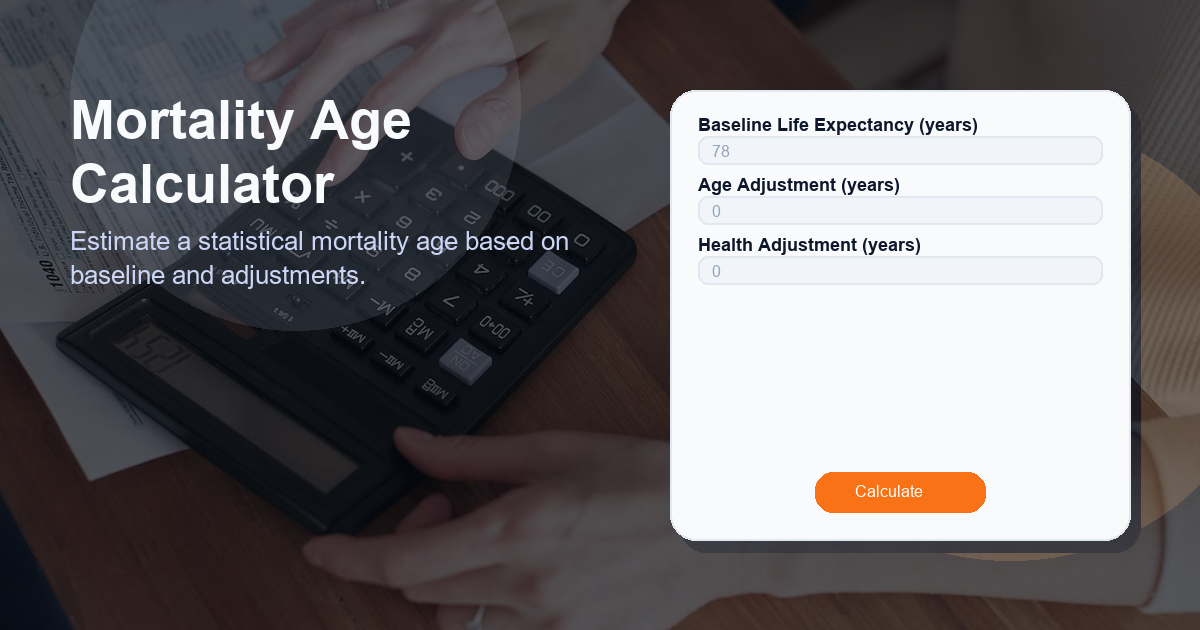
The Mortality Age Calculator provides a straightforward, statistical estimate of a likely mortality age by combining a baseline life expectancy with user-supplied adjustments. This tool does not predict a specific individual’s fate; instead, it returns an Estimated Mortality Age using the inputs you provide:
- Baseline Life Expectancy (years) — a starting value derived from local actuarial tables, national averages, or personal baseline assumptions.
- Age Adjustment (years) — an adjustment to account for demographic or temporal factors (for example, if you are already older or younger than the baseline population used).
- Health Adjustment (years) — an adjustment to reflect personal health, habits, or medical conditions that increase or decrease expected lifespan.
With these inputs, the calculator computes the final value using a transparent formula and displays it as the Estimated Mortality Age. The result is best used for planning, benchmarking, or educational purposes rather than as a medical diagnosis.
How to use the Mortality Age Calculator
Using the Mortality Age Calculator is simple and designed for clarity. Follow these steps to produce an estimated mortality age:
- Choose a Baseline Life Expectancy: Select a baseline number in years. This could be a national average (e.g., 78 years), a regional life table value, or your personalized baseline estimate.
- Enter an Age Adjustment: Add a positive or negative number to reflect how your age or cohort differs from the baseline. For example, if the baseline is based on births in year X and you are significantly older, you might add a small positive adjustment.
- Enter a Health Adjustment: Add or subtract years based on known health factors — excellent health may warrant a positive adjustment, while chronic conditions or risky behavior could justify a negative adjustment.
- Compute the Result: The calculator applies the formula and returns the Estimated Mortality Age.
Example: If Baseline Life Expectancy = 80, Age Adjustment = -2, Health Adjustment = +3, then Estimated Mortality Age = 80 + (-2) + 3 = 81 years.
Tips for reliable inputs:
- Use official life tables where possible for the baseline.
- Document the rationale for each adjustment to maintain transparency.
- Be conservative with large adjustments — small values are usually more defensible.
How the Mortality Age Calculator formula works
The formula behind the Mortality Age Calculator is intentionally simple and additive to promote interpretability. The formula is:
Estimated Mortality Age = base_expectancy + age_adjustment + health_adjustment
Key points about the formula:
- Linear and additive: Each input contributes directly to the final age in years. This keeps the model transparent.
- Baseline-driven: The baseline life expectancy anchors the estimate; all adjustments are relative to it.
- Adjustments are flexible: Users can use negative or positive numbers to reflect shorter or longer expected lifespans than the baseline.
Why choose an additive model?
- It is easy to explain to non-technical audiences.
- It facilitates scenario analysis — you can quickly see how different health or age adjustments move the estimate.
- It avoids overfitting or false precision that can come from complex actuarial models when only a few personal inputs are available.
Limitations of the formula: it does not model probabilistic survival curves, competing risks, or time-varying hazards. It returns a point estimate — useful for planning and communication, not for clinical decision-making.
Use cases for the Mortality Age Calculator
This calculator is useful for a variety of non-clinical purposes where a simple, understandable estimate of lifespan is helpful:
- Financial planning: Estimating how long retirement savings should last or determining required pension horizons.
- Estate planning: Helping families plan wills, trusts, and long-term care funding by providing a benchmark age.
- Public policy modeling: Quick scenario estimates for demographic or population-level analyses when exact actuarial models are unnecessary.
- Personal benchmarking: Allowing individuals to compare their lifestyle choices or health interventions as year-based adjustments.
- Education and communication: Demonstrating how changes in health or demographic factors translate into changes in expected lifespan in an easy-to-understand way.
Each use case benefits from documenting the chosen baseline and the reasons for adjustments to maintain credibility and reproducibility of results.
Other factors to consider when calculating mortality age
While the Mortality Age Calculator is intentionally simple, several additional factors can influence real-world mortality estimates. Consider these when interpreting results:
- Genetics: Family history can significantly affect longevity but is difficult to quantify as a single year adjustment.
- Socioeconomic status: Income, education, and access to healthcare are strong predictors of life expectancy.
- Environmental exposures: Pollution, occupational hazards, and regional disease prevalence can change risk profiles.
- Medical advances: Breakthroughs in treatment and prevention (e.g., new vaccines, therapies) can shift population baselines over time.
- Behavioral factors: Smoking, diet, exercise, alcohol use, and adherence to medical advice all influence lifespan.
- Random variability: Chance events and unpredictable illnesses mean that any point estimate has substantial uncertainty.
Recommendations for robust use:
- Use the calculator as a starting point, not a final answer.
- Combine this estimate with probabilistic models or actuarial tables for formal financial or clinical decisions.
- Regularly update the baseline as public health data and life tables change.
Inputs, Formula and Result
Inputs:
- Baseline Life Expectancy (years)
- Age Adjustment (years)
- Health Adjustment (years)
Formula: base_expectancy + age_adjustment + health_adjustment
Result label: Estimated Mortality Age
FAQ
Q: Is the Mortality Age Calculator a medical tool?
A: No. The Mortality Age Calculator is a statistical, illustrative tool intended for planning and education. It does not replace medical advice, clinical risk models, or actuarial analysis.
Q: Where should I get a reliable baseline life expectancy?
A: Use official life tables from government or reputable actuarial organizations, or published national averages. Citing the source of your baseline increases transparency.
Q: How should I choose the health adjustment value?
A: Choose an adjustment based on observable factors: chronic diseases, lifestyle habits, and recent medical findings. Keep adjustments conservative (e.g., ±1–5 years) unless you have strong justification for larger values.
Q: Can I use negative adjustments?
A: Yes. Both age adjustment and health adjustment may be negative to indicate shorter expected lifespan relative to the baseline.
Q: How accurate is the Estimated Mortality Age?
A: Accuracy depends on the quality of the baseline and the reasonableness of adjustments. The result is a point estimate and should be treated as indicative, not definitive. For precise planning, combine with actuarial tables or consult professionals.