Maternal mortality refers to deaths due to complications of pregnancy or childbirth. A widely used standard definition (used by WHO and in many national reports) is: the death of a woman while pregnant or within 42 days of the end of pregnancy, from causes related to or aggravated by the pregnancy or its management (excluding accidental/incidental causes).
maternal mortality statistics
Key maternal mortality statistics
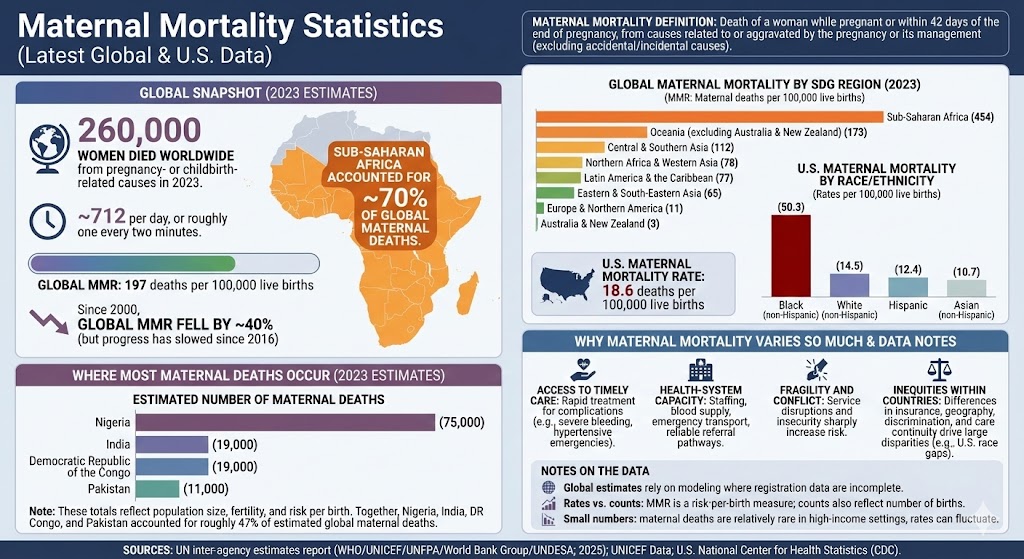
260,000 women died worldwide from pregnancy- or childbirth-related causes in 2023 (about 712 per day, or roughly one every two minutes).
The global maternal mortality ratio (MMR) in 2023 was 197 deaths per 100,000 live births.
Since 2000, the global MMR fell by about 40% (but progress has slowed since 2016).
Sub-Saharan Africa accounted for about 70% of global maternal deaths in 2023.
In 2023, Nigeria had the largest estimated number of maternal deaths (about 75,000), and together Nigeria, India, DR Congo, and Pakistan accounted for roughly 47% of estimated global maternal deaths.
United States (2023): maternal mortality rate was 18.6 deaths per 100,000 live births, with large disparities by race/ethnicity and age.
Global maternal mortality by SDG region (2023)
MMR = maternal deaths per 100,000 live births (point estimates).
Label
Bar
Value
Sub-Saharan Africa
454
Oceania (excluding Australia & New Zealand)
173
Central & Southern Asia
112
Northern Africa & Western Asia
78
Latin America & the Caribbean
77
Eastern & South-Eastern Asia
65
Europe & Northern America
11
Australia & New Zealand
3
Max = 454. Widths: Sub-Saharan Africa 100.00%, Oceania (excluding Australia & New Zealand) 38.11%, Central & Southern Asia 24.67%, Northern Africa & Western Asia 17.18%, Latin America & the Caribbean 16.96%, Eastern & South-Eastern Asia 14.32%, Europe & Northern America 2.42%, Australia & New Zealand 0.66%.
U.S. maternal mortality by race/ethnicity (2023)
Maternal mortality rates per 100,000 live births (U.S. national vital statistics).
Label
Bar
Value
Black (non-Hispanic)
50.3
White (non-Hispanic)
14.5
Hispanic
12.4
Asian (non-Hispanic)
10.7
Max = 50.3. Widths: Black (non-Hispanic) 100.00%, White (non-Hispanic) 28.83%, Hispanic 24.65%, Asian (non-Hispanic) 21.27%.
Where most maternal deaths occur (2023)
Estimated number of maternal deaths (not a rate). These totals reflect population size, fertility, and risk per birth.
Label
Bar
Value
Nigeria
75,000
India
19,000
Democratic Republic of the Congo
19,000
Pakistan
11,000
Max = 75,000. Widths: Nigeria 100.00%, India 25.33%, Democratic Republic of the Congo 25.33%, Pakistan 14.67%.
Why maternal mortality varies so much
Access to timely care: survival depends on rapid treatment for complications (for example, severe bleeding or hypertensive emergencies).
Health-system capacity: staffing, blood supply, emergency transport, and reliable referral pathways matter more than any single intervention.
Fragility and conflict: service disruptions and insecurity can sharply increase risk.
Inequities within countries: differences in insurance coverage, geography, discrimination, and continuity of care can drive large disparities (as seen in U.S. race/ethnicity gaps).
Notes on the data
Global estimates are designed to be internationally comparable and often rely on modeling where registration data are incomplete.
Rates vs. counts: MMR is a risk-per-birth measure; “number of maternal deaths” also reflects how many births occur in a country.
Small numbers: maternal deaths are relatively rare events in many high-income settings, so year-to-year rates can fluctuate.
Sources
UN inter-agency estimates report: Trends in maternal mortality estimates 2000 to 2023 (WHO/UNICEF/UNFPA/World Bank Group/UNDESA; 2025).
UNICEF Data: Trends in maternal mortality 2000 to 2023 (summary and downloads).
U.S. National Center for Health Statistics (CDC): Maternal Mortality Rates in the United States, 2023.