Lifetime Mortality Calculator
What this Lifetime Mortality Calculator calculator does
The Lifetime Mortality Calculator estimates the probability that an individual (or cohort) will experience a death event at least once over a specified number of years given a constant annual risk. It takes a simple, intuitive approach: starting from an annual risk expressed as a percentage, optionally scales that risk with a risk multiplier, and projects the cumulative probability across the chosen number of years.
This calculator is useful for quick, transparent assessments where you want a single-number summary: Lifetime Mortality Probability. It’s designed for clarity and speed, not for complex actuarial modeling.
How to use the Lifetime Mortality Calculator calculator
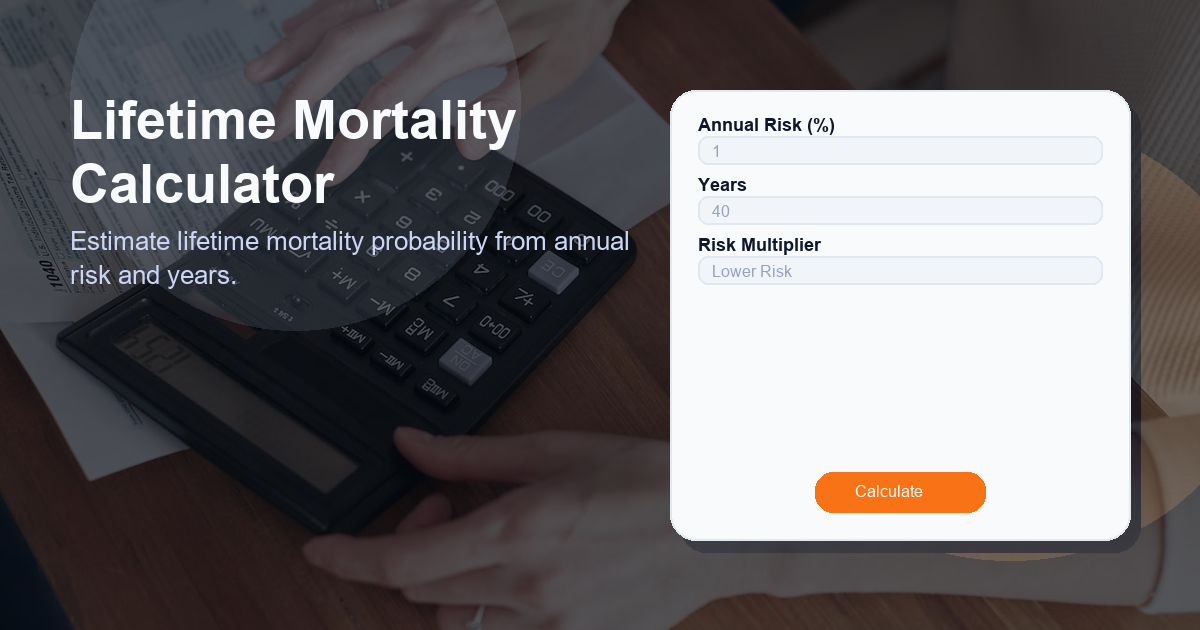
Using the Lifetime Mortality Calculator is straightforward. Provide three inputs and read the result labeled Lifetime Mortality Probability:
- Annual Risk (%) — the yearly probability of the event (mortality) expressed in percent (for example, enter 2 for 2%).
- Years — the number of years over which you want to project cumulative probability (for example, 30).
- Risk Multiplier — a factor used to scale the annual risk to model increased or decreased exposure (for example, 1.0 for unchanged risk, 1.5 for 50% higher risk).
After entering these values, the calculator computes the Lifetime Mortality Probability as a percent. The output answers the question: “What is the chance of experiencing the event at least once during this period?”
How the Lifetime Mortality Calculator formula works
The underlying formula used by the Lifetime Mortality Calculator is:
(1-Math.pow(1-(annual_risk_percent*risk_multiplier/100),years))*100Breaking the formula down:
- annual_risk_percent*risk_multiplier/100 converts the input percent and multiplier into a decimal probability p for a single year.
- 1 – p is the probability of not experiencing the event in a single year.
- Math.pow(1 – p, years) computes the probability of surviving (not experiencing the event) every year for the entire period — i.e., no event occurs across all years.
- 1 – Math.pow(…) converts that survival probability into the cumulative probability of at least one event over the period.
- Multiplying by 100 converts the result back to a percentage for the label Lifetime Mortality Probability.
Example calculation:
- Annual Risk = 2%
- Years = 30
- Risk Multiplier = 1
Step-by-step: p = 2% * 1 = 0.02. Survival across 30 years = (1 − 0.02)^30 ≈ 0.98^30 ≈ 0.5455. Lifetime probability = (1 − 0.5455) × 100 ≈ 45.45%.
If you increase the Risk Multiplier to 1.5 (so annual risk becomes 3%), survival = 0.97^30 ≈ 0.401, giving lifetime probability ≈ 59.9%.
Use cases for the Lifetime Mortality Calculator
The Lifetime Mortality Calculator is useful in many practical contexts where a simple cumulative risk estimate is needed quickly.
- Personal planning: Estimating the cumulative impact of lifestyle risks (smoking, high-risk sports) over decades.
- Healthcare decision aids: Communicating aggregate risk to patients when discussing interventions that alter annual risk.
- Public health: Rapid scenario analysis to compare how different annual risk reduction strategies change lifetime probability for a population cohort.
- Insurance and financial planning: Back-of-envelope estimates for product design or personal risk exposure assessments (note: not a substitute for actuarial tables).
- Safety and reliability: Modeling the chance of at least one failure over a product lifetime when treating yearly hazard as constant.
In all those use cases, the calculator offers a quick, transparent estimate that helps decision-makers compare scenarios and understand tradeoffs.
Other factors to consider when calculating lifetime mortality
While the Lifetime Mortality Calculator is useful, it relies on simplifying assumptions. Consider these important caveats before using the result for high-stakes decisions:
- Constant annual risk: The formula assumes the annual risk is constant and independent from year to year. Real-world risks often vary by age, health status, or conditions that change over time.
- Independence assumption: The model treats each year as an independent trial. Prior events or changing exposures might violate independence (for example, a non-fatal event that increases future risk).
- Competing risks: The calculator measures the chance of “at least one event.” If there are multiple mutually exclusive outcomes (competing risks), more complex methods are needed.
- Population vs. individual risk: Yearly probabilities from population studies are averages; individual risk may be higher or lower due to genetics, environment, or behavior.
- Time discretization: The model uses discrete annual periods. For small annual probabilities a continuous-time approximation (1 − exp(−rate × years)) is similar, but differences appear for larger annual risks.
- Data quality: The accuracy of the input annual risk matters: garbage in, garbage out. Use high-quality, context-appropriate risk estimates.
When precision is required (e.g., for clinical, actuarial, or regulatory work), use age-specific hazard models, life tables, or professional actuarial analyses rather than this simple calculator.
Frequently Asked Questions
What does “Lifetime Mortality Probability” mean?
Lifetime Mortality Probability is the calculated chance (expressed as a percent) that the mortality event will occur at least once during the specified interval of years, given the inputs. It is not an instantaneous risk but a cumulative probability over the entire period.
Why does the formula use Math.pow(1 – p, years)?
Because (1 − p) is the probability of surviving a single year with no event. Raising that to the power of years gives the probability of surviving all years with no event. Subtracting from 1 yields the probability of having at least one event.
When should I change the Risk Multiplier?
Use the Risk Multiplier to model scenarios where exposure changes (e.g., moving to a hazardous environment, adopting a risky behavior) or where interventions reduce risk. It’s a convenient scalar to represent relative change in annual risk.
Can this calculator handle very small or very large annual risks?
Yes, numerically it works for small or large annual risks. For very large annual probabilities (near 100%), the formula still works but interpretation becomes trivial (lifetime probability approaches 100%). For very small probabilities, the discrete model and continuous approximations produce similar results.
Is this a replacement for actuarial life tables or clinical risk models?
No. The Lifetime Mortality Calculator is a simple tool for quick estimates and scenario comparison. It does not incorporate age-dependent hazards, competing risks, or detailed covariates found in actuarial or clinical models. For formal decisions, consult domain experts and specialized models.
Final note: The Lifetime Mortality Calculator provides an accessible, transparent way to convert an annual risk into a meaningful cumulative probability. Use it for scenario analysis, communication, and planning — and pair it with more detailed methods when precision and nuance are required.