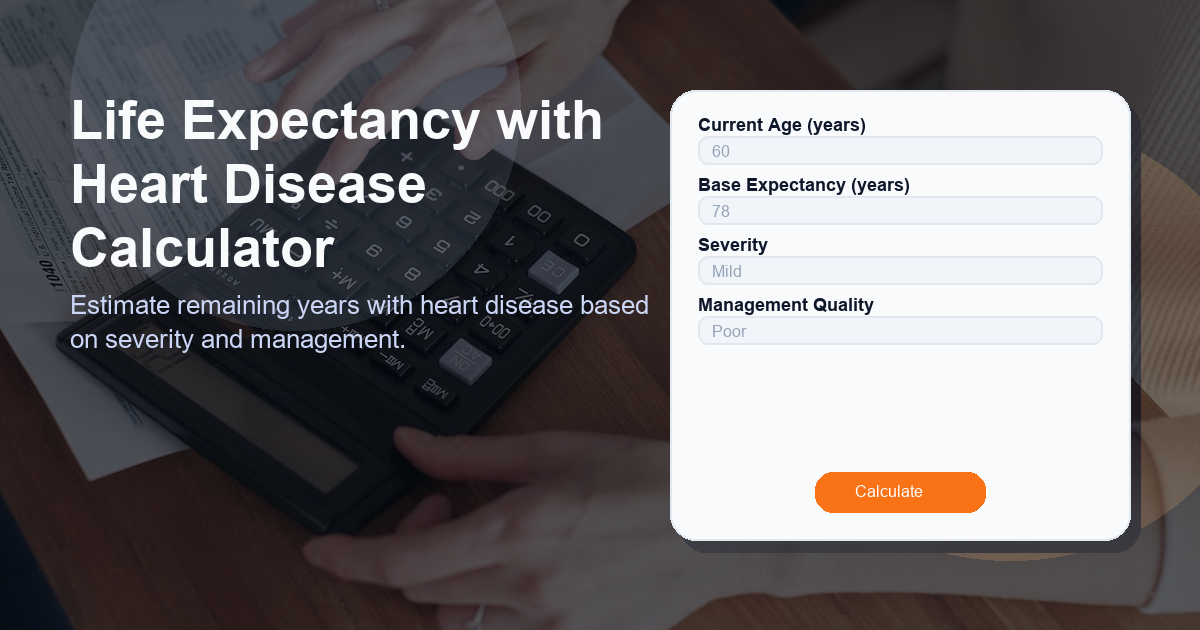
Life Expectancy with Heart Disease Calculator
Description: Estimate remaining years with heart disease based on severity and management.
What this Life Expectancy with Heart Disease Calculator does
The Life Expectancy with Heart Disease Calculator is a simple, transparent tool designed to give a quick, evidence-informed estimate of how many years a person might expect to live given a baseline life expectancy, their current age, the severity of their heart disease, and the quality of management they receive. This calculator is meant to be a high-level planning and awareness aid — not a clinical diagnosis. It combines four inputs to output the Estimated Remaining Years using an easy-to-follow formula.
Key benefits of this calculator:
- Fast insight: Get an immediate estimate without complex modeling.
- Transparent inputs: You control the base expectancy, severity, and management quality values so you can model different scenarios.
- Educational: Understand how disease severity and care quality can shift remaining years.
How to use the Life Expectancy with Heart Disease Calculator
Using the calculator is straightforward. Provide four inputs and the calculator computes the result using a simple arithmetic formula.
Inputs required:
- Current Age (years): Your current age in whole years.
- Base Expectancy (years): The average life expectancy for someone with similar demographics if no heart disease were present (or a personalized baseline). Typical values might come from national life tables or clinician guidance.
- Severity: A numerical adjustment reflecting how severe the heart disease is. Common usage: negative numbers to reduce life expectancy for more severe disease, or small positive adjustments for milder presentations. (See guidance below.)
- Management Quality: A numerical adjustment representing how well the heart disease is being managed — medications, lifestyle, procedures, and follow-up. Positive numbers boost the expectancy; negative numbers reduce it.
Step-by-step:
- Enter your Current Age (for example, 65).
- Enter a Base Expectancy (for example, 85) — this is the baseline expected lifespan without heart disease adjustments.
- Choose a Severity value (for example, -6 for moderate to severe disease).
- Choose a Management Quality value (for example, +3 for excellent management).
- Press “Calculate” (in a UI implementation) or compute the result with the provided formula to get the Estimated Remaining Years.
Example: Current Age = 65, Base Expectancy = 85, Severity = -6, Management Quality = +3. The calculator will output the Estimated Remaining Years (see formula section for the mathematical step).
How the Life Expectancy with Heart Disease Calculator formula works
The calculator uses a clear, additive formula to estimate remaining years:
Formula: base_expectancy + severity + management_quality - current_age
How to interpret each term:
- base_expectancy: The lifetime expectancy in years without accounting for current heart disease. It represents a baseline reference point.
- severity: A numeric adjustment that captures the expected life-shortening (negative values) or neutral/slight improvement (small positive or zero values) due to the current heart disease state.
- management_quality: A numeric adjustment reflecting the effectiveness of treatment, lifestyle changes, and follow-up care. Higher values indicate better management and can offset some severity-related reductions.
- current_age: Subtracting current age converts an absolute life expectancy into remaining years from now.
Calculation walkthrough (example):
- base_expectancy = 85
- severity = -6
- management_quality = +3
- current_age = 65
Apply the formula: 85 + (-6) + 3 – 65 = 17. The Estimated Remaining Years in this example would be 17 years.
Notes on choosing values for severity and management_quality:
- Severity: Consider using a scale where 0 = no added risk, -1 to -5 = mild to moderate impact, -6 to -12 = moderate to severe impact, and so forth. This scale should be adapted to clinical context.
- Management Quality: Use positive numbers to reflect excellent care (medication adherence, controlled risk factors, regular monitoring) and negative numbers for poor management or limited access to care.
Use cases for the Life Expectancy with Heart Disease Calculator
This calculator can be useful in a variety of settings where a quick, interpretable estimate is helpful:
- Patient Counseling: Help patients and families understand how disease severity and treatment choices might affect years of life remaining.
- Care Planning: Support discussions about long-term care needs, advanced care planning, and timing of interventions.
- Scenario Modeling: Compare hypothetical “what if” scenarios (e.g., improved management quality or successful procedures) to see potential gains in remaining years.
- Education and Awareness: Use as a teaching aid in clinics or community health programs to illustrate the impact of management on outcomes.
Important: This tool is best used for discussion and planning rather than precise clinical forecasting.
Other factors to consider when calculating life expectancy
While the Life Expectancy with Heart Disease Calculator gives a straightforward estimate, many additional factors influence real-world outcomes. Consider the following:
- Comorbidities: Diabetes, chronic kidney disease, chronic obstructive pulmonary disease (COPD), and cancer significantly alter life expectancy.
- Functional status: Mobility, daily living independence, and frailty are strong predictors of survival and quality of life.
- Socioeconomic factors: Access to healthcare, medication affordability, nutrition, and living conditions impact mortality.
- Genetics and family history: Hereditary predispositions can shift baseline risk.
- Acute events: Sudden cardiac events, strokes, or infections can change prognosis rapidly.
- Data limitations: The simple additive model does not capture interactions between variables or non-linear risk changes over time.
Always consult a healthcare professional for personalized medical advice. Use the calculator as an educational and planning aid, not a substitute for clinical evaluation.
Frequently Asked Questions
Q: Is the Life Expectancy with Heart Disease Calculator medically accurate?
A: The calculator provides a simplified estimate based on user-supplied inputs. It is not a clinical prognostic model and does not replace professional medical assessment. For medically accurate predictions, speak with a cardiologist who can use validated risk scores and clinical data.
Q: How should I choose the severity and management quality values?
A: There is no universal scale built into the calculator; choose values that reflect clinical judgment or scenario assumptions. A typical approach is to use negative numbers for increasing severity and positive numbers for better management. When possible, consult a clinician to help quantify these adjustments.
Q: Can this calculator predict sudden cardiac events?
A: No. The calculator estimates average remaining years based on additive adjustments. It cannot predict the timing of sudden events like heart attacks or arrhythmias, which require different risk assessments and diagnostic tests.
Q: Can lifestyle changes improve my Estimated Remaining Years?
A: Yes. The management_quality input is meant to capture the positive impact of medications, smoking cessation, diet, exercise, and adherence to care. Improving management quality in the model will increase the estimated remaining years, reflecting the benefit of good care and healthy behavior.
Q: What should I do if the calculator shows a low number of remaining years?
A: Use the result as a prompt to discuss care goals with your healthcare team. A low estimate is not a definitive outcome; it highlights the importance of reviewing treatment options, optimizing management, and addressing modifiable risks.
Disclaimer: This tool is educational and informational. It should not be used as a substitute for personalized medical advice, diagnosis, or treatment. Always consult qualified healthcare professionals for decisions about medical care.