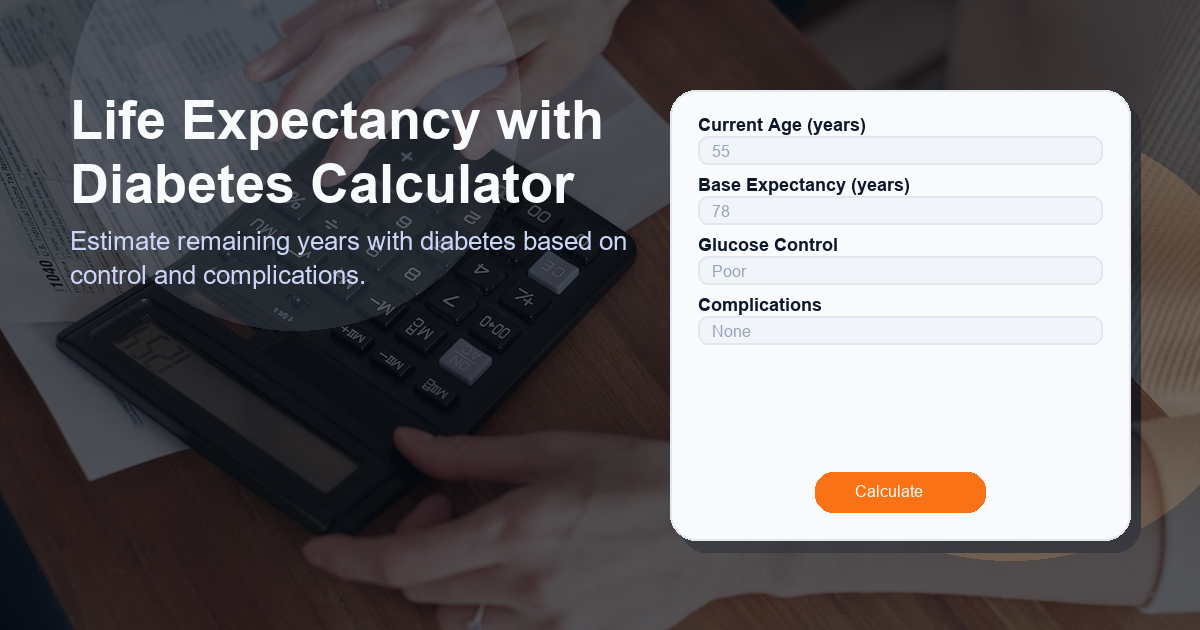
Life Expectancy with Diabetes Calculator
Description: Estimate remaining years with diabetes based on control and complications. Use the Life Expectancy with Diabetes Calculator to get a quick, evidence-informed, easy-to-understand estimate of your expected remaining years given current age, baseline life expectancy, glucose control, and diabetes-related complications.
What this Life Expectancy with Diabetes Calculator calculator does
The Life Expectancy with Diabetes Calculator provides a straightforward numerical estimate of how many years you might expect to live while managing diabetes. It is designed for quick modeling and educational purposes and is not a substitute for professional medical advice. This tool helps users visualize the combined impact of three main factors on remaining years:
- Baseline life expectancy (what a person of the same demographics would typically expect without diabetes-related adjustments).
- Glucose control (a numeric modifier reflecting the benefits or harms of current blood sugar management).
- Complications (a numeric modifier representing the cumulative effect of complications such as heart disease, neuropathy, kidney disease, or stroke).
By combining these components with your current age, the calculator estimates your Estimated Remaining Years living with diabetes. It can serve as a starting point for conversations with clinicians about risk reduction and treatment goals.
How to use the Life Expectancy with Diabetes Calculator calculator
Using the calculator is simple. Enter the following inputs and the tool will display the result labeled Estimated Remaining Years:
- Current Age (years): Your present age in years.
- Base Expectancy (years): A baseline life expectancy aligned to age, sex, and population norms (for example, the average remaining years for a person aged X without diabetes-related adjustments).
- Glucose Control: A numeric adjustment (positive or negative) that reflects the estimated effect of current glycemic control—tight, moderate, or poor—on life expectancy.
- Complications: A numeric adjustment (usually negative) that reflects the cumulative mortality impact of diabetes complications (cardiovascular disease, kidney disease, etc.).
Step-by-step:
- Gather the required inputs: your current age, an appropriate base expectancy, and two modifiers for glucose control and complications.
- Plug the values into the calculator fields.
- Submit to compute the Estimated Remaining Years.
- Interpret the result as an estimate, not a definitive prediction—use it to guide questions and care planning.
Example: If you are 60 years old, your base expectancy is 85 years, glucose control contributes -3 years (poor control), and complications contribute -7 years, then the calculator would estimate remaining years accordingly.
How the Life Expectancy with Diabetes Calculator formula works
The calculator uses a clear and transparent formula so you can see exactly how the estimate is produced. The formula is:
Estimated Remaining Years = base_expectancy + glucose_control + complications – current_age
Explanation of each component:
- base_expectancy: This is the expected lifespan for your demographic group in years. It serves as the starting point for calculations.
- glucose_control: This numeric value represents the net gain or loss in years associated with current blood glucose management. Better control typically yields a positive or less-negative value; poor control results in a negative adjustment.
- complications: This figure consolidates the mortality impact of diabetes-related complications. It is commonly negative because complications tend to reduce life expectancy.
- current_age: The person’s present age in years; subtracting it converts the total life expectancy into remaining years.
Using the earlier example numerically:
- base_expectancy = 85
- glucose_control = -3
- complications = -7
- current_age = 60
Estimated Remaining Years = 85 + (-3) + (-7) – 60 = 15 years
This means the calculator estimates about 15 remaining years under the scenario provided. The formula is intentionally simple so that it is transparent and easy to adapt. You can revise the glucose_control and complications numbers to see how improved management or mitigation of complications might change the outcome.
Use cases for the Life Expectancy with Diabetes Calculator
The calculator is useful in multiple contexts. Common use cases include:
- Patient education: Helping patients understand how glycemic control and complication management may affect remaining years.
- Care planning: Supporting clinicians and care teams in prioritizing interventions that may increase life expectancy or quality of life.
- Comparative scenarios: Modeling “what if” scenarios—e.g., what if glucose control improves by a certain amount?—to see potential gains in years.
- Public health and policy discussions: Demonstrating the population-level importance of diabetes prevention and complication reduction.
- Personal motivation: Offering a concrete number that can motivate lifestyle changes such as improved diet, exercise, medication adherence, and smoking cessation.
Remember: this calculator is best used as a discussion starter and planning aid rather than a clinical decision-making tool on its own.
Other factors to consider when calculating life expectancy
While the calculator captures the broad effects of glucose control and complications, many additional variables influence life expectancy. Consider these important factors when interpreting results:
- Comorbid conditions: Hypertension, high cholesterol, obesity, chronic kidney disease, and other illnesses significantly affect outcomes.
- Medications and treatments: Use of statins, ACE inhibitors, SGLT2 inhibitors, GLP-1 receptor agonists, and insulin regimens can alter prognosis.
- Lifestyle factors: Smoking status, physical activity level, diet quality, sleep patterns, and alcohol use all play a role.
- Socioeconomic determinants: Access to care, medication affordability, education, social support, and environment influence long-term health.
- Genetics and family history: Individual genetic predisposition to cardiovascular disease or other conditions can change risk profiles.
- Measurement uncertainty: Base expectancy tables and numeric adjustments are approximations—real outcomes vary.
Given these complexities, use the calculator as a guide and always discuss personalized risk and treatment strategies with a qualified healthcare professional. Improving control and reducing complications can often increase the number of estimated remaining years in meaningful ways.
Frequently Asked Questions
What does the Life Expectancy with Diabetes Calculator measure?
The calculator estimates the number of remaining years you might expect to live, based on a baseline life expectancy adjusted for your current glucose control and diabetes-related complications. It is an estimate, not a prediction.
How do I choose values for Glucose Control and Complications?
These are numeric adjustments you or a clinician assign to reflect the expected impact on years of life. They can be estimated from clinical risk models, guidelines, or consensus values. For simple use, negative values reflect loss of years; positive values reflect gains.
Can this tool replace a medical assessment?
No. The calculator is an educational and planning tool. It does not substitute for a comprehensive medical evaluation. Consult your healthcare provider for interpretation tailored to your health status and treatment options.
How accurate is the formula?
The formula is simple and transparent but intentionally reductive. It provides a clear way to model changes, but real-world life expectancy depends on many interacting factors not captured by the four inputs. Treat results as approximations.
How can I use this calculator to improve my outlook?
Use scenario testing: try adjusting the Glucose Control and Complications inputs to see potential gains from better management. Then discuss evidence-based strategies—medication optimization, lifestyle changes, and complication screening—with your care team to work toward those improvements.
Note: This calculator is intended for informational purposes. Always seek professional medical advice for diagnoses, treatment plans, and interpretation of individual risk.