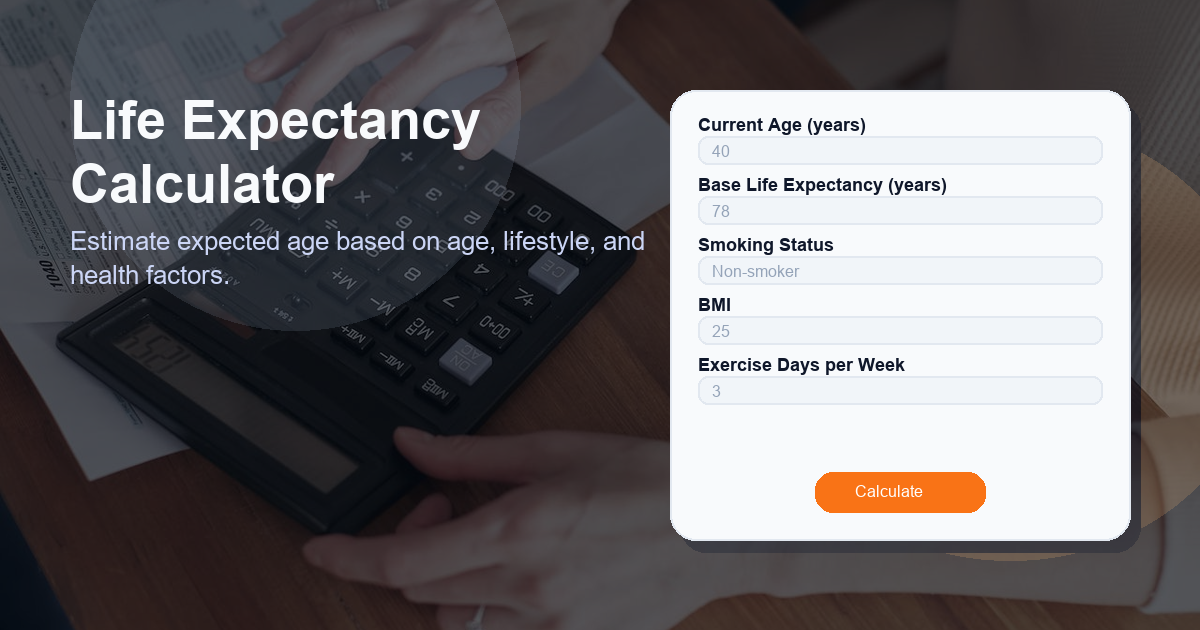
Life Expectancy Calculator
Description: Estimate expected age based on age, lifestyle, and health factors using the Life Expectancy Calculator. This tool combines a baseline life expectancy with simple adjustments for smoking, body mass index (BMI), and weekly exercise to provide an easy-to-understand estimate labeled Estimated Life Expectancy.
What this Life Expectancy Calculator calculator does
The Life Expectancy Calculator is designed to give a quick, data-informed estimate of the age you might expect to reach based on five user inputs. It is not a clinical diagnosis tool, but it helps illustrate how common lifestyle and health factors — smoking status, BMI, and exercise frequency — can influence expected lifespan when applied to a baseline life expectancy.
Key behaviors of this calculator:
- Combines a baseline value (you provide a Base Life Expectancy) with lifestyle modifiers.
- Adjusts for exercise — more exercise modestly increases life expectancy in the formula.
- Adjusts for BMI — BMI deviations above 25 modestly decrease expectancy; below 25 provides a small benefit by formula structure.
- Adjusts for smoking — a dedicated smoker factor reduces life expectancy for current smokers.
- Returns a single number labeled as the Estimated Life Expectancy, expressed in years of age.
How to use the Life Expectancy Calculator calculator
Using the Life Expectancy Calculator is straightforward. Provide the following inputs:
- Current Age (years): Your present chronological age. This is used to help interpret results (for example, if your estimated life expectancy is less than your current age, you have already exceeded it).
- Base Life Expectancy (years): A starting life expectancy number. This can be the average life expectancy in your country, the global average, or a personalized baseline provided by your healthcare professional.
- Smoking Status: Select whether you are a current smoker, former smoker, or never smoked. In the calculator formula this maps to a smoker_factor that reduces expected years for current smokers.
- BMI (Body Mass Index): Your BMI value (weight in kg / height in m²). The formula uses BMI to assess the effect of weight status on longevity relative to a healthy reference (25).
- Exercise Days per Week: How many days per week you exercise (moderate or vigorous). The formula assumes a benefit around a baseline of 3 days/week.
Steps to use the tool:
- Enter your Current Age and choose an appropriate Base Life Expectancy.
- Select your Smoking Status (this sets the smoker_factor).
- Enter your BMI and how many days per week you exercise.
- Apply the formula and read the value labeled Estimated Life Expectancy.
- Interpret: If the estimated age is higher than your current age, the difference is the number of years you might still expect to live under the model’s assumptions.
How the Life Expectancy Calculator formula works
The underlying formula used by this calculator is:
base_expectancy + (exercise_days – 3) * 0.3 – (bmi – 25) * 0.2 – smoker_factor
Explanation of each term:
- base_expectancy — starting expected age in years (for example, average national life expectancy).
- (exercise_days – 3) * 0.3 — exercise adjustment: the model treats 3 days/week as a reference point. Each additional day increases expected years by 0.3; each fewer day reduces it by 0.3. This represents a modest benefit for regular activity.
- -(bmi – 25) * 0.2 — BMI adjustment: BMI above 25 reduces life expectancy proportionally (0.2 years lost per BMI point above 25). If BMI is below 25 the term becomes negative and therefore increases expected years slightly.
- – smoker_factor — a fixed penalty applied if you are a current smoker. Typical mappings used in the calculator are:
- Never smoked: smoker_factor = 0
- Former smoker: smoker_factor = 3 (example; reflects partial recovery of risk)
- Current smoker: smoker_factor = 8 (example; approximate average reduction)
These values are illustrative and can be adjusted to represent different smoking intensities or medical evidence.
Result label: Estimated Life Expectancy — this number is an estimated age (in years) that the formula predicts.
Example calculation:
- Base Life Expectancy = 82 years
- Exercise Days = 4 → (4 – 3) * 0.3 = +0.3
- BMI = 28 → (28 – 25) * 0.2 = 3 * 0.2 = 0.6 (subtract 0.6)
- Smoking Status = Current smoker → smoker_factor = 8
- Estimated Life Expectancy = 82 + 0.3 – 0.6 – 8 = 73.7 years
Use cases for the Life Expectancy Calculator
This calculator is useful in a variety of practical contexts:
- Personal planning: Estimate how lifestyle changes like quitting smoking or exercising more could influence your expected age for retirement planning or long-term goals.
- Public health education: Demonstrate how small changes in exercise and weight can affect average expected lifespan in community health messaging.
- Behavioral motivation: Use the calculator to motivate healthier behaviors by showing quantified potential gains from exercising more or quitting smoking.
- Comparison and scenario analysis: Compare outcomes for different scenarios (e.g., current smoker vs. non-smoker, or BMI adjustments) to prioritize interventions.
Other factors to consider when calculating life expectancy
The formula in this Life Expectancy Calculator captures a handful of important lifestyle variables, but it omits many other real-world factors that strongly influence longevity. Consider the following when interpreting results:
- Genetics: Family history of chronic disease can significantly raise or lower risk independent of lifestyle.
- Medical conditions: Diabetes, cardiovascular disease, cancer history, and other chronic illnesses materially affect life expectancy.
- Socioeconomic factors: Income, education, access to healthcare, and living environment influence health outcomes.
- Mental health and stress: Chronic stress and untreated mental health conditions can shorten lifespan.
- Diet and substance use: Nutrition, alcohol consumption, and recreational drug use are not explicitly modeled but affect risk.
- Healthcare access and preventive care: Vaccination, screening, and early treatment change outcomes.
Important note: This calculator is intended for educational and planning purposes only. It does not replace professional medical advice. Always consult a healthcare professional for personalized risk assessment.
FAQ
Q: Is the Life Expectancy Calculator medically accurate?
A: No calculator can capture every individual factor. The Life Expectancy Calculator uses a simple, transparent formula for illustrative purposes. It provides a rough estimate and should not be used as a medical prognosis. For accurate health risk assessments, consult a qualified healthcare provider.
Q: How should I pick the Base Life Expectancy value?
A: You can use your country’s average life expectancy (available from government or WHO statistics) or a personalized baseline suggested by your clinician. The base value should represent the typical expected age for a person of your demographic and environment.
Q: How does the calculator handle former smokers?
A: The calculator assigns a reduced penalty for former smokers (for example, smoker_factor = 3) to reflect that quitting reduces risk over time. The exact value can be adjusted based on quit duration and smoking intensity.
Q: Can I improve my estimated life expectancy using this tool?
A: Yes — the formula shows how modest increases in exercise and lowering BMI can increase the estimated value. Stopping smoking yields one of the largest single improvements in the model. Use the tool to model different scenarios and motivate healthy lifestyle changes.
Q: Why doesn’t the formula use Current Age directly?
A: The formula returns an estimated final age (the age you may live to). Current Age is included as an input primarily to help interpret the result—if the Estimated Life Expectancy is below your Current Age, you’ve already exceeded the model’s expectation. You may also subtract Current Age from the result to see expected remaining years.