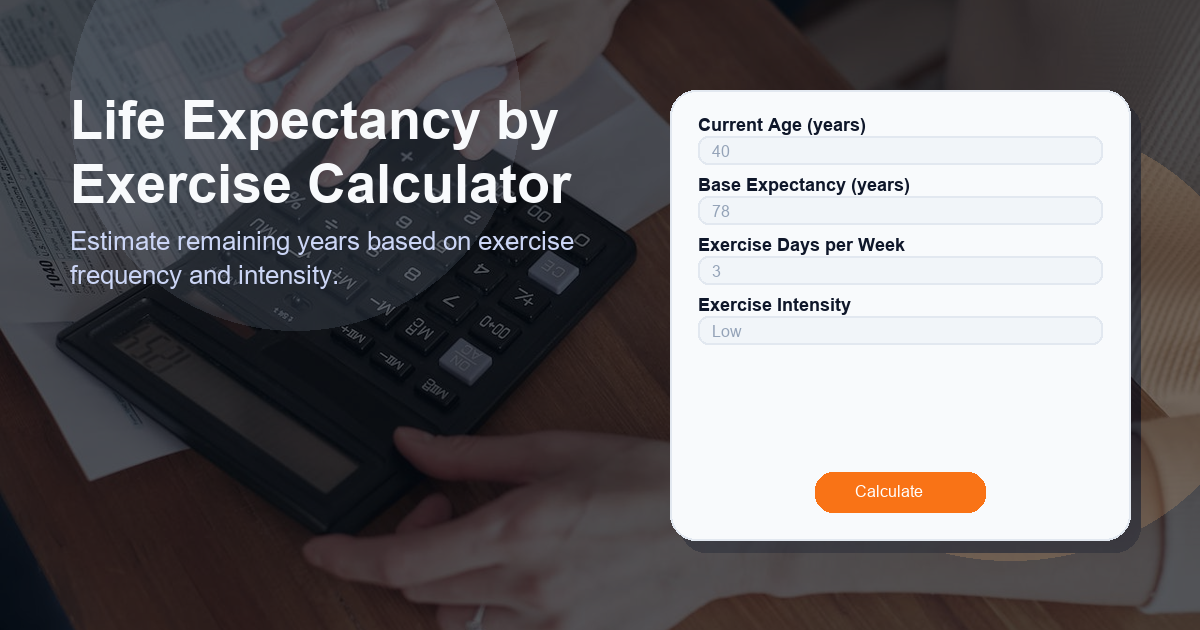
Life Expectancy by Exercise Calculator
The Life Expectancy by Exercise Calculator is a quick, transparent tool that helps you estimate how many years you may have left based on your current age, a chosen base life expectancy, and your weekly exercise habits. This calculator is designed for clarity and ease of use: enter a few values and get an instantaneous estimate labeled Estimated Remaining Years. Use it for planning, motivation, or simple curiosity — but remember it is a simplified model, not a medical or actuarial report.
What the Life Expectancy by Exercise Calculator does
The Life Expectancy by Exercise Calculator provides a straightforward numeric estimate of remaining years by combining:
- Base Expectancy — a starting life-expectancy value you provide (for example, an average population expectancy or an actuarial value).
- Exercise Days per Week — how often you exercise each week (0–7).
- Exercise Intensity — a numeric intensity value you select to reflect workout vigor.
- Current Age — your present age in years.
The calculator translates those inputs into an Estimated Remaining Years value using a transparent formula. It is meant to be intuitive and actionable — giving you immediate insight into how increasing weekly exercise or intensity may influence a simple life-expectancy estimate.
How to use the Life Expectancy by Exercise Calculator
Using the calculator is simple. Follow these steps to get your estimate:
- Enter Current Age (years) — your present age (for example, 40).
- Set Base Expectancy (years) — an expected lifespan baseline (for example, 82). You can use national averages or an actuarial value.
- Input Exercise Days per Week — how many days you exercise each week (0–7).
- Select Exercise Intensity — choose a numeric value to represent intensity (see guidance below).
- Press calculate to see the Estimated Remaining Years result.
Suggested intensity scale (example):
- 0 — Sedentary / no structured exercise
- 1 — Light activity (walking, light yoga)
- 2 — Moderate activity (brisk walking, cycling, light jogging)
- 3 — Vigorous activity (running, intensive cardio, heavy lifting)
Example calculation:
- Current Age = 40
- Base Expectancy = 82
- Exercise Days per Week = 4
- Exercise Intensity = 2
Result: Estimated Remaining Years = 82 + (4 − 3) * 0.5 + 2 − 40 = 44.5 years remaining.
How the Life Expectancy by Exercise Calculator formula works
The calculator uses a simple, additive formula to translate exercise frequency and intensity into years of life change relative to a base expectancy. The formula is:
Formula: base_expectancy + (exercise_days − 3) * 0.5 + intensity − current_age
Breakdown of terms:
- base_expectancy: the baseline life expectancy in years you choose as a starting point.
- (exercise_days − 3) * 0.5: a frequency adjustment that assumes exercising 3 days per week is neutral. Each additional day above 3 adds 0.5 years; each day below 3 subtracts 0.5 years.
- intensity: a straightforward addition of years depending on exercise intensity on the numeric scale you select (example 0–3).
- − current_age: subtracting your current age yields the remaining years relative to your present age.
Why this structure?
- The calculator treats three days of exercise per week as a baseline because moderate consistency is commonly associated with health benefits.
- The 0.5 years per extra day is a simple, interpretable increment to show marginal benefit from more frequent exercise.
- The intensity term acknowledges that vigorous exercise can add to overall benefit beyond frequency.
Important: this formula is intentionally simplified. It is designed to be transparent and educational rather than definitive. It highlights direction and magnitude of benefit rather than precise actuarial predictions.
Use cases for the Life Expectancy by Exercise Calculator
This calculator is useful in a variety of personal and professional contexts:
- Personal planning: Estimate how adjustments to your weekly exercise schedule might change a simple life-expectancy projection.
- Motivation: Visualize the potential payoff in years for increasing exercise frequency or intensity.
- Health education: Use the tool to demonstrate the relative impact of frequency versus intensity in group presentations or wellness programs.
- Lifestyle comparisons: Compare scenarios (e.g., sedentary vs. moderate exercise) to inform habit change priorities.
- Coaching and wellness: Trainers and health coaches can use the calculator to give clients a clear, easy-to-understand estimate as part of a broader behavior-change plan.
Other factors to consider when calculating life expectancy
Exercise is an important part of longevity, but it is only one piece of the puzzle. When using the Life Expectancy by Exercise Calculator, consider these additional factors that significantly affect real-world life expectancy:
- Genetics: Family history and inherited conditions can alter risk in ways a simple model cannot capture.
- Diet and nutrition: Quality of diet, caloric balance, and nutrient intake play a central role in health outcomes.
- Smoking, alcohol, and substance use: These behaviors can substantially decrease life expectancy.
- Chronic conditions: Diabetes, heart disease, COPD, and other illnesses shift actuarial risk materially.
- Mental health and stress: Chronic stress, depression, and anxiety affect sleep, immune function, and behavior.
- Socioeconomic status and access to care: Income, education, and healthcare availability are major determinants of lifespan.
- Environment: Air and water quality, occupational hazards, and neighborhood safety all matter.
- Sleep and recovery: Regular, quality sleep is essential for long-term health.
Because of these influences, treat the calculator’s output as a directional guide — useful for seeing the potential impact of exercise changes but not a medical certificate of life expectancy.
FAQ — Life Expectancy by Exercise Calculator
1. How accurate is the Life Expectancy by Exercise Calculator?
The calculator provides a simplified estimate based on a transparent formula. It is not an actuarial or medical tool and should not be used as a definitive prediction. Use it to understand relative changes resulting from exercise frequency and intensity, while consulting professionals for personalized risk assessments.
2. What should I put for Base Expectancy?
Base Expectancy can be a national average life expectancy or a value from an actuarial table you trust. For many users, a commonly used baseline (for example, 80–85 years depending on country) works fine. You can also use a personalized actuarial value if available.
3. How do I choose the Exercise Intensity number?
Use a simple scale such as 0 (sedentary) to 3 (vigorous). Choose the value that best matches your typical workout intensity. Keep the scale consistent across comparisons to get meaningful relative results.
4. Can this calculator replace advice from a doctor?
No. This tool is informational and educational. It does not replace medical advice, diagnosis, or treatment. For personalized health planning, consult your physician or a qualified healthcare professional.
5. What if the result shows very low or negative remaining years?
If your inputs create a small or negative result, it means your chosen base expectancy and current age lead to that arithmetic outcome. This indicates a need to reassess your base expectancy or inputs; it does not reflect an actual imminent risk. Use the calculator to explore realistic scenarios.
Final note: The Life Expectancy by Exercise Calculator is a clear, lightweight way to see how exercise frequency and intensity might change a simple estimate of remaining years. Use it to inform lifestyle decisions, motivate consistency, and spark conversations with healthcare providers about comprehensive plans for long-term health.