End of Life Cost Calculator
Description: Estimate end-of-life costs from medical, care, and funeral expenses. Use the End of Life Cost Calculator to create a clear, realistic total of expenses you or a loved one may face during end-of-life planning.
What this End of Life Cost Calculator calculator does
The End of Life Cost Calculator is a straightforward tool designed to help individuals, families, and advisors estimate the total financial burden associated with the final months or years of life. It aggregates four primary categories of expenses into a single, easy-to-understand figure labeled the Total End-of-Life Costs. This enables better budgeting, insurance review, estate planning, and conversations about care preferences.
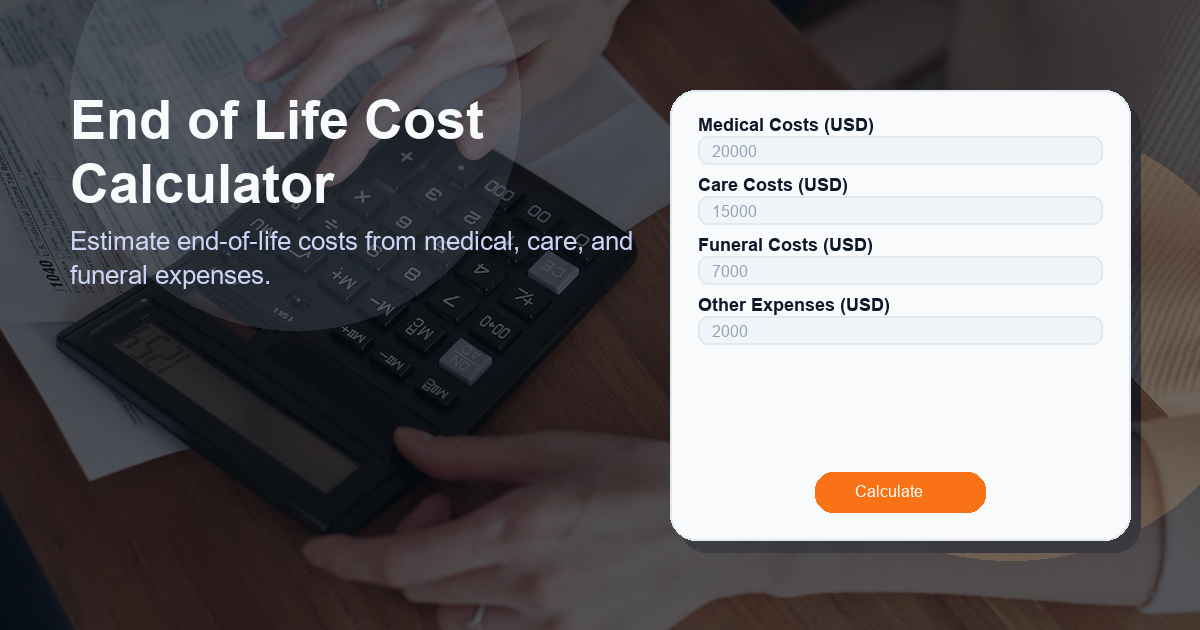
Specifically, this calculator accepts these inputs:
- Medical Costs (USD) — hospital bills, specialist fees, medications, hospice medical supplies
- Care Costs (USD) — in-home care, assisted living, nursing home fees, respite care
- Funeral Costs (USD) — burial or cremation, memorial services, caskets, headstones
- Other Expenses (USD) — legal fees, travel for family, home modification, debt repayment
The calculator then sums these values to return a single, actionable result: the Total End-of-Life Costs.
How to use the End of Life Cost Calculator calculator
Using the calculator is simple and intuitive. Follow these steps for an accurate estimate:
- Gather recent bills and quotes. Collect your latest medical statements, care provider estimates, funeral home pricing, and any outstanding obligations you expect to apply at the end of life.
- Enter each amount into the appropriate field. Input values in USD for Medical Costs, Care Costs, Funeral Costs, and Other Expenses.
- Double-check one-time vs recurring items. Note whether an expense is a one-time cost (e.g., funeral) or a recurring cost (e.g., monthly care fees) and multiply recurring costs to reflect the expected duration before adding them.
- Review and adjust. Consider adding a buffer for unexpected expenses—many users add 10–20% as contingency.
- Calculate the total. Press the calculate button or manually add the four inputs using the formula provided below to reveal your Total End-of-Life Costs.
Example: If Medical Costs = 12,000, Care Costs = 20,000, Funeral Costs = 8,000, Other Expenses = 2,000, then…
Result: Total End-of-Life Costs = 12,000 + 20,000 + 8,000 + 2,000 = 42,000 USD.
How the End of Life Cost Calculator formula works
The formula for this calculator is intentionally simple to keep the tool transparent and easy to validate. It uses a basic addition model:
Formula: medical_costs + care_costs + funeral_costs + other_expenses
This formula reflects a conservative baseline: it assumes that the total cost is the sum of major cost categories relevant to end-of-life planning. Because of the straightforward structure, the calculator is easy to audit and to expand; for example, users can break down each category into sub-items (medication, bed rental, hospice fees) and sum them before entering the category totals.
Why addition is appropriate:
- Each category represents separate financial obligations that generally do not overlap.
- Additive totals provide a clear, actionable number for budgeting and policy decisions.
- Simplicity improves understanding for non-financial audiences, such as family members making decisions under stress.
Use cases for the End of Life Cost Calculator
The calculator is useful in a variety of real-world situations. Typical use cases include:
- Personal financial planning: Individuals can estimate funds needed for their own end-of-life care and funeral arrangements to decide how much life insurance or savings to maintain.
- Estate and retirement planning: Financial planners use the tool to align clients’ portfolios with expected end-of-life obligations.
- Family discussions: Families can use a clear cost estimate to make informed decisions about care options and whether to tap savings, insurance, or government assistance.
- Nonprofit and social work: Social workers can quickly estimate shortfalls and apply for grants, subsidies, or community resources.
- Comparative analysis: Use the calculator to compare care settings (home care vs. assisted living) or to test how different funeral choices affect the total cost.
Other factors to consider when calculating end-of-life costs
While the calculator provides a clear numeric baseline, real-life planning often requires attention to additional factors that can materially change totals. Consider including or researching the following:
- Inflation and time horizon: If the end-of-life period is several years away, inflation can increase costs considerably—especially for long-term care and medical services.
- Insurance coverage: Medicare, Medicaid, private health insurance, long-term care insurance, and life insurance can offset many of the expenses listed. Determine coverage limits, deductibles, and exclusions.
- Geographic differences: Medical and care costs vary greatly by region. Funeral costs also change by local customs and service providers.
- Public assistance and benefits: Veterans’ benefits, state assistance programs, and charitable organizations may cover portions of expenses.
- Tax implications: Some expenses may be tax-deductible for the estate or family; consult a tax professional for details.
- Non-financial considerations: Quality of care, proximity to family, religious preferences, and legacy wishes can all influence choices—and therefore costs.
- Contingency planning: Unexpected costs such as legal disputes, emergency transportation, or last-minute travel can add significant sums—consider a contingency buffer.
In short, treat the calculator output as a strong starting point. Use it in combination with professional advice and updated local pricing to form a robust end-of-life financial plan.
FAQ
Q: What exactly does the End of Life Cost Calculator include?
A: The calculator includes four input categories: Medical Costs, Care Costs, Funeral Costs, and Other Expenses. These are summed to produce the Total End-of-Life Costs.
Q: Do I need to include recurring monthly care fees?
A: Yes. Convert recurring fees into a total expected amount by multiplying the monthly fee by the number of months you expect care to be needed. Then enter that total under Care Costs.
Q: Can insurance payments be subtracted from the total?
A: The calculator itself totals gross costs. To estimate net out-of-pocket costs, subtract expected insurance reimbursements, benefits, or subsidies from the Total End-of-Life Costs.
Q: How accurate is the estimate?
A: Accuracy depends on the quality of your input values. Use current bills and quotes for the best results. Because it’s a summation tool, it’s only as reliable as the numbers you provide—consider adding a contingency margin for unknowns.
Q: Is there a recommended contingency percentage to add?
A: Many planners recommend adding a contingency buffer of 10–20% to account for unexpected expenses and inflation, but the ideal percentage varies by individual risk tolerance and the time horizon.
Final note: The End of Life Cost Calculator is a practical first step toward clear financial planning for end-of-life needs. Use it to inform decisions, communicate with family, and prepare documentation for advisors and providers.