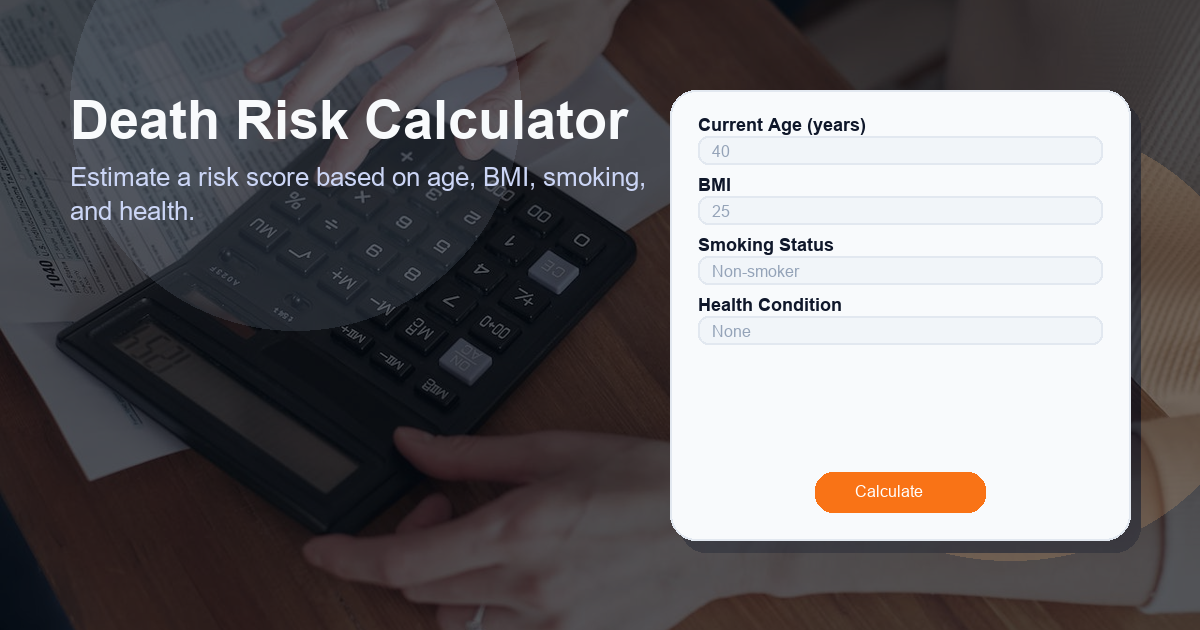
Death Risk Calculator
Death Risk Calculator — estimate a simple risk score based on age, body mass index (BMI), smoking, and an overall health condition. This tool provides a quick, transparent calculation using a clear formula so you can see how each input influences your Risk Score. It is intended for educational and informational purposes and should not replace professional medical evaluation.
1) What this Death Risk Calculator calculator does
This Death Risk Calculator produces a single numeric Risk Score by combining four user-provided inputs:
- Current Age (years)
- BMI (Body Mass Index)
- Smoking Status
- Health Condition
The output is a simplified measure designed to highlight relative differences in risk as inputs change. The calculator is useful when you want a quick comparison — for example, to see how weight reduction, quitting smoking, or improving overall health may reduce your score.
2) How to use the Death Risk Calculator calculator
Using the Death Risk Calculator is straightforward. Follow these steps:
- Enter your current age in years (integer or decimal is accepted).
- Enter your BMI — if you don’t know it, use weight (kg) ÷ (height (m))² to calculate. Many online BMI calculators can help.
- Select your smoking status:
- 0 = Non-smoker
- 1 = Former smoker
- 2 = Current smoker
- Select your overall health condition:
- 0 = Excellent
- 1 = Good
- 2 = Fair
- 3 = Poor
- Click Calculate to produce your Risk Score. The calculator will show a numeric score and an interpretation band (low, moderate, high).
Example: a 50-year-old with BMI 30, current smoker (2), and fair health (2) would have a score computed by the formula shown below.
3) How the Death Risk Calculator formula works
The algorithm is deliberately transparent and linear. The formula used by this Death Risk Calculator is:
current_age*0.02 + (bmi-25)*0.1 + smoking_status + health_condition
Breakdown of each component:
- Age term (current_age*0.02): Age contributes steadily to risk. Each additional year increases the score by 0.02 points. For example, 10 extra years adds 0.2 to the score.
- BMI term ((bmi-25)*0.1): The calculation uses 25 as a baseline BMI. Values above 25 (overweight/obesity range) increase the score; values below 25 reduce the score. Each BMI point above baseline adds 0.1; each point below subtracts 0.1.
- Smoking status (smoking_status): A small integer captures the relative additional risk of tobacco use. Typical mapping: 0 = non-smoker, 1 = former smoker, 2 = current smoker.
- Health condition (health_condition): A simple ordinal value for overall health quality: 0 (excellent) to 3 (poor). Each increment adds 1 point to the score.
Result label: the output is shown as Risk Score. The raw score is a unitless number used for comparison. Example calculation:
- Age = 50 → 50 * 0.02 = 1.0
- BMI = 30 → (30 − 25) * 0.1 = 0.5
- Smoking status = 2 → +2
- Health condition = 2 → +2
- Risk Score = 1.0 + 0.5 + 2 + 2 = 5.5
Interpretation bands (example):
- Low risk: Score < 2.5
- Moderate risk: Score 2.5–4.9
- High risk: Score ≥ 5.0
These bands are illustrative. The calculator emphasizes relative differences, not exact probabilities of mortality. Always consult a clinician for personalized risk assessment and clinical testing.
4) Use cases for the Death Risk Calculator
The Death Risk Calculator is helpful in several contexts:
- Personal awareness: Quickly compare how changes in weight, smoking cessation, or health improvements affect a simple risk score.
- Public health education: Demonstrate how lifestyle factors such as smoking and obesity influence measurable scores in outreach materials.
- Initial screening: Use as an initial screen in a wellness program to identify individuals who may benefit from deeper clinical evaluation.
- Scenario planning: Model hypothetical changes — for example, “If I lose 5 BMI points and quit smoking, how will my score change?”
Benefits of this approach:
- Transparency: The linear formula is simple to understand and reproduce.
- Speed: Requires only four inputs for an immediate result.
- Actionable insight: Shows which modifiable inputs (BMI, smoking, health behaviors) most affect the score.
5) Other factors to consider when calculating Death Risk
While this Death Risk Calculator provides a handy score, many important factors are not included in the formula. Consider these additional elements when thinking about risk:
- Medical history: Chronic conditions (heart disease, diabetes, cancer, COPD) substantially influence mortality risk and are not modeled here.
- Medication and treatment: Effective medical treatment can reduce risk despite unfavorable raw numbers.
- Family history: Genetic predisposition to certain conditions is an important determinant of long-term risk.
- Socioeconomic factors: Access to healthcare, nutrition, and social determinants of health affect outcomes.
- Physical activity and diet: Lifestyle factors beyond BMI (cardiovascular fitness, diet quality) are powerful modifiers.
- Mental health and stress: Chronic stress and psychiatric conditions can influence physical health outcomes.
Important disclaimer: The Death Risk Calculator is a simplified model intended for educational use and is not a substitute for medical advice. If you are concerned about your health or risk, please consult a qualified healthcare professional.
Interactive calculator
Risk Score: —
FAQ
1) Is the Death Risk Calculator a medical tool?
No. The Death Risk Calculator is an educational, simplified model that illustrates how age, BMI, smoking, and general health can influence a numeric risk score. It is not a diagnostic or clinical tool. For medical advice, testing, or personalized risk prediction, consult a healthcare professional.
2) How should I interpret the Risk Score?
The Risk Score is a relative, unitless number. Higher scores indicate higher relative risk in the context of this model. The interpretation bands (low, moderate, high) are illustrative to help compare results, not absolute probabilities.
3) Can I change the formula or add other factors?
The current formula is intentionally simple and transparent. Researchers or developers can extend it by incorporating medical history, lab values, or other predictors, but doing so requires validated models. Any extended model should be evaluated and validated before clinical use.
4) How accurate is the score for predicting actual mortality?
Accuracy is limited. This linear formula does not account for many clinical variables and therefore cannot provide precise mortality predictions. Use the score as a comparative, educational metric rather than a definitive assessment.
5) What actions can lower my Risk Score?
Based on this model, modifiable actions that can reduce your score include: losing weight to lower BMI, quitting smoking, and improving overall health through medical care and lifestyle changes. Consult professionals for safe and effective strategies.
Final note: The Death Risk Calculator helps you explore the relative impact of a few common factors on a simple score. Use it to learn, make comparisons, and inform conversations with healthcare providers — but not as a replacement for clinical judgment.