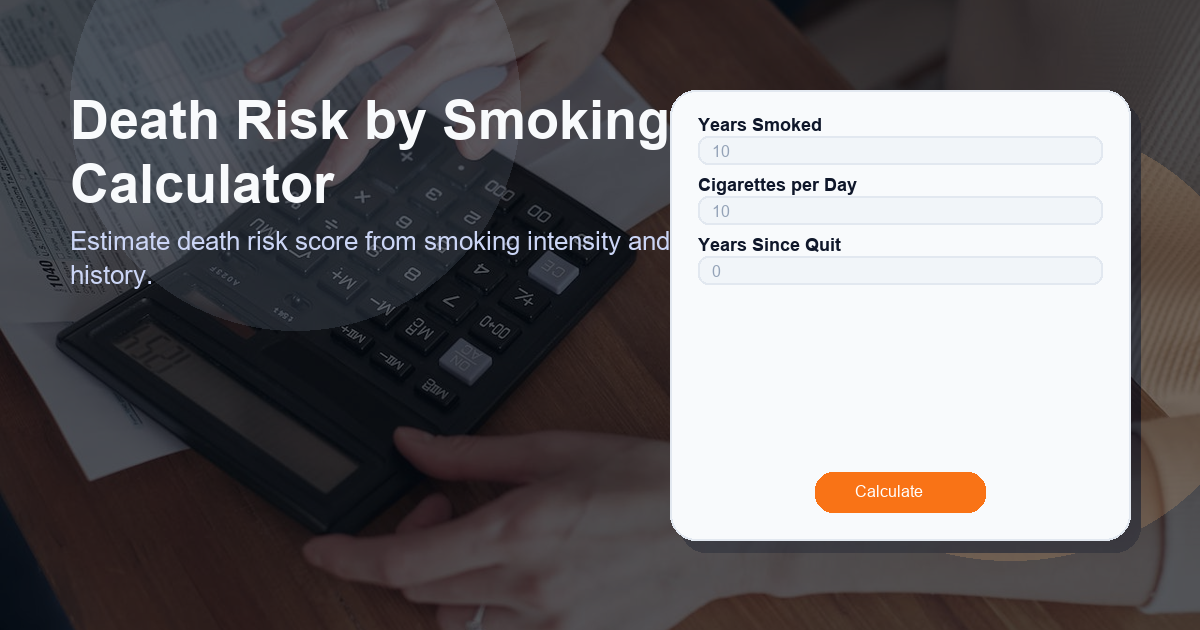
Death Risk by Smoking Calculator
Description: Estimate death risk score from smoking intensity and history using the Death Risk by Smoking Calculator. This simple, transparent tool produces a Smoking Risk Score based on three inputs: Years Smoked, Cigarettes per Day, and Years Since Quit. It is intended for awareness and rough comparison rather than clinical diagnosis.
What this Death Risk by Smoking Calculator calculator does
The Death Risk by Smoking Calculator provides a quick, easy-to-understand index—called the Smoking Risk Score—that summarizes smoking history into a single number. The score is not a direct probability of death but an interpretable metric that correlates smoking intensity and cessation history to relative risk.
Key purposes:
- Give an immediate sense of the relative long-term risk due to smoking history.
- Compare risk scores for different smoking patterns or to track improvement after quitting.
- Serve as a starting point for conversations between patients, clinicians, and public health professionals.
How to use the Death Risk by Smoking Calculator calculator
Using the calculator is straightforward. Enter each input as described below and click Calculate to get your Smoking Risk Score. The calculator expects whole numbers or decimals where applicable.
Inputs
- Years Smoked: Total number of years you smoked regularly (e.g., 5, 10, 25).
- Cigarettes per Day: Typical number of cigarettes you smoked each day when you were smoking (e.g., 5, 10, 20).
- Years Since Quit: If you quit smoking, enter the number of full years since quitting. Enter 0 if you still smoke.
Try an example calculation
Result label: Smoking Risk Score: —
How the Death Risk by Smoking Calculator formula works
The formula used by the calculator is intentionally simple and linear so that results are easy to explain and interpret. The underlying expression is:
Smoking Risk Score = years_smoked * 0.2 + cigarettes_per_day * 0.3 - Math.min(quit_years, 20) * 0.2
Breakdown of the formula components:
- years_smoked * 0.2: This term increases the score proportionally to the number of years spent smoking. Longer durations raise the score because cumulative exposure typically increases long-term risk.
- cigarettes_per_day * 0.3: Daily smoking intensity is weighted slightly heavier than years smoked because the daily dose of tobacco (and thus toxins) is strongly associated with adverse outcomes.
- – Math.min(quit_years, 20) * 0.2: Years since quitting reduce the score, reflecting partial risk recovery after cessation. The formula caps the benefit from quitting at 20 years to model diminishing returns—after a certain point, additional years of abstinence give smaller marginal improvements in this simplified index.
Interpretation tips:
- Higher scores indicate greater relative risk attributable to smoking history.
- The score is a comparative index rather than an absolute probability of death.
- Because the formula is linear, changes in inputs have predictable effects—e.g., quitting for more years will steadily reduce the score until the 20-year cap is reached.
Use cases for the Death Risk by Smoking Calculator
The Death Risk by Smoking Calculator is useful in a variety of contexts where a quick, interpretable summary of smoking-related risk is helpful:
- Personal awareness: Individuals can estimate how their smoking history compares to other profiles and visualize improvements after quitting.
- Clinical communication: Healthcare providers may use the score as a simple conversation starter about the benefits of cessation and risk modification.
- Health education: Public health campaigns and educational materials can include the score to illustrate the impact of smoking intensity and quitting.
- Research and triage: For low-fidelity screening or exploratory data analysis, the score can provide a rapid numeric feature representing smoking exposure.
Other factors to consider when calculating smoking-related risk
While the calculator focuses on three straightforward inputs, many other variables influence an individual’s true risk of death from smoking-related causes. Consider these additional factors:
- Age: Older adults typically face higher baseline mortality risks. Age modifies absolute risk beyond the score produced here.
- Gender: Biological differences and historical patterns can alter disease risk profiles.
- Comorbid conditions: Respiratory disease, heart disease, diabetes, and immune status all impact mortality risk.
- Type of tobacco and inhalation: Cigars, pipes, smokeless tobacco, and vaping differ in exposure and risk. Depth of inhalation changes dose.
- Pack-years: A common epidemiologic measure combining years smoked and cigarettes per day (pack-years) may be used in clinical studies; the calculator uses a simplified linear combination instead.
- Secondhand smoke and environmental exposure: Non-smokers exposed to tobacco smoke can still incur risk.
- Genetics and socioeconomic factors: Genetic predisposition, nutrition, access to healthcare, and occupational hazards modify outcomes.
- Accuracy and validation: This tool is a heuristic and has not been validated as a clinical decision tool. For personalized medical advice, consult a healthcare professional.
Frequently Asked Questions
Is the Death Risk by Smoking Calculator medical advice?
No. This calculator provides an educational Smoking Risk Score to summarize smoking history. It is not a substitute for professional medical assessment or diagnostic testing. Use it to increase awareness or start a discussion with your clinician.
How accurate is the Smoking Risk Score?
The score is a simplified index, not a validated probability of death. It uses a linear formula to combine duration, intensity, and years since quitting. While useful for comparisons, it does not account for many clinical variables that determine real-world risk.
Can quitting smoking reduce my score and risk?
Yes. In the formula, each year since quitting reduces the score by 0.2 until 20 years, reflecting risk decline after cessation. Quitting earlier and reducing daily cigarette intake both lower the score and are associated with better health outcomes over time.
Why does the formula cap Years Since Quit at 20?
The cap models diminishing returns from extended abstinence in a simple way. Many studies show that risk declines substantially after quitting but the rate of reduction slows over decades. The 20-year cap prevents the quit benefit from growing without bound in this index.
What do different score ranges mean?
There is no universal clinical threshold embedded in this tool. As a rule of thumb for interpretation:
- Low score: relatively lower relative smoking-related risk.
- Moderate score: notable historical exposure; consider clinical follow-up and risk-reduction steps.
- High score: significant exposure that may warrant deeper clinical evaluation and targeted prevention efforts.
Always contextualize the score with age, health conditions, and professional medical advice.
Final note: The Death Risk by Smoking Calculator is designed to be transparent, simple, and actionable for awareness. It helps quantify how years smoked, cigarettes per day, and years since quitting interact to influence a smoking-related risk index labeled Smoking Risk Score. For individualized health planning, contact a healthcare provider.