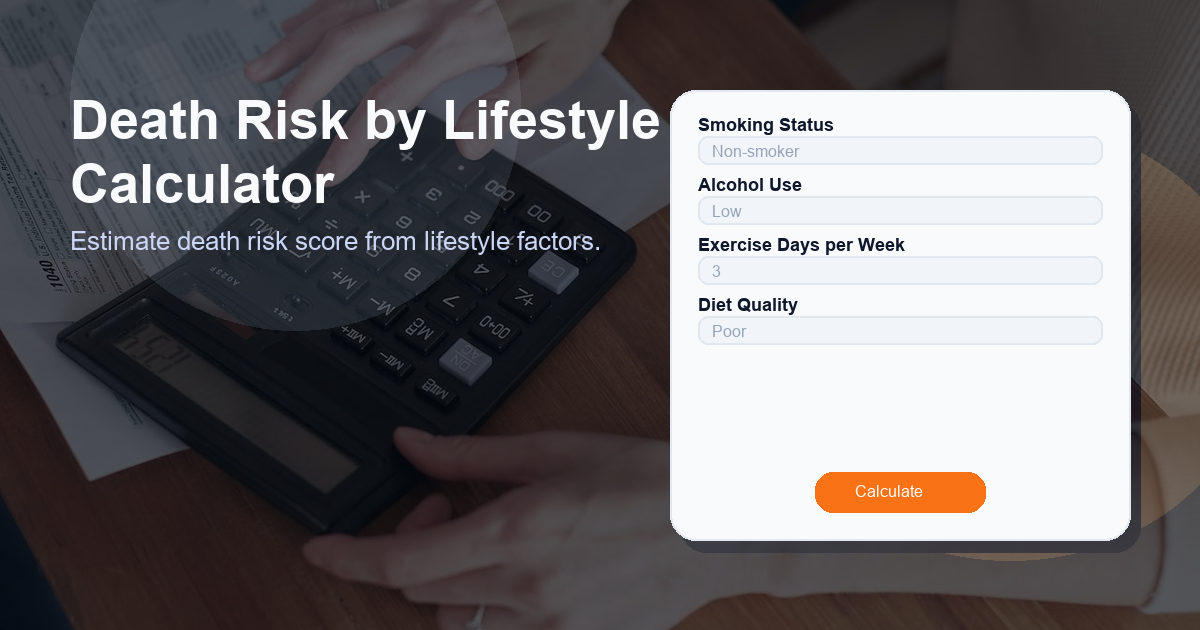
Death Risk by Lifestyle Calculator
Estimate death risk score from lifestyle factors with this easy-to-understand Death Risk by Lifestyle Calculator. This article explains what the calculator does, how to use it, the exact formula behind the score, practical use cases, and important caveats. Use the calculator to get a quick, comparative Lifestyle Risk Score based on four simple inputs: Smoking Status, Alcohol Use, Exercise Days per Week, and Diet Quality.
1) What this Death Risk by Lifestyle Calculator calculator does
The Death Risk by Lifestyle Calculator converts common lifestyle choices into a single numeric metric called the Lifestyle Risk Score. It is designed to help users quickly compare how changes in behavior — for example, quitting smoking or exercising more often — may affect a simple risk score.
Key features:
- Simple inputs: Smoking Status, Alcohol Use, Exercise Days per Week, Diet Quality.
- Fast output: Computes a single numeric score—Lifestyle Risk Score—using a transparent formula.
- Comparative guidance: Use it to compare scenarios (e.g., current vs. improved lifestyle) rather than to make clinical predictions.
2) How to use the Death Risk by Lifestyle Calculator calculator
Using the Death Risk by Lifestyle Calculator is straightforward. Follow these steps to compute your Lifestyle Risk Score:
- Select Smoking Status: Choose the category that best matches you (see numeric mapping below).
- Choose Alcohol Use: Select none, moderate, or heavy drinking (mapped to numeric values below).
- Enter Exercise Days per Week: Provide a number from 0 to 7 representing how many days you exercise each week.
- Choose Diet Quality: Rate your diet as healthy, average, or poor (numeric mapping provided).
- Calculate: The calculator applies the formula and displays your Lifestyle Risk Score.
Numeric input mappings commonly used with this calculator (recommended mapping for interpretation):
- Smoking Status: Non-smoker = 0, Former smoker = 1, Current smoker = 2
- Alcohol Use: None = 0, Moderate = 1, Heavy = 2
- Exercise Days per Week: 0 to 7 (numeric)
- Diet Quality: Healthy = 0, Average = 1, Poor = 2
3) How the Death Risk by Lifestyle Calculator formula works
The calculator uses a clear and compact formula:
Formula: smoking_status + alcohol_use + (3 – exercise_days) * 0.5 + diet_quality
Breakdown of the formula components:
- smoking_status: A numerical value reflecting smoking behavior. Higher values increase the Lifestyle Risk Score.
- alcohol_use: A numerical value for alcohol consumption. Heavier drinking increases the score.
- (3 – exercise_days) * 0.5: This term rewards exercise. If you exercise more than 3 days per week, the contribution becomes negative, thereby reducing risk. If you exercise fewer than 3 days, the term adds to the risk. The multiplier 0.5 makes exercise count less per day than smoking or poor diet.
- diet_quality: A simple numeric scale for diet healthiness; worse diet raises the score.
Example calculations to demonstrate interpretation:
- Example A — Healthier lifestyle: Non-smoker (0) + None alcohol (0) + (3 – 4) * 0.5 + Healthy diet (0) = 0 + 0 + (-1)*0.5 + 0 = -0.5 → Lifestyle Risk Score = -0.5 (lower is better).
- Example B — Higher-risk lifestyle: Current smoker (2) + Heavy alcohol (2) + (3 – 1) * 0.5 + Poor diet (2) = 2 + 2 + 2*0.5 + 2 = 2 + 2 + 1 + 2 = 7 → Lifestyle Risk Score = 7 (higher is worse).
Interpretation tips:
- Lower scores suggest a healthier lifestyle profile regarding these specific inputs.
- Higher scores suggest more lifestyle-related risk factors that, in aggregate, may be associated with higher mortality risk.
- This numeric score is best used for relative comparison, not as an absolute probability of death.
4) Use cases for the Death Risk by Lifestyle Calculator
The Death Risk by Lifestyle Calculator has several practical and educational use cases:
- Personal motivation: See the impact of incremental changes (e.g., quitting smoking, reducing alcohol, improving diet, increasing exercise).
- Scenario comparison: Compare “current” vs. “improved” lifestyle configurations to set realistic health goals.
- Public health education: Use as a simple demonstration tool in workshops or classes to show how combined lifestyle factors influence risk.
- Workplace wellness: Incorporate into wellness programs for anonymous, aggregate feedback on employee lifestyle patterns.
Remember: the score is a simplified summary metric intended to highlight relative differences and encourage healthier choices.
5) Other factors to consider when calculating death risk
While the Death Risk by Lifestyle Calculator focuses on four lifestyle factors, real-world mortality risk is influenced by many additional variables. Consider these important factors that are not included in the calculator but are often critical:
- Age and sex: Baseline risk changes dramatically with age and differs between sexes.
- Medical history: Chronic conditions (heart disease, diabetes, cancer) strongly influence mortality.
- Genetics: Family history can predispose to specific diseases.
- Environmental exposures: Air quality, occupational hazards, and social determinants of health matter.
- Medication and healthcare access: Preventive care and treatment access change outcomes.
Because of these additional variables, the Lifestyle Risk Score should be treated as an educational tool rather than a medical diagnosis. Always consult healthcare professionals for personalized risk assessment and clinical decisions.
FAQ
1. What exactly is the “Lifestyle Risk Score”?
The Lifestyle Risk Score is a single numeric value produced by the Death Risk by Lifestyle Calculator using the formula: smoking_status + alcohol_use + (3 – exercise_days) * 0.5 + diet_quality. It summarizes the relative contribution of the four specified lifestyle factors. Lower values are better; higher values indicate more lifestyle-related risk.
2. Are the input mappings fixed or can I change them?
The article recommends common numeric mappings (e.g., Non-smoker = 0, Current smoker = 2), but you can adjust mappings to better reflect your context. Be consistent across comparisons. Any change in mapping will change the resulting Lifestyle Risk Score and how it should be interpreted.
3. Is this calculator a medical tool? Can it predict life expectancy?
No. The Death Risk by Lifestyle Calculator is an educational and comparative tool. It does not provide a medically validated probability of death or life expectancy. Use it to understand the relative impact of lifestyle changes and consult medical professionals for formal risk assessments.
4. How should I interpret negative scores from the formula?
Negative scores can occur if exercise_days is sufficiently high and other inputs are low. A negative Lifestyle Risk Score indicates a favorable combination of the included lifestyle factors. The absolute number has no clinical meaning beyond relative comparison.
5. Can this calculator be used in population health or research?
It can be used as a simple educational or exploratory metric in population health initiatives, but it is not a substitute for validated epidemiological models. Researchers should rely on peer-reviewed risk models and adjust for confounders, demographics, and clinical data.
Disclaimer: The Death Risk by Lifestyle Calculator provides a simplified score and should not replace professional medical advice. Use it for awareness and motivation to improve healthy behaviors.