Death Risk by Age and Gender Calculator
What this Death Risk by Age and Gender Calculator calculator does
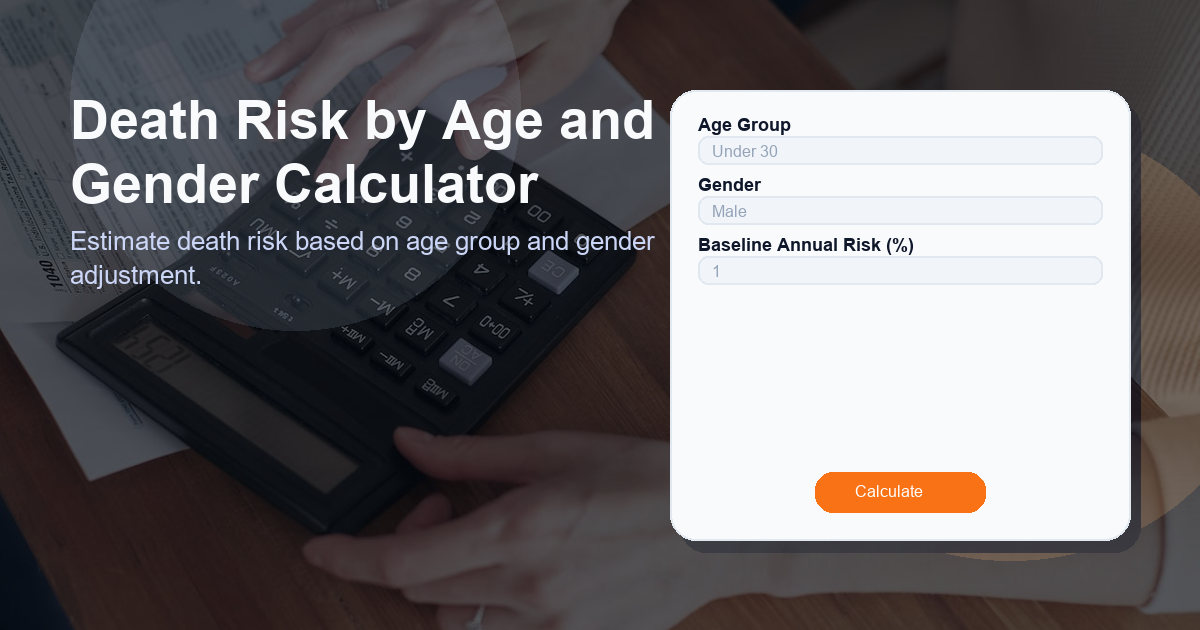
The Death Risk by Age and Gender Calculator is a simple, transparent tool to help you estimate an individual’s relative annual death risk using three user-provided inputs: Age Group, Gender, and a Baseline Annual Risk (%). It applies a straightforward multiplicative formula to adjust the baseline risk based on age and gender factors, returning an Estimated Annual Risk expressed as a percentage.
This calculator is intended for educational and illustrative purposes: it helps compare relative risk across age groups and between genders when you have a baseline risk estimate. It is not a substitute for clinical judgment or personalized medical risk assessment.
How to use the Death Risk by Age and Gender Calculator calculator
Using the Death Risk by Age and Gender Calculator is quick and easy. Follow these steps:
- Step 1: Enter a Baseline Annual Risk (%). This should be a numeric percentage representing an average population annual mortality risk (for example, 0.5 for 0.5%).
- Step 2: Select an Age Group. Age groups map to multipliers (see the example multipliers below).
- Step 3: Select a Gender option. Gender selections map to small adjustment multipliers to reflect documented differences in population mortality by gender.
- Step 4: The calculator applies the formula and displays the Estimated Annual Risk as a percentage.
Important usage notes:
- Input the baseline risk as a percentage number (e.g., type 1.2 for 1.2%).
- If you only have a decimal (e.g., 0.012 for 1.2%), convert to percentage by multiplying by 100 before entering or use the decimal guidance provided by the tool.
- The output is an estimate. For clinical decisions, consult a qualified professional and use comprehensive models that include comorbidities and other risk factors.
How the Death Risk by Age and Gender Calculator formula works
The calculator uses a simple multiplicative model:
Formula: baseline_risk * age_group * gender_adjustment
Where:
- baseline_risk — the baseline annual mortality risk expressed as a percentage (e.g., 0.5 for 0.5%).
- age_group — an age bracket multiplier derived from observed increases in mortality with age.
- gender_adjustment — a multiplier to reflect observed differences in mortality by gender.
Example multipliers (illustrative — you should calibrate to the population and data source you trust):
- Age Group Multipliers:
- 0–17 years: 0.25
- 18–34 years: 0.5
- 35–49 years: 1.0
- 50–64 years: 2.0
- 65–79 years: 5.0
- 80+ years: 12.0
- Gender Adjustments (example):
- Male: 1.10
- Female: 0.90
- Other / Unknown: 1.00
Example calculation:
- Baseline Annual Risk = 0.5 (meaning 0.5%)
- Age Group = 65–79 → multiplier = 5.0
- Gender = Male → adjustment = 1.10
- Estimated Annual Risk = 0.5 * 5.0 * 1.10 = 2.75%
In this example, the calculator estimates an Estimated Annual Risk of 2.75% for a male in the 65–79 age group when the baseline population risk is 0.5%.
Use cases for the Death Risk by Age and Gender Calculator
The Death Risk by Age and Gender Calculator supports multiple practical scenarios where a quick, transparent adjustment of risk by age and gender is useful:
- Public health communication: Demonstrate how risk increases with age and differs by gender when explaining population-level mortality statistics.
- Risk stratification: Compare relative annual risks between demographic groups when building simple prioritization rules for outreach or screening.
- Educational materials: Use in classroom or training contexts to teach how baseline risk can be modified by demographic multipliers.
- Scenario modeling: Rapidly test “what-if” scenarios by adjusting baseline risk (e.g., due to epidemics) and seeing how different age/gender mixes change estimated outcomes.
- Policy planning: Provide a first-pass view to inform discussions about resource allocation where age and gender distributions matter.
Because the tool is compact and transparent, it is especially useful when you need a quick, reproducible number to feed into larger planning models or visualizations.
Other factors to consider when calculating x
The simple formula underlying the Death Risk by Age and Gender Calculator omits many real-world variables that materially affect mortality. When interpreting results, consider these additional factors:
- Pre-existing health conditions: Chronic diseases (cardiovascular disease, diabetes, COPD, cancer) can increase risk substantially. Include comorbidity indices when possible.
- Lifestyle: Smoking status, alcohol use, physical activity, diet, and body mass index all influence mortality risk.
- Socioeconomic factors: Income, education, occupational hazards, and access to healthcare can modify baseline and adjusted risk.
- Acute exposures: Infectious outbreaks, natural disasters, or other acute risks can raise baseline risk temporarily.
- Genetics and family history: Hereditary conditions or familial risk patterns may change individual risk substantially from population averages.
- Measurement and data source: The accuracy of the baseline risk and the multipliers depends on the quality and representativeness of the underlying data.
- Temporal trends: Mortality rates change over time; use up-to-date baseline risks and recalibrate multipliers periodically.
Because of these complexities, the calculator is best used as a comparative or illustrative tool rather than a definitive predictor of an individual’s mortality risk. Always combine it with clinical context and additional modeling for high-stakes decisions.
FAQ
Q: What units should I use for the Baseline Annual Risk?
A: Enter the baseline as a percentage (for example, type 0.5 to represent 0.5%). The output will also be a percentage (Estimated Annual Risk).
Q: How are age group multipliers chosen?
A: Multipliers reflect relative increases in mortality across age ranges. The example multipliers shown are illustrative; for accurate estimates, derive multipliers from reliable population mortality tables or epidemiological data specific to your region and time period.
Q: Can I use this calculator for individual medical decisions?
A: No. This calculator provides rough, transparent estimates. It does not account for individual health conditions or comprehensive risk factors. For individual medical decisions, consult healthcare professionals and specialized risk models.
Q: What if I don’t know the baseline risk?
A: You can obtain baseline annual mortality risk from national statistics agencies, published life tables, or epidemiological studies. If unavailable, use conservative estimates and clearly state assumptions when sharing results.
Q: Does the calculator support non-binary gender options?
A: Yes. The formula accommodates any numeric gender_adjustment multiplier. If gender is non-binary or unknown, use an evidence-based multiplier or use 1.00 for no adjustment.
Disclaimer: The Death Risk by Age and Gender Calculator is intended for educational and informational use only. It is not a medical, legal, or underwriting tool. For personalized assessments, consult qualified professionals and use comprehensive data sources.