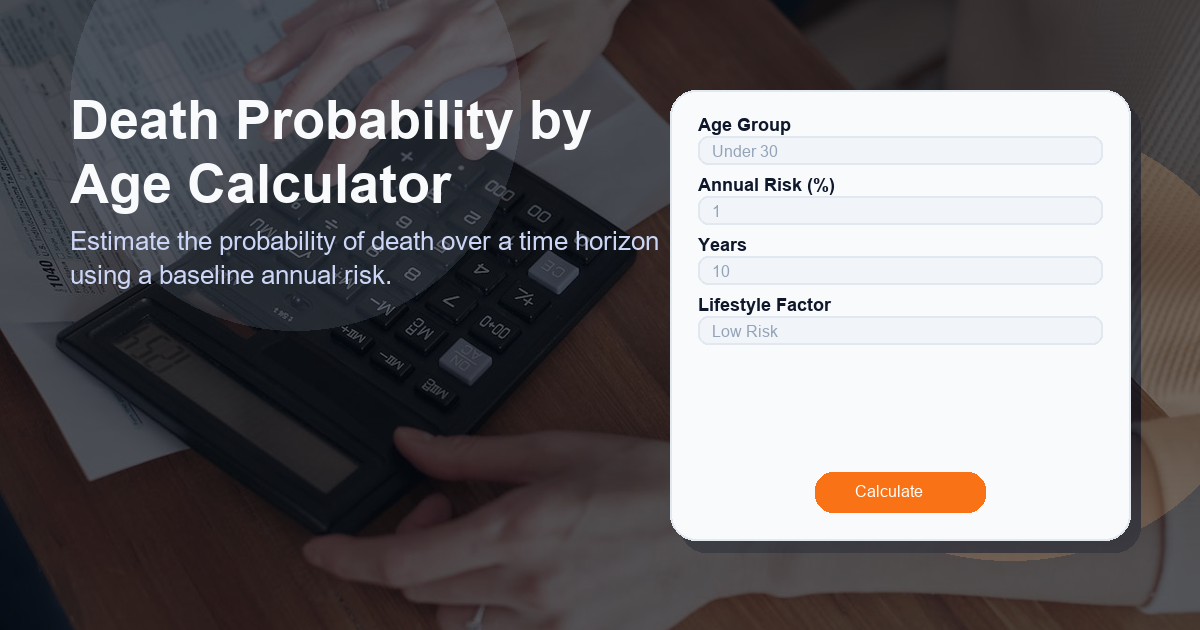
Death Probability by Age Calculator
Description: Estimate the probability of death over a time horizon using a baseline annual risk. This Death Probability by Age Calculator provides a fast, transparent way to convert an annual risk assumption into a multi-year probability of death based on age-group and lifestyle adjustments.
What this Death Probability by Age Calculator calculator does
The Death Probability by Age Calculator computes the cumulative probability that an individual will die within a specified number of years given a baseline annual risk. It adjusts that baseline risk for an age group multiplier and a lifestyle factor, then converts the adjusted annual risk into a multi-year probability using the complement of repeated survival probabilities.
This tool is helpful when you need a quick estimate for:
- Financial planning and retirement modeling
- Insurance underwriting and pricing scenarios
- Public health rough projections and risk communication
- Personal decision-making when comparing long-term choices
How to use the Death Probability by Age Calculator calculator
Using the Death Probability by Age Calculator requires four inputs. Enter values clearly and consistently (percentages vs decimals):
- Age Group: select or enter a numeric multiplier representing the relative risk of the chosen age cohort compared to a baseline. Example multipliers might be 0.5 for very young adults, 1.0 for a baseline middle-aged cohort, or higher values for older age groups.
- Annual Risk (%): the baseline percent chance of death in a single year (for the baseline group). Enter as a percent (for example, type 2 for 2%).
- Years: the time horizon in years over which you want to estimate the probability of death.
- Lifestyle Factor: a multiplier that adjusts risk up or down based on lifestyle choices (for example, 1.2 for unhealthy, 0.8 for healthy).
After you supply these inputs, the calculator applies the formula and returns the Probability of Death (as a percent) for the specified time horizon.
How the Death Probability by Age Calculator formula works
The calculator uses the following formula (JavaScript notation):
(1-Math.pow(1-(annual_risk_percent*age_group*lifestyle_factor/100),years))*100
Step-by-step explanation:
- Compute the effective annual risk by multiplying the baseline annual risk (as a percent) by the age group multiplier and the lifestyle factor, then convert that percent into a proportion: annual_risk_percent * age_group * lifestyle_factor / 100.
- Calculate the annual survival probability as 1 minus the effective annual risk.
- Raise the annual survival probability to the power of years to get the probability of surviving the entire time horizon.
- The cumulative probability of death over the time horizon is the complement of the multi-year survival probability: 1 minus the survival probability, expressed as a percent by multiplying by 100.
Why this approach? It’s a standard way to convert a repeated independent annual risk into a multi-year probability: if each year carries a constant chance of death (adjusted for age and lifestyle), the multi-year survival is the product of the yearly survival probabilities.
Example calculation:
- Annual Risk = 2%
- Age Group multiplier = 1.5 (older cohort)
- Lifestyle Factor = 1.2 (unhealthy lifestyle)
- Years = 10
Compute effective annual risk proportion: 2 * 1.5 * 1.2 / 100 = 0.036 (3.6% per year). Annual survival = 1 – 0.036 = 0.964. Ten-year survival = 0.964^10 ≈ 0.693. Therefore the 10-year Probability of Death ≈ (1 – 0.693) * 100 = 30.7%.
Use cases for the Death Probability by Age Calculator
The Death Probability by Age Calculator is suitable for a variety of practical applications. Some common use cases include:
- Retirement planning: Estimate the chance of dying within a retirement horizon to make decisions about annuities, long-term care, or withdrawal strategies.
- Insurance scenario testing: Quickly compare how changes in assumed baseline risk, age group, or lifestyle factors affect quoted probabilities used in pricing models.
- Public health communication: Present simple, understandable probabilistic estimates for outreach materials, policy briefs, or educational content.
- Research prototyping: Create rough sensitivity analyses where a complex survival model is not required or data are limited.
- Personal decisions: Use it as a rough guide when weighing lifestyle changes, medical interventions, or travel and lifestyle risks over a multi-year period.
Other factors to consider when calculating death probability
While this calculator is a useful quick estimator, several important caveats and additional factors can change real-world outcomes:
- Non-constant risk: Real annual risk often changes with age, medical events, or treatment — the calculator assumes a constant adjusted annual risk.
- Comorbidities and medical history: Specific diseases, genetic disorders, or medical treatments can increase or decrease risk beyond the simple age and lifestyle multipliers.
- Data quality: Baseline annual risk should come from reliable actuarial tables or epidemiological studies. Poor input data yield poor estimates.
- Acute events and clustering: Catastrophic or one-time risks (accidents, pandemics) do not fit the steady annual-risk assumption.
- Population vs individual risk: This approach is best for cohort-level or rough individual estimates; it does not replace personalized medical assessment.
- Behavior and interventions: Changes in lifestyle, medical advances, or access to care over the time horizon can materially alter probabilities.
FAQ
Q: What does the “Age Group” input mean?
A: The Age Group input is a numeric multiplier representing how much higher or lower an age cohort’s risk is relative to a baseline. For example, a baseline middle-aged group might use 1.0, while older groups use values greater than 1. These multipliers can be taken from actuarial tables or chosen for scenario analysis.
Q: Can I enter annual risk as a decimal instead of a percent?
A: The calculator expects Annual Risk (%) as a percent (enter 2 for 2%). If you enter a decimal like 0.02, the result will be incorrect unless you convert it to percent first. Always check the input format.
Q: Does the formula account for changing risk over time?
A: No. The formula assumes a constant effective annual risk across the entire time horizon. If risk changes with age or due to events, use a year-by-year survival model instead of this single-rate approximation.
Q: How should I choose a lifestyle factor?
A: The Lifestyle Factor is a relative multiplier that captures the effect of behaviors such as smoking, exercise, diet, and substance use. Common practice is to use values less than 1.0 for protective lifestyles (e.g., 0.8) and greater than 1.0 for higher-risk lifestyles (e.g., 1.2). Use evidence-based adjustments where possible.
Q: Is this calculator suitable for legal or clinical decisions?
A: Use caution. The Death Probability by Age Calculator is an illustrative tool for planning and scenario analysis. It is not a substitute for professional actuarial, legal, or medical advice tailored to an individual’s full clinical profile.
Final note: The Death Probability by Age Calculator offers a transparent and easy-to-understand method for converting annual risk assumptions into multi-year probabilities. Always verify inputs and consider more detailed modeling when precision is required.