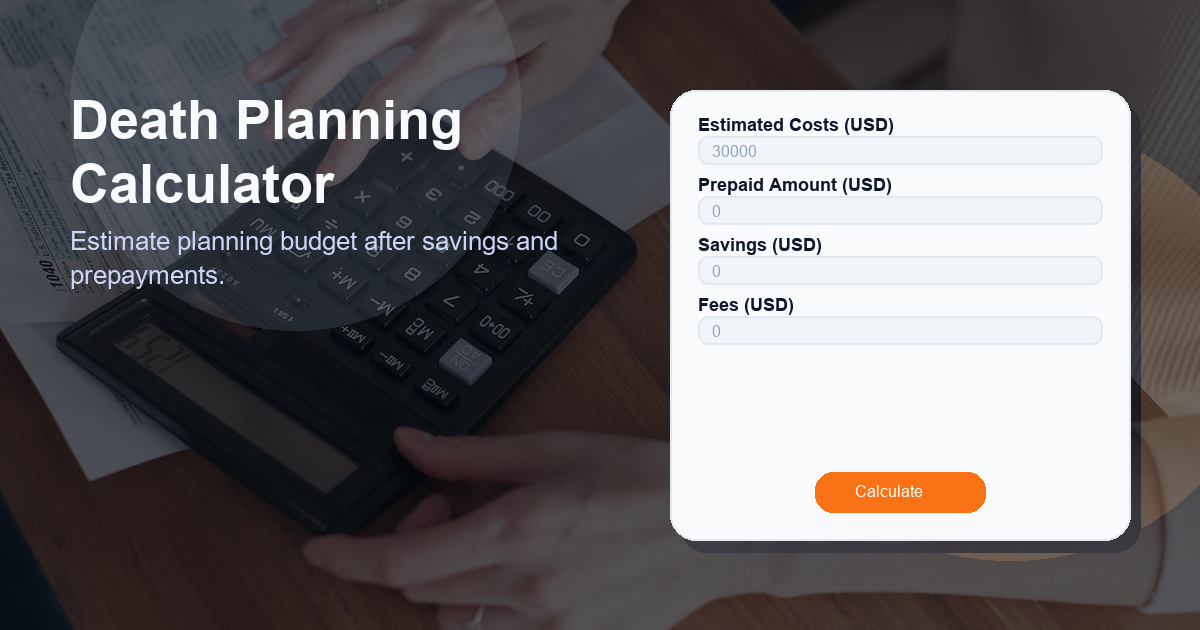
Death Planning Calculator
What this Death Planning Calculator calculator does
The Death Planning Calculator helps you estimate the budget needed to cover end-of-life planning after accounting for amounts you have already saved or prepaid. This tool is designed to give a clear, fast estimate of the Remaining Planning Amount you may need to fund funeral, burial, legal, and administrative costs.
Use this calculator when you want a straightforward budget snapshot. It subtracts your prepayments and savings from your estimated total costs, then adds any expected administrative or service fees. The result tells you what remains to be funded so you can make practical decisions about insurance, savings, or payment plans.
How to use the Death Planning Calculator calculator
To use the Death Planning Calculator, collect four numbers and plug them into the formula. You don’t need advanced financial knowledge. Here are the inputs explained:
- Estimated Costs (USD) — The total projected cost for all services and obligations related to the plan (e.g., funeral, burial/cremation, memorial, attorney fees).
- Prepaid Amount (USD) — Money already paid in advance (prepaid funeral plan, pre-need insurance, or deposits).
- Savings (USD) — Cash set aside in savings accounts specifically earmarked for planning costs.
- Fees (USD) — Additional fees you expect to pay (service charges, administrative fees, probate fees, or cemetery costs not included in estimated costs).
Example step-by-step:
- Step 1: Enter your Estimated Costs. For example, $12,000.
- Step 2: Enter your Prepaid Amount. For example, $3,000.
- Step 3: Enter your Savings. For example, $2,500.
- Step 4: Enter Fees. For example, $800.
- Step 5: Apply the formula (see next section) to obtain the Remaining Planning Amount.
How the Death Planning Calculator formula works
The Death Planning Calculator uses a simple arithmetic formula to produce the Remaining Planning Amount. The formula is:
Formula: estimated_costs – prepaid_amount – savings + fees
Breaking the formula down:
- estimated_costs: Start with the total expected expense.
- – prepaid_amount: Subtract any amounts already paid. Prepayments reduce what you still owe.
- – savings: Subtract designated savings set aside for the plan.
- + fees: Add any additional fees that increase the final required amount.
Example calculation with the numbers above:
- Estimated Costs = $12,000
- Prepaid Amount = $3,000
- Savings = $2,500
- Fees = $800
Calculation: $12,000 – $3,000 – $2,500 + $800 = $7,300
Result label: Remaining Planning Amount = $7,300
This final number is what you would need to cover the plan beyond your prepaid and saved money, adjusted for fees.
Use cases for the Death Planning Calculator
The Death Planning Calculator is useful in many real-world scenarios. Typical use cases include:
- Estate planning meetings: Professionals and clients can quickly determine shortfalls when deciding how much life insurance or savings is required.
- Comparing prepayment options: Evaluate whether a prepaid funeral plan actually reduces future financial burden.
- Budgeting for family members: Families can see how much they’ll need to set aside or raise through crowdfunding, insurance, or savings.
- Nonprofit and community planning: Organizations planning group services can estimate remaining costs per person after deposits and grants.
- Financial checkups: Individuals doing an annual review of their end-of-life finances can track whether they are on target.
Because it uses a clear, transparent formula, the Death Planning Calculator is suitable for quick estimates and high-level planning. For complex estates or tax-sensitive situations, combine the calculator with professional advice.
Other factors to consider when calculating death planning
The Remaining Planning Amount is a practical baseline, but it doesn’t capture every nuance. Here are additional factors to consider before finalizing a plan:
- Inflation: Cost estimates may rise over time. If death planning is for the distant future, adjust estimates upward to account for inflation.
- Hidden fees and taxes: Local taxes, probate costs, and transfer fees can increase the final outlay beyond initial fee estimates.
- Service upgrades: Families sometimes upgrade services in the moment; build a buffer rather than an exact match to avoid shortfalls.
- Insurance timing: If you plan to rely on life insurance, confirm the policy’s payout timing and any contestability periods that could affect availability.
- Liquidity: Savings may be tied up in accounts that aren’t immediately accessible; consider whether funds are liquid enough to meet planning needs.
- Legal changes: Regulations around estates, wills, and end-of-life services may change; keep plans regularly updated.
- Emotional choices: Emotional decisions can influence spending; discuss preferences with family in advance to align expectations.
Consider keeping a contingency of 10–20% on top of your Remaining Planning Amount to account for unexpected expenses. Doing so reduces stress and avoids last-minute financial gaps.
FAQ
1. What does the Death Planning Calculator actually calculate?
It calculates the Remaining Planning Amount you need by applying the formula estimated_costs – prepaid_amount – savings + fees. The result shows the shortfall (or surplus if negative) after accounting for prepayments and savings.
2. Can this calculator handle negative results?
Yes. A negative Remaining Planning Amount means your prepayments and savings exceed the estimated costs plus fees, indicating a surplus. You may then reallocate or reduce planned insurance contributions.
3. Should I include taxes and probate fees in the fees input?
Yes. Include all foreseeable charges in the Fees (USD) input—such as probate fees, administrative charges, and local taxes—to make the estimate realistic.
4. How often should I update my inputs?
Review and update inputs annually or whenever significant changes occur (e.g., a prepaid plan purchase, large new savings, or major change in funeral service costs).
5. Is this calculator a substitute for professional advice?
No. The Death Planning Calculator is a practical budgeting tool for estimates. For tax planning, estate law, or complex financial decisions, consult an attorney, financial planner, or tax professional.