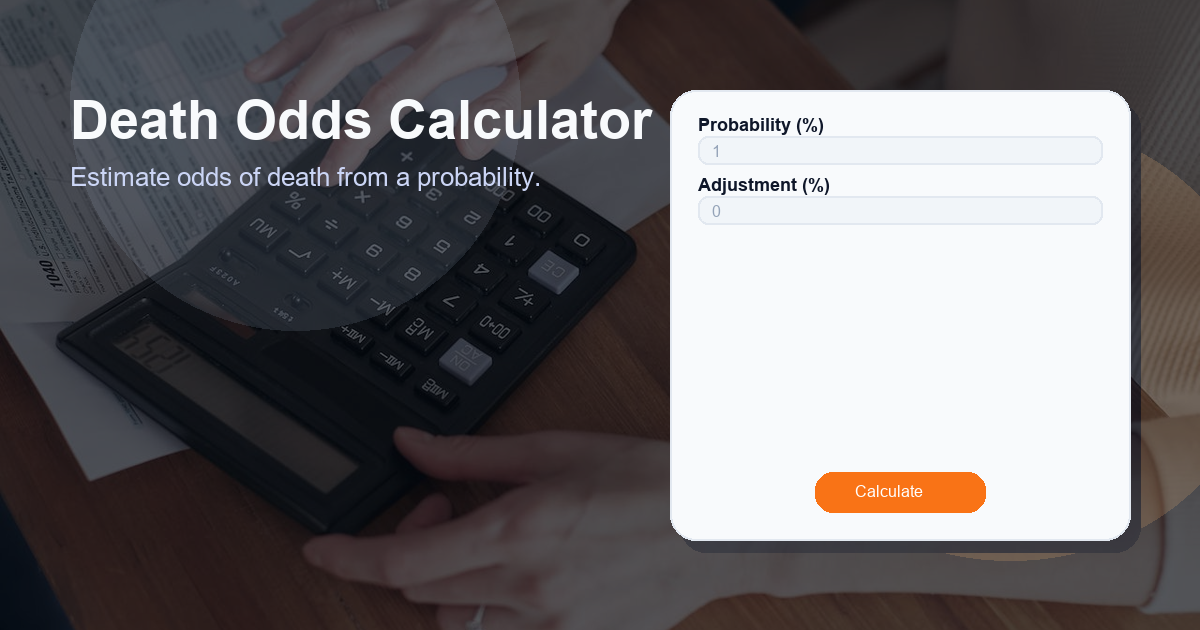
Death Odds Calculator
Estimate the odds of death from a given probability quickly and clearly with this Death Odds Calculator. Enter a risk expressed as a percentage, optionally add an adjustment percentage (to reflect increased risk, measurement error, or context-specific modifiers), and see the odds expressed as Odds (1 in X).
What this Death Odds Calculator calculator does
The Death Odds Calculator converts a percentage probability of death into an odds ratio using a standard statistical formula. It:
- Takes a probability in percent (for example, 5% chance).
- Accepts an adjustment percent to increase or decrease that probability (for example, +1% for a comorbidity, or -0.5% to account for protective factors).
- Calculates odds using the formula:
(probability_percent + adjustment) / (100 - (probability_percent + adjustment)). - Displays the result as Odds (1 in X) so the probability is easier to interpret for decision-making or communication.
This tool is designed for quick conversions and teaching; it is not a substitute for professional medical, actuarial, or statistical advice. Always consult experts when making consequential decisions.
How to use the Death Odds Calculator calculator
Using the Death Odds Calculator is simple and intuitive. Follow these steps:
- Enter the base probability (Probability (%)). This is the estimated chance of death in percentage form. Example: 2.5 for 2.5%.
- Enter an adjustment (Adjustment (%)). Use a positive value to increase the probability or a negative value to decrease it. Example: 0.5 or -0.5.
- Click Calculate — the calculator will apply the formula and return:
- The raw odds ratio computed by
(probability_percent + adjustment) / (100 - (probability_percent + adjustment)). - The friendly “Odds (1 in X)” format so you can read the result as “1 in X” chance.
- Interpret the output. A result such as Odds (1 in 40) means that, on average, one death is expected in every 40 similar exposures given the adjusted probability.
Example: If Probability (%) = 5 and Adjustment (%) = 1, then adjusted percent = 6. The formula gives (6)/(94) = 0.063829…, or odds of about 1 in 15.67. The calculator will report both the odds ratio and the rounded “1 in X” value.
How the Death Odds Calculator formula works
The core formula used by the Death Odds Calculator is:
(probability_percent + adjustment) / (100 - (probability_percent + adjustment))Here’s how to interpret and use this formula step-by-step:
- Convert percentages to a comparable ratio: If you have a percentage chance of death, say P%, and you apply an Adjustment A%, the adjusted percentage is (P + A).
- Compute odds: Odds are the ratio of the probability that the event (death) occurs to the probability that it does not occur. With percentages, that’s (P + A) divided by (100 – (P + A)).
- Convert to “1 in X”: The formula above yields the odds as a ratio (for example, 0.05 / 0.95 = 0.05263). To phrase this as “1 in X”, invert that ratio: X = (100 – (P + A)) / (P + A). In the example, X ≈ 19. So 0.05 probability = roughly 1 in 19 odds.
Why this matters: Percentages can be intuitive but sometimes obscure the balance between event and non-event. Odds make clearer how rare or common an outcome is relative to its complement. The Death Odds Calculator automates this conversion and shows both views for clarity.
Use cases for the Death Odds Calculator
The Death Odds Calculator is useful in many practical and educational contexts. Common use cases include:
- Public health communications: Converting mortality probabilities into odds can help the public understand risk in an intuitive “1 in X” format.
- Clinical decision-making: Clinicians and patients sometimes compare risks expressed as odds rather than raw percentages when discussing treatment trade-offs.
- Risk modeling and scenario analysis: Analysts can quickly test how adjustments (e.g., comorbidities, interventions) affect the odds of death.
- Insurance and actuarial estimates: Actuaries often convert between probability and odds when setting premiums or reserves.
- Education and training: Teachers and students can use the Death Odds Calculator to learn the difference between probability and odds.
By making translation between percent probability and odds straightforward, the calculator supports better communication and more informed decisions across disciplines.
Other factors to consider when calculating x
When you use the Death Odds Calculator and compute “1 in X” values, keep several important caveats in mind:
- Quality of input data: The calculator is only as good as the probability and adjustment you enter. Garbage in, garbage out—use reliable, well-sourced probabilities.
- Understanding adjustment values: Adjustments should reflect realistic, evidence-based modifiers (age, comorbidities, exposure level). Arbitrary adjustments can lead to misleading odds.
- Small percentages and rounding: For very small probabilities, rounding can dramatically change the “1 in X” presentation. Consider using more decimal places when precision matters.
- Time horizon and conditionality: Is the probability annual, lifetime, per-exposure? Odds vary with time and context—ensure the time frame is consistent.
- Population vs. individual risk: Population-level probabilities may not translate directly to an individual’s risk due to heterogeneity in exposure and susceptibility.
- Uncertainty and confidence intervals: The single value produced by this calculator does not show uncertainty. When possible, pair point estimates with confidence intervals or scenario ranges.
Always treat “1 in X” results as approximations and use them alongside other evidence and professional judgement.
Frequently Asked Questions (FAQ)
Q: What is the difference between probability and odds?
A: Probability is the chance an event occurs out of all possibilities (expressed as a percentage). Odds compare the chance the event happens to the chance it does not. The Death Odds Calculator converts the percentage into a ratio using the formula above.
Q: How should I choose the Adjustment (%) value?
A: Use an adjustment to reflect known modifiers — for example, higher risk due to a comorbidity, or reduced risk due to vaccination. Adjustments should be evidence-based whenever possible and carefully documented.
Q: Can the calculator handle negative adjustments?
A: Yes. A negative Adjustment (%) lowers the base probability. Ensure the adjusted percentage remains between 0 and 100. Values outside that range are invalid and will produce nonsensical odds.
Q: Is “1 in X” the same as a percentage?
A: They express the same information in different forms. “1 in X” emphasizes rarity or frequency (for example, 1 in 20 ≈ 5%), while percentage gives a direct proportion. Convert between them using the formulas provided.
Q: Can this tool predict individual outcomes?
A: No. The Death Odds Calculator provides a statistical conversion based on supplied probabilities. It does not account for unique individual characteristics unless those are accurately reflected in the probability and adjustment you enter.
Interactive Death Odds Calculator