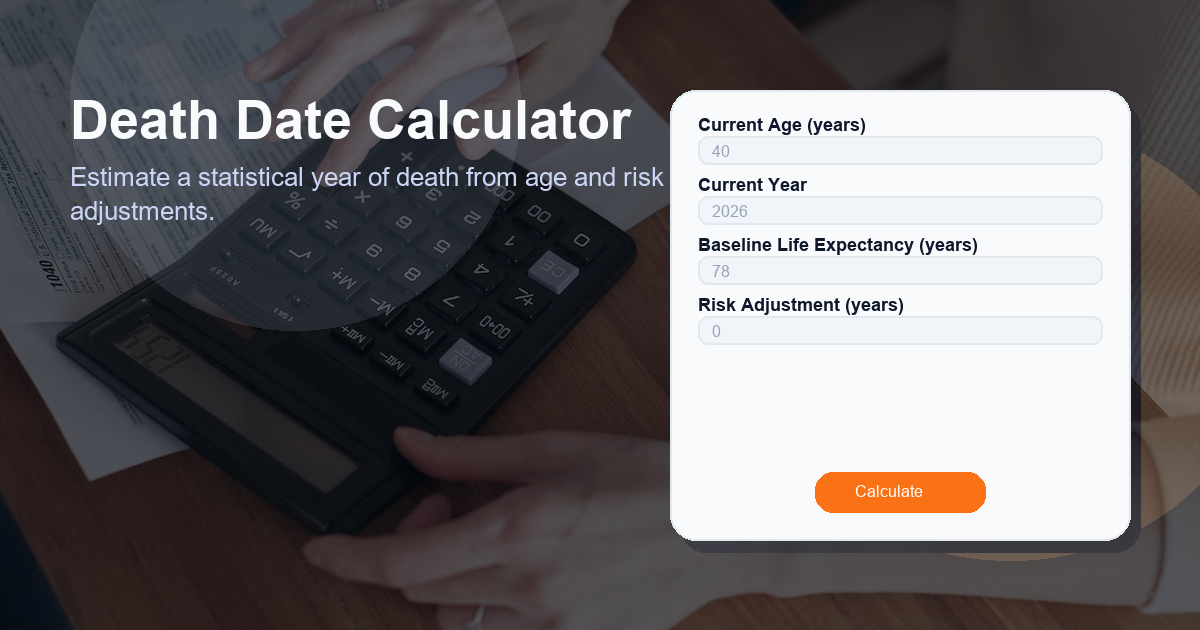
Death Date Calculator
The Death Date Calculator is a simple, transparent tool to estimate a statistical year of death using your current age, an agreed baseline life expectancy, and adjustments for risk. This calculator is not a prediction of an individual’s destiny; rather, it provides a straightforward, reproducible estimate based on the inputs you provide. Use it for planning, research, or as an illustrative tool in conversations about life expectancy, retirement planning, and risk management.
What this Death Date Calculator calculator does
This Death Date Calculator computes an estimated year of death by combining four user-provided values into a single arithmetic formula. It translates a person’s current age and a baseline life expectancy into a calendar year that represents the statistically expected time of death, after applying a positive or negative risk adjustment.
Key features:
- Deterministic formula: No randomness — the same inputs always give the same result.
- Transparent inputs: You control the baseline life expectancy and any risk adjustment.
- Quick results: The calculator returns an Estimated Year of Death with a simple calculation.
- Use for planning: Helpful for high-level financial, healthcare, or personal planning scenarios.
How to use the Death Date Calculator calculator
Using the Death Date Calculator is straightforward. Collect these four inputs, then apply the formula shown in the next section.
- Current Age (years): Your present age in whole years (or a decimal if you prefer more precision).
- Current Year: The calendar year today (e.g., 2026).
- Baseline Life Expectancy (years): A reference life expectancy—this can come from national statistics, actuarial tables, or a personal estimate (e.g., 82 years).
- Risk Adjustment (years): Positive or negative years to adjust the baseline expectancy based on personal health, behavior, or other risk factors (e.g., -5 for higher risk, +3 for lower risk).
Step-by-step:
- Enter your Current Age and the Current Year.
- Choose a Baseline Life Expectancy that fits your reference (national average, actuarial table, or personal target).
- Decide on a Risk Adjustment to reflect lifestyle, family history, medical conditions, or other factors.
- Apply the formula to compute the Estimated Year of Death.
How the Death Date Calculator formula works
The formula is deliberately simple and easy to follow. It converts a life-expectancy figure into a calendar year by offsetting the current age against the adjusted expectancy:
Formula: current_year + (base_expectancy + risk_adjustment – current_age)
Breaking down the formula:
- base_expectancy — the baseline life expectancy in years.
- risk_adjustment — an integer or decimal number of years added to (or subtracted from) the baseline to reflect personal risk factors.
- current_age — the person’s present age in years.
- The quantity (base_expectancy + risk_adjustment – current_age) represents the remaining years until the expected end-of-life based on the adjusted expectancy.
- Adding that remaining time to the current_year yields the Estimated Year of Death.
Example:
- Current Age = 45
- Current Year = 2026
- Baseline Life Expectancy = 82
- Risk Adjustment = -3 (higher risk)
Calculation: 2026 + (82 + (-3) – 45) = 2026 + (79 – 45) = 2026 + 34 = 2060.
Result label displayed by the calculator: Estimated Year of Death.
Use cases for the Death Date Calculator
The Death Date Calculator can be employed in multiple contexts, especially where a simple, transparent estimate of expected end-of-life year is useful:
- Retirement planning: Estimate how many years remain to allocate savings, pensions, and insurance coverage.
- Estate planning: Create timelines for wills, trusts, and legacy planning based on an expected horizon.
- Healthcare and lifestyle decisions: Visualize the impact of risk adjustments (e.g., smoking cessation, weight loss, chronic disease management) on expected timeline.
- Teaching and research: Demonstrate how actuarial life expectancy converts to calendar years in classes or reports.
- Personal curiosity: Provide a clear, reproducible result for conversation or introspection.
Because the tool is simple and transparent, it is especially useful when you want to show how specific changes to risk assumptions directly change the estimated year without hidden model complexity.
Other factors to consider when calculating death date
While the Death Date Calculator is useful for high-level estimates, remember that actual lifespan depends on many variables not captured by a single number. Consider these additional factors:
- Genetics: Family history can strongly influence life expectancy but is hard to quantify precisely in years without detailed medical knowledge.
- Medical conditions: Chronic diseases, mental health, and recent diagnoses may change risk trajectories dramatically.
- Socioeconomic factors: Income, education, access to healthcare, and environment affect longevity.
- Lifestyle behaviors: Diet, exercise, smoking, alcohol use, and stress management are important and may be considered in the Risk Adjustment, but translating them into years requires expert judgment.
- Advances in medicine: Future medical breakthroughs can extend life beyond current actuarial expectations.
- Statistical uncertainty: This calculator does not provide confidence intervals, survival curves, or probability distributions — it gives a single estimated year only.
Use the calculator as a guide, not a guarantee. For individualized medical or financial advice, consult qualified professionals who can incorporate a complete risk profile and provide tailored recommendations.
Frequently Asked Questions
Q: Is the Death Date Calculator accurate for predicting an individual’s date of death?
A: No. The Death Date Calculator provides a statistical, single-value estimate based on simple arithmetic. It is not a medical or forensic predictor and cannot account for all individual variability or future changes.
Q: How should I choose the Baseline Life Expectancy and Risk Adjustment?
A: Use reputable sources for baseline life expectancy (national statistics, actuarial tables). For risk adjustment, consider adding or subtracting years based on known health factors, but be conservative — small changes in the adjustment can shift the estimated year significantly.
Q: Can the Risk Adjustment be a decimal (non-integer) number?
A: Yes. The formula accepts integer or decimal values for Risk Adjustment, allowing you to fine-tune the estimate to fractions of a year if desired.
Q: Does the calculator consider future improvements in healthcare that might extend life expectancy?
A: Not automatically. If you expect medical advances to materially affect your lifespan, you should reflect that expectation by increasing the Baseline Life Expectancy or adding a positive Risk Adjustment.
Q: Can I use this calculator for populations or only individuals?
A: The formula works for both, but for populations you’ll generally want to work with averages and include uncertainty measures. This tool is best for illustrative, individual-level estimates rather than rigorous population epidemiology.
Disclaimer: The Death Date Calculator is for informational and planning purposes only. It is not a substitute for professional medical, actuarial, or financial advice.