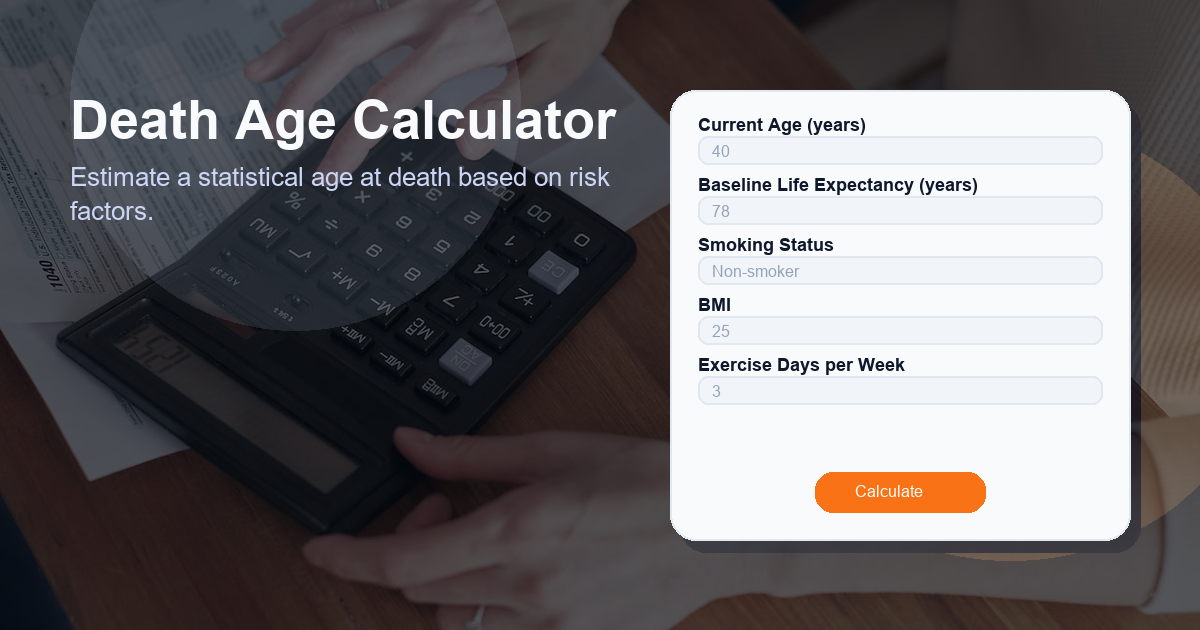
Death Age Calculator
Description: Estimate a statistical age at death based on risk factors. The Death Age Calculator provides a simple, transparent way to adjust a baseline life expectancy using common lifestyle and biometric inputs. This calculator is intended for general informational use and is not a clinical or medical prediction tool.
What this Death Age Calculator calculator does
The Death Age Calculator produces an estimated age at death (the Estimated Age at Death) by starting from a user-supplied baseline life expectancy and applying adjustments for:
- Exercise frequency (days per week)
- BMI (body mass index)
- Smoking status
The result is a single number representing a statistical estimate of the age at which someone with the given characteristics might be expected to die. The calculator also accepts a Current Age input so you can view remaining years of life implied by the estimate (Estimated Age at Death minus Current Age).
How to use the Death Age Calculator calculator
Using this Death Age Calculator is straightforward. Provide the following inputs:
- Current Age (years) — your present age in years.
- Baseline Life Expectancy (years) — a population or personal baseline expectation (for example, national life expectancy or a clinician-provided estimate). Enter this as an age (e.g., 82).
- Smoking Status — choose among Never smoker, Former smoker, or Current smoker. The calculator maps these to a numeric smoker_factor.
- BMI — your body mass index (weight in kg / height in m²).
- Exercise Days per Week — how many days per week you do moderate or vigorous exercise.
After entering the inputs, the calculator applies a simple formula and returns the Estimated Age at Death. It will also show the implied years remaining from your current age. If the estimated death age is less than the current age, the calculator flags that result as inconsistent and suggests reviewing inputs.
How the Death Age Calculator formula works
The Death Age Calculator uses the following transparent formula:
Estimated Age at Death = base_expectancy + (exercise_days – 3) * 0.3 – (bmi – 25) * 0.2 – smoker_factor
Explanation of terms:
- base_expectancy — the Baseline Life Expectancy input (an age in years).
- exercise_days — number of exercise days per week. The formula uses 3 days/week as a neutral reference point; each day above or below shifts the estimate by 0.3 years (about 3.6 months).
- bmi — body mass index. The formula uses 25 as the reference BMI; each point above 25 reduces estimated lifespan by 0.2 years (about 2.4 months), and each point below 25 increases it by 0.2 years.
- smoker_factor — a simple numeric penalty based on Smoking Status. For example (this mapping is illustrative and can be adjusted):
- Never smoker: smoker_factor = 0
- Former smoker: smoker_factor = 2
- Current smoker: smoker_factor = 6
Notes on the math:
- Exercise has a modest but positive effect: each additional active day beyond three adds roughly 0.3 years to the estimate.
- BMI is treated linearly relative to 25. A BMI of 30 would reduce the estimate by (30-25)*0.2 = 1.0 year.
- Smoking carries the largest single penalty in this simple model; a current smoker receives a substantial reduction via the smoker_factor.
Example calculation:
- Current Age: 45
- Baseline Life Expectancy: 82
- Exercise Days per Week: 2 -> (2 – 3) * 0.3 = -0.3
- BMI: 28 -> – (28 – 25) * 0.2 = -0.6
- Smoking Status: Current smoker -> smoker_factor = 6
Estimated Age at Death = 82 – 0.3 – 0.6 – 6 = 74.9 years.
Implied remaining years = 74.9 – 45 = 29.9 years.
Use cases for the Death Age Calculator
The Death Age Calculator is useful for several non-clinical purposes:
- Personal planning: Understand how lifestyle adjustments (more exercise, weight loss, smoking cessation) could change a simple statistical estimate.
- Health education: Demonstrate the relative impact of exercise, BMI, and smoking on expected lifespan in an accessible way.
- Risk communication: Help people compare the effect sizes of behaviors (e.g., how much 1 extra exercise day compares to a 1-point BMI change).
- Financial planning: Roughly estimate remaining years for retirement or insurance planning with the caveat that this is a simplified model.
Other factors to consider when calculating death age
While the Death Age Calculator captures a few major lifestyle factors, many other variables influence longevity. Consider the following additional factors before drawing strong conclusions:
- Genetics: Family history and inherited conditions can significantly shift life expectancy in either direction.
- Medical conditions: Chronic illnesses (diabetes, heart disease, cancer, etc.) are powerful determinants of mortality risk.
- Socioeconomic factors: Access to healthcare, income, education, and environment matter.
- Mental health and stress: Long-term stress, depression, and social isolation can negatively affect longevity.
- Other behaviors: Alcohol use, diet quality, sleep, seat belt use, and occupational hazards are not included but are important.
Because of these omissions and simplifications, treat the calculator as a high-level, educational tool rather than a precise medical instrument. Always consult healthcare professionals for personalized assessments and medical advice.
FAQ
Is the Death Age Calculator medically accurate?
No. This calculator is a simplified, statistical tool meant for informational and educational purposes. It is not a substitute for medical evaluation. It does not account for many clinical, genetic, and environmental factors that influence real-world outcomes.
How should I choose Baseline Life Expectancy?
Baseline Life Expectancy should be an age-based starting point—commonly the national life expectancy or an estimate provided by a health professional. For example, if national life expectancy is 82 years, enter 82. The calculator then adjusts that baseline for selected risk factors.
What does the smoker_factor represent?
The smoker_factor is a numeric penalty applied for smoking status. Typical example values in this model are: 0 for never smokers, 2 for former smokers, and 6 for current smokers. These values are illustrative and intended to show the relative impact of smoking versus other factors.
Can this calculator show how quitting smoking will change my estimate?
Yes. To simulate quitting, compare the Estimated Age at Death with Smoking Status set to Current smoker versus Former smoker or Never smoker. The difference shows the change in the simplified statistical estimate.
What if the estimated age is less than my current age?
If the result is lower than your current age, review the inputs for errors (for example, an unusually low baseline expectancy or very high smoker_factor). The model is simplified; a result below current age suggests inconsistency and the need for professional assessment.
Final note: The Death Age Calculator is useful for exploring the relative effects of common lifestyle factors. Use it to inform conversations about health and planning, but not as a definitive prediction of individual lifespan.