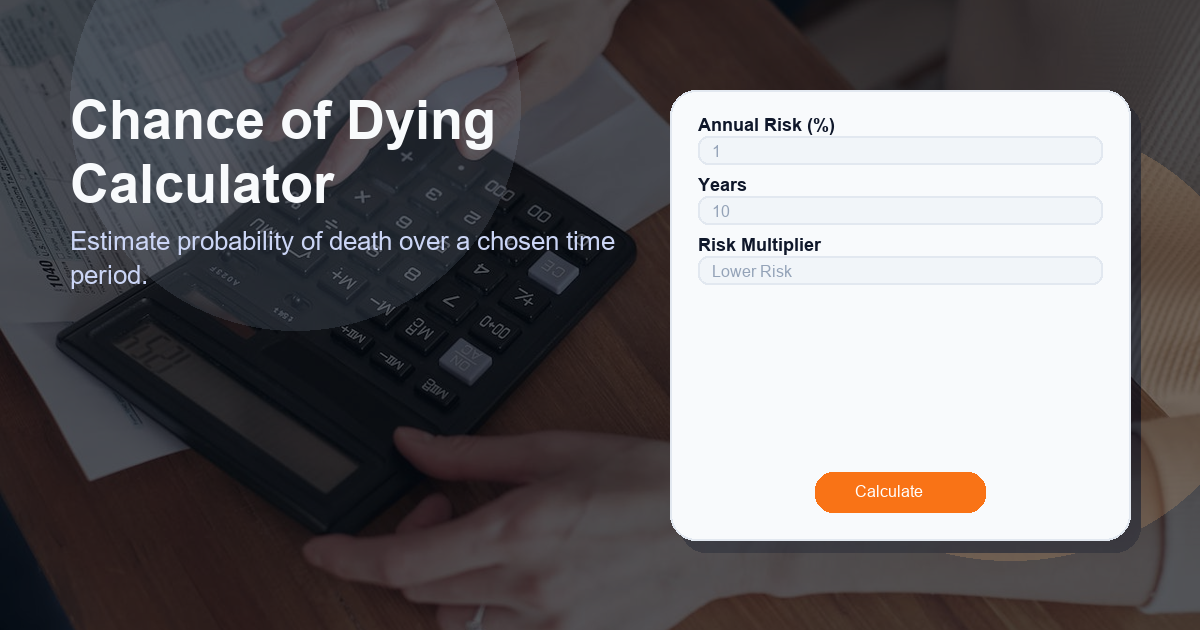
Chance of Dying Calculator
Description: Estimate probability of death over a chosen time period using a simple, easy-to-understand mathematical model. This Chance of Dying Calculator converts an annual risk (%), the number of years you want to project, and an optional risk multiplier into a single cumulative probability: the Chance of Dying over that period.
What this Chance of Dying Calculator does
The Chance of Dying Calculator computes the cumulative probability of death over a specified number of years, given a constant annual risk (expressed as a percentage) and an optional risk multiplier that scales that annual risk up or down. It is intended to provide a quick, transparent estimate rather than a definitive actuarial life-table projection.
Key outcomes produced by the calculator:
- Chance of Dying — the estimated cumulative probability (in percent) of dying during the chosen period.
- Simple sensitivity: change the Annual Risk (%) or Risk Multiplier to see how the cumulative risk reacts over time.
How to use the Chance of Dying Calculator
Using the calculator is straightforward. Provide three inputs and read the single output.
- Annual Risk (%): Enter the baseline probability of death in one year, expressed as a percentage (for example, 0.5 for 0.5% per year).
- Years: Enter the number of years you want to project (for example, 10 or 30).
- Risk Multiplier: Enter a multiplier to scale the annual risk (for example, 1 for no change, 1.5 for a 50% higher risk, 0.8 for a 20% lower risk).
After entering values, the calculator returns the Chance of Dying over the chosen period as a percentage. Example steps:
- Set Annual Risk (%) = 0.5 (meaning 0.5% chance per year).
- Set Years = 20.
- Set Risk Multiplier = 1 (no change).
- Read the result labeled Chance of Dying (the cumulative percent chance across 20 years).
How the Chance of Dying Calculator formula works
The calculator uses a standard complement-of-survival approach. If the probability of death in a single year is p (as a decimal), then the probability of surviving that year is (1 − p). If the annual risk is assumed constant and independent each year, the probability of surviving N years is (1 − p)^N. Therefore, the probability of dying at least once in N years is 1 minus the survival probability.
The specific formula implemented by the calculator is:
(1 - Math.pow(1 - (annual_risk_percent * risk_multiplier / 100), years)) * 100Where:
- annual_risk_percent is the annual risk entered as a percent (e.g., 0.5 for 0.5%).
- risk_multiplier scales that percent (e.g., 1.2 increases it by 20%).
- years is the projection horizon.
Example calculation (step-by-step):
- Annual Risk (%) = 0.5 → as a decimal p = 0.005
- Risk Multiplier = 1 → adjusted p = 0.005 × 1 = 0.005
- Years = 20
- Survival over 20 years = (1 − 0.005)^20 ≈ 0.9059
- Chance of Dying = (1 − 0.9059) × 100 ≈ 9.41%
This output (reported as Chance of Dying) is a cumulative probability that at least one fatal event occurs in the chosen timeframe, under the calculator’s assumptions.
Use cases for the Chance of Dying Calculator
The Chance of Dying Calculator is suitable for a variety of practical uses where a simple, transparent risk projection is helpful:
- Personal planning: Estimating long-term mortality risk for lifestyle choices, travel, or health interventions.
- Insurance and finance: Quick checks to compare how different annual risks affect long-term probabilities for term life discussions or simple planning scenarios.
- Workplace safety: Estimating cumulative fatality risk in hazardous occupations when annual fatality rates are known.
- Public health communication: Demonstrating how even small annual risks can accumulate over years to non-negligible chances.
- Sensitivity analysis: Exploring how increasing or decreasing risks (via the risk multiplier) affect long-term outcomes.
Other factors to consider when calculating Chance of Dying
While useful for quick estimates, this calculator relies on simplifying assumptions. Keep the following considerations in mind:
- Constant annual risk assumption: The formula assumes the same probability each year. Real-world risk often varies by age, treatment, environment, or time.
- Independence of years: The model treats each year as an independent event. Some conditions change risk dynamically (e.g., progressive illness or recovery).
- Competing risks: The calculator computes the chance of dying from any cause; it doesn’t model cause-specific competing risks or multiple event types with different dynamics.
- Data quality: The accuracy depends on how well the input annual risk reflects reality. Use reliable sources (epidemiological studies, actuarial tables) where possible.
- Population differences: Age, sex, comorbidities, and regional factors can greatly change true annual risk relative to a generic percentage.
- Small probabilities and rounding: For very low annual risks and long horizons, numerical precision and rounding can affect readability; consider expressing results with an appropriate number of decimal places.
- Confidence intervals: The calculator gives a point estimate only. For formal analysis, compute confidence intervals or use stochastic simulations (Monte Carlo) to capture uncertainty.
Best practice: use this calculator for initial exploration and sensitivity checks, and consult actuarial tables, epidemiological models, or a qualified professional for high-stakes decisions.
FAQ
Q: What does the Risk Multiplier do?
A: The Risk Multiplier scales the input annual risk. A multiplier of 1 leaves the annual risk unchanged. A multiplier greater than 1 increases the risk (e.g., 1.5 raises it by 50%), while a multiplier less than 1 reduces it (e.g., 0.8 reduces it by 20%). It’s useful for “what-if” scenarios.
Q: Is the calculator accurate for long lifetimes (e.g., 50+ years)?
A: The calculator provides an arithmetic projection assuming constant annual risk. For very long horizons, real-world risk often changes (age-related mortality, medical advances), so results become less realistic the farther you project. Use caution and treat long-term outputs as illustrative.
Q: Can I use this for cause-specific mortality (e.g., risk of dying from a particular disease)?
A: Yes, if you can supply an annual risk specifically for that cause. However, cause-specific risks may interact with other risks, so interpreting the result as the exclusive chance of dying from that cause requires careful consideration of competing risks.
Q: Why is the result not simply annual risk times years?
A: Multiplying annual risk by the number of years treats events as additive and can overestimate risk when probabilities are not tiny. The calculator uses the complement-of-survival approach, which correctly accounts for the decreasing pool of survivors each year and avoids double-counting overlapping probabilities.
Q: Where should I get a reliable annual risk estimate?
A: Use life tables, published epidemiological data, government statistics, or insurance actuarial tables for reliable baseline annual risk figures. For individual risk, clinical assessments and professional guidance are recommended.
If you need help selecting inputs or interpreting results for a particular scenario, provide the annual risk, years, and any modifiers and we can walk through an example together.