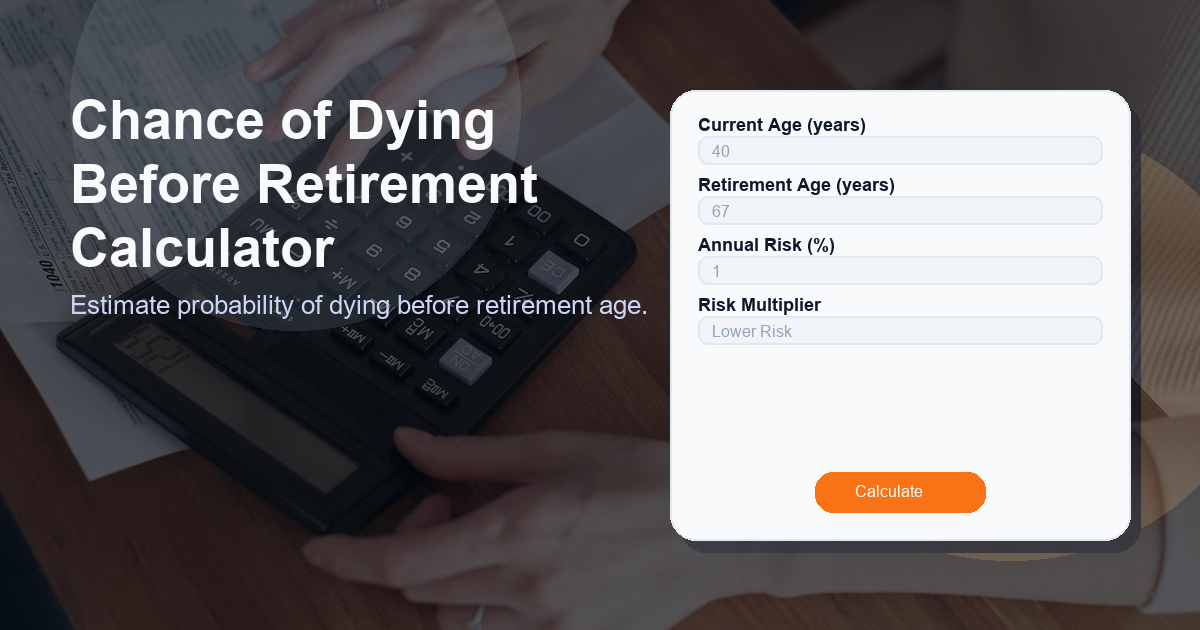
Chance of Dying Before Retirement Calculator
Description: Estimate probability of dying before retirement age with the Chance of Dying Before Retirement Calculator. This tool provides a simple probabilistic estimate based on current age, planned retirement age, an annual risk percentage, and an adjustable risk multiplier.
What this Chance of Dying Before Retirement Calculator calculator does
The Chance of Dying Before Retirement Calculator estimates the probability that a person will die before reaching their planned retirement age. It takes four inputs:
- Current Age (years) — your current age in full years.
- Retirement Age (years) — the age at which you plan or expect to retire.
- Annual Risk (%) — an estimated annual probability of death expressed as a percentage (for example, 0.5 for 0.5%).
- Risk Multiplier — a scaling factor to increase or decrease the annual risk to reflect personal health, occupation, lifestyle, or other considerations.
After you provide these inputs, the calculator outputs the Chance of Dying Before Retirement as a percentage. This is a statistical approximation intended to help with planning and risk awareness — not a medical prognosis.
How to use the Chance of Dying Before Retirement Calculator calculator
Using the calculator is straightforward. Follow these steps to get a meaningful estimate:
- Enter your current age in years. Use whole numbers (for example, 35).
- Enter your retirement age in years. This should be greater than or equal to your current age; if not, the calculator treats the remaining years as zero.
- Provide an annual risk percentage. This is an estimate of the year-over-year chance of death. Use population life tables, insurance quotes, or medical guidance to choose a reasonable number. For example, a 0.5% annual risk would be entered as 0.5.
- Set a risk multiplier to reflect personal factors. Use numbers like 1.0 (no change), 1.5 (50% higher risk), or 0.8 (20% lower risk).
- Read the output labeled Chance of Dying Before Retirement, shown as a percentage value representing the cumulative probability from now until your planned retirement age.
Example: If you are 40, plan to retire at 65, have an annual risk of 0.6%, and use a risk multiplier of 1.2 (to account for a higher-risk job), the calculator will compute the cumulative chance of dying over the 25-year period until retirement and report that percentage.
How the Chance of Dying Before Retirement Calculator formula works
The calculator applies a simple probabilistic model assuming an approximately constant annual risk of death, adjusted by a risk multiplier. The formula used is:
(1 - Math.pow(1 - (annual_risk_percent * risk_multiplier / 100), Math.max(0, retirement_age - current_age))) * 100Breaking the formula down:
- annual_risk_percent — the input annual risk as a percentage (for example, 0.5 for 0.5%).
- risk_multiplier — scales the annual risk to reflect personal circumstances (values >1 increase risk; values <1 decrease it).
- retirement_age – current_age — the number of years until retirement. The
Math.max(0, ...)ensures negative intervals are treated as zero. - Math.pow(1 – adjusted_annual_risk, years) — computes the probability of surviving every year until retirement (the complement of dying at least once during the interval).
- 1 – that value — gives the cumulative probability of dying at least once before retirement, multiplied by 100 to convert to a percentage.
Interpretation: If the adjusted annual death probability is small, the formula approximates the standard actuarial concept of cumulative risk assuming independence across years. The model assumes the risk is constant each year and independent of previous years (which is a simplification).
Use cases for the Chance of Dying Before Retirement Calculator
This calculator is useful for a variety of planning and awareness scenarios. Typical use cases include:
- Retirement planning: Estimate the chance of not reaching retirement to inform decisions about savings, insurance, and pensions.
- Life insurance needs: Determine whether you need term life insurance and for how long, based on the chance of dying before a target retirement age.
- Financial contingency planning: Build contingency funds or designate beneficiaries with knowledge of the relative risk until retirement.
- Risk assessment: Individuals in high-risk occupations can model different multipliers to see how job hazards affect their retirement survival probability.
- Scenario analysis: Compare outcomes under different annual-risk assumptions (e.g., baseline vs. elevated risk due to illness or lifestyle changes).
Practical tips:
- Run multiple scenarios with different risk multipliers to see how sensitive your result is to changes in health or lifestyle.
- Use reliable sources (life tables, insurance actuarial data) to choose a reasonable annual risk value when possible.
- Remember to update inputs as your current age changes, or after major life events (e.g., medical diagnosis, career change).
Other factors to consider when calculating x
Although the Chance of Dying Before Retirement Calculator provides a quick numerical estimate, several important factors can affect the result that the basic formula does not capture. Consider the following before relying on the output for critical decisions:
- Age-dependent risk: Real-world mortality rates are not constant; they generally increase with age. The calculator assumes a constant adjusted annual risk, which can understate or overstate cumulative risk for long horizons.
- Health and medical conditions: Chronic illnesses, recent diagnoses, or significant medical histories can change year-to-year risk in ways a single multiplier may not capture.
- Lifestyle and behavior changes: Quitting smoking, improving fitness, or changing diet can lower future risk; conversely, hazardous activities or occupations can raise it.
- External events: Pandemics, natural disasters, and regional factors can influence mortality probabilities temporarily or permanently.
- Dependence and comorbidity: Some conditions increase risk in combination; multiplicative adjustments may not model these complexities correctly.
- Insurance and actuarial tables: For financial decisions, consult professional life tables or a licensed actuary or insurance advisor to obtain more accurate, age-specific probabilities.
Use the calculator as a high-level guide and combine it with professional advice when planning major financial commitments.
FAQ
Q: Is this calculator a medical prediction tool?
A: No. The Chance of Dying Before Retirement Calculator is a statistical estimator for planning purposes. It is not a substitute for medical evaluation or personalized actuarial analysis.
Q: How do I choose the correct annual risk percentage?
A: Use publicly available life tables, insurance premium data, or consultation with an actuary to select a baseline annual risk. For personal adjustment, apply the risk multiplier to reflect occupation, lifestyle, or health status.
Q: What does the risk multiplier do?
A: The risk multiplier scales the annual risk input. Values greater than 1 increase the yearly death probability (higher risk); values less than 1 reduce it (lower risk). It provides a simple way to reflect individual differences.
Q: Can the calculator handle retirement ages below current age?
A: If the retirement age is less than or equal to the current age, the calculator treats the remaining years as zero and returns a Chance of Dying Before Retirement of 0% because there is no future interval to accumulate risk.
Q: How accurate is the result for long time horizons (30+ years)?
A: Accuracy diminishes for long horizons because real mortality rates change with age and other time-dependent factors. For long-term planning, use age-specific mortality tables or consult a professional for a more precise projection.