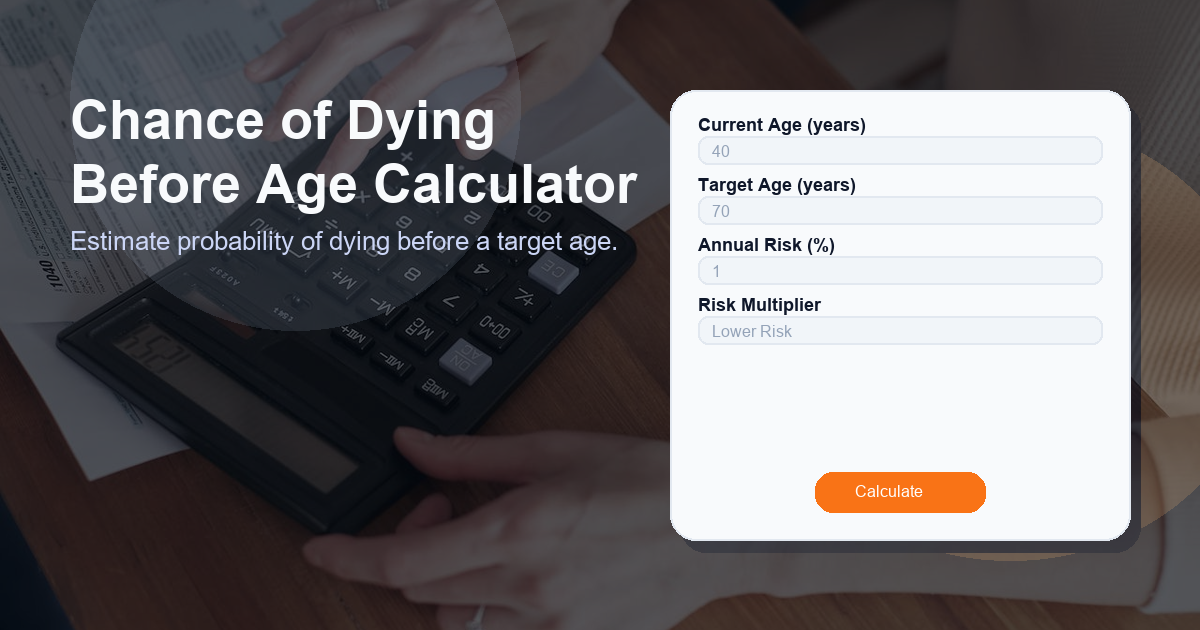
Chance of Dying Before Age Calculator
Estimate probability of dying before a target age with a simple, transparent calculator based on a constant annual risk and an optional multiplier. This tool is called the Chance of Dying Before Age Calculator and helps you quickly quantify the cumulative risk between your current age and a future target age.
What this Chance of Dying Before Age Calculator calculator does
The Chance of Dying Before Age Calculator estimates the probability that a person will die before reaching a specified target age given:
- Current Age (years) — the starting age of the person.
- Target Age (years) — the age you want to know the chance of not surviving to.
- Annual Risk (%) — a constant, annual percentage risk of dying in any given year (expressed as a percent, e.g., 1.5 for 1.5%).
- Risk Multiplier — a factor to increase or decrease the annual risk (for example, to model higher risk due to behaviors or conditions).
The tool returns the Chance of Dying Before Target Age (expressed as a percentage). This is a simplified probabilistic model assuming the annual risk is constant over the years considered and events are independent year-to-year.
How to use the Chance of Dying Before Age Calculator calculator
Using the calculator is straightforward. Follow these steps:
- Enter your current age (in whole or fractional years).
- Enter the target age you want to evaluate — the age you are concerned about reaching.
- Provide an annual risk percentage representing the chance of dying in any given year. Use estimates from population mortality tables or a personal estimate.
- Set a risk multiplier to reflect higher or lower personal risk compared to the baseline annual risk. For example, 1.0 leaves the annual risk unchanged, 1.5 increases it by 50%, and 0.8 reduces it by 20%.
- Press “Calculate” to get the result labeled: Chance of Dying Before Target Age. The output is shown as a percentage.
Important input tips:
- If the target age is less than or equal to your current age, the model returns 0% (you’ve already reached that age).
- Annual risk should be entered as a percentage (not a decimal). For example, enter 2 for 2% per year.
- Use realistic values: typical annual mortality rates vary strongly by age and health status. This calculator uses a constant annual rate for simplicity.
Result: Chance of Dying Before Target Age: —%
How the Chance of Dying Before Age Calculator formula works
The calculator uses a simple cumulative probability formula based on repeated independent annual risks. The exact formula implemented is:
(1 – Math.pow(1 – (annual_risk_percent * risk_multiplier / 100), Math.max(0, target_age – current_age))) * 100
Explanation step-by-step:
- annual_risk_percent * risk_multiplier / 100 converts the input percent into a decimal annual probability after applying the multiplier. Example: 1.5% with multiplier 1.2 becomes 0.018 (1.8% per year).
- 1 – annual_prob gives the probability of surviving a single year.
- Math.pow(1 – annual_prob, years) computes the probability of surviving every year for the full period (product of independent yearly survival probabilities).
- 1 – survival_probability converts that to the probability of dying at least once before the end of the period — which is the chance of dying before reaching the target age.
- The final multiplication by 100 presents the result as a percentage.
This approach assumes:
- Yearly risks are identical and independent across years.
- Risk is small enough each year that compounding with the simple power function is appropriate.
Use cases for the Chance of Dying Before Age Calculator
The Chance of Dying Before Age Calculator is useful in many practical scenarios where a simple, transparent estimate is helpful:
- Financial planning: Estimate longevity risk when planning retirement withdrawals, life insurance needs, or legacy planning.
- Insurance underwriting (rough estimates): Provide a quick intuition about probabilities when detailed life tables are not available.
- Health decisions: Model the impact of changes in annual risk (e.g., quitting smoking, improving fitness) by adjusting the multiplier or annual risk.
- Travel and activity risk assessment: Compare the incremental chance of dying before a target age when facing higher-risk periods (e.g., extended travel or hazardous work).
- Education and research: Teach concepts of cumulative probabilities and survival modeling in a simplified format.
Other factors to consider when calculating risk
While this calculator is a convenient first pass, many real-world factors influence mortality risk beyond a constant annual percentage. Consider these important points:
- Age-specific mortality: Real mortality rates usually rise with age. Using a single constant annual risk across many decades can under- or over-estimate true probabilities.
- Health status and comorbidities: Chronic illnesses, obesity, smoking status, and genetic factors dramatically alter annual risk compared to population averages.
- Medical advances: Improvements in healthcare over decades can lower future annual risks relative to current estimates.
- Non-independence of events: Some risks are correlated across years; a serious illness increases subsequent year mortality, which violates the independence assumption.
- Population life tables: For precise actuarial work, use official life tables or age-specific hazard rates rather than a flat annual rate.
- Short time horizons: When the time span is short (a few years), this model is reasonable; for long horizons (30+ years), consider age progression of risk.
Bottom line: The calculator provides a transparent, easy-to-understand estimate and is best used for intuition, teaching, or preliminary planning. For critical decisions (legal, insurance underwriting, medical planning), consult professionals and use detailed actuarial tables or clinical risk models.
FAQ
Q: What does the result represent?
A: The result labeled Chance of Dying Before Target Age is the estimated probability (in percent) that an individual with the specified constant annual risk will die at least once before reaching the target age, assuming independent annual risk each year.
Q: Can I use this for long-term lifetime projections?
A: You can, but be cautious. Long-term projections are less accurate with a constant annual rate, because real-world mortality changes with age and over time. For long horizons, age-specific mortality tables are recommended.
Q: How should I choose the annual risk percentage?
A: Use published mortality rates for your age group if available, or a reasoned estimate based on health and behavior. The annual risk should be entered as a percent (e.g., 1.2 for 1.2%).
Q: What is the risk multiplier for?
A: The risk multiplier scales the chosen annual risk to reflect higher or lower personal risk (for example, multiply by 1.5 to model 50% higher annual risk than baseline). It is a simple way to model relative risk changes.
Q: Is this calculator a substitute for professional advice?
A: No. This tool is for estimation and educational purposes only. For insurance underwriting, medical decisions, or legal planning, consult qualified professionals and use detailed actuarial or clinical models.