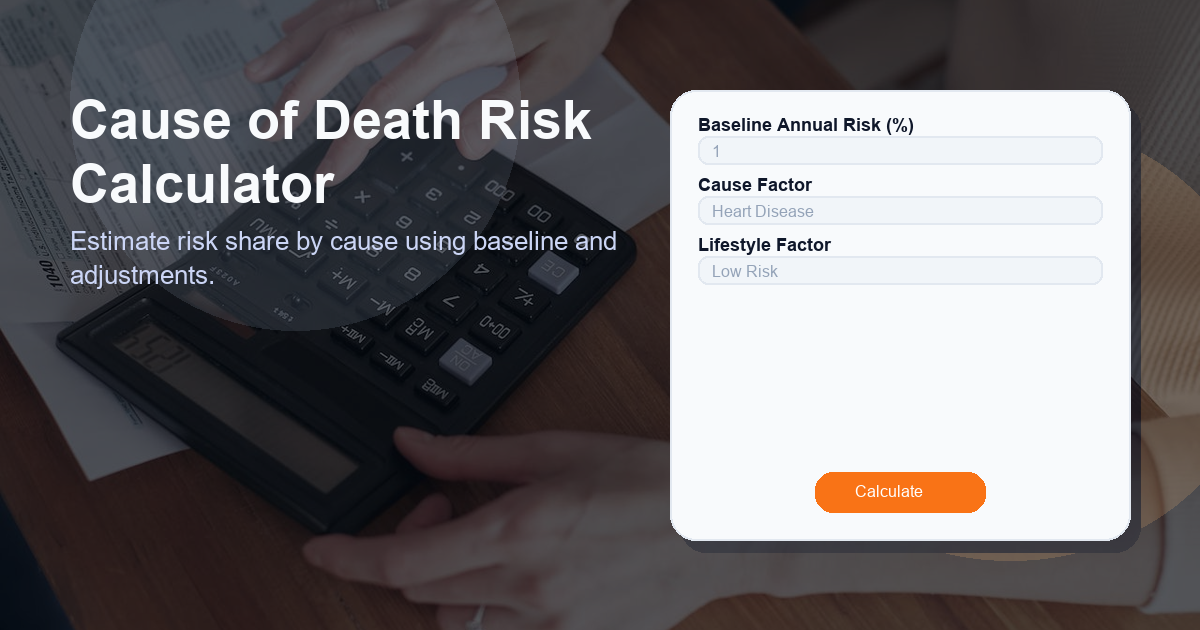
Cause of Death Risk Calculator
Description: Estimate risk share by cause using baseline and adjustments. This Cause of Death Risk Calculator helps you quickly estimate an individual’s annual risk for a specific cause by combining a baseline risk with cause-specific and lifestyle adjustment factors.
What this Cause of Death Risk Calculator calculator does
The Cause of Death Risk Calculator provides a simple, transparent way to estimate the portion of annual mortality risk attributable to a particular cause. It is designed for public health communicators, data analysts, researchers, and informed individuals who want to model how different factors change risk.
Specifically, this tool:
- Combines a baseline annual risk (expressed as a percentage) with two multipliers: a cause factor and a lifestyle factor.
- Produces an easy-to-interpret output labeled Estimated Annual Risk, showing the annual probability (as a percentage) of death from the selected cause.
- Is intentionally simple so it can be used as part of sensitivity analysis: change inputs and observe how the estimated risk reacts.
Because the calculation is multiplicative, it is best suited for scenarios where relative risk adjustments are reasonable approximations (for example, when cause and lifestyle factors are independent modifiers of baseline risk).
How to use the Cause of Death Risk Calculator calculator
Using the Cause of Death Risk Calculator requires three inputs:
- Baseline Annual Risk (%): The baseline probability of death in a year for the population or person of interest, expressed as a percentage (for example, 0.5 for 0.5%).
- Cause Factor: A multiplier representing how much more (or less) likely the cause makes death relative to the baseline. Use values >1 to increase risk and <1 to decrease it (for example, 1.2 or 0.8).
- Lifestyle Factor: A multiplier representing the effect of lifestyle or behavior on the risk for this cause (for example, smoking might be 1.5 for certain causes; healthy behaviors could be 0.7).
Step-by-step:
- Decide the Baseline Annual Risk (%) for the population or individual. This can come from public health tables, life tables, or published cohort studies.
- Choose a Cause Factor that reflects relative risk for the cause compared to baseline.
- Choose a Lifestyle Factor reflecting behavior-related adjustments.
- Apply the formula below to compute the Estimated Annual Risk.
Example: If the baseline annual risk is 0.5% (0.5), the cause factor is 1.5, and the lifestyle factor is 1.2, the calculation yields an estimated annual risk of 0.5 * 1.5 * 1.2 = 0.9%.
How the Cause of Death Risk Calculator formula works
The core computation is intentionally simple and transparent. The formula used by this Cause of Death Risk Calculator is:
baseline_risk * cause_factor * lifestyle_factorWhere:
- baseline_risk is expressed as a percentage (or decimal representing percent). If you prefer decimals, convert 0.5% to 0.005; the formula works the same if you keep units consistent.
- cause_factor adjusts for the specific disease, injury, or cause relative to the baseline risk for the group.
- lifestyle_factor adjusts for behavioral or lifestyle attributes (e.g., smoking, diet, exercise).
Key points about the math:
- The formula is multiplicative, so small change in multipliers can produce proportional changes in the final estimate.
- It assumes independent, multiplicative effects. If factors interact in more complex ways (e.g., synergy), this simple model may under- or over-estimate risk.
- Keep units consistent: if you use percent like 0.5 for 0.5%, the result will be percent. If you use a decimal like 0.005, interpret result as a decimal and convert to percent by multiplying by 100.
Use cases for the Cause of Death Risk Calculator
The Cause of Death Risk Calculator is useful in a variety of professional and personal contexts:
- Public health planning: Quickly estimate the contribution of a cause to overall mortality for scenario planning and resource allocation.
- Risk communication: Explain to patients or the public how specific behaviors (captured via lifestyle factor) change relative risk for a cause.
- Data analysis and sensitivity testing: Run what-if scenarios by varying cause and lifestyle factors to see how robust conclusions are to different assumptions.
- Educational use: Teach students and stakeholders about multiplicative risk models and the impact of modifiers on outcomes.
Because the calculator is straightforward to use, it’s especially helpful when you need transparent, reproducible calculations that can be demonstrated in a report or presentation.
Other factors to consider when calculating Cause of Death Risk
While the Cause of Death Risk Calculator is a helpful first step, real-world risk estimation often requires more nuance. Consider the following factors before drawing strong conclusions from a simple multiplicative estimate:
- Age and sex: Baseline risk often varies dramatically by age and sex. Use age- and sex-specific baselines when possible.
- Comorbidities: Existing health conditions can change both baseline risk and how cause and lifestyle factors interact.
- Time horizons: This calculator estimates annual risk. For multi-year risk, consider compounding or cumulative models rather than repeating annual estimates without adjustment.
- Interaction effects: Some causes and behaviors interact (e.g., alcohol and certain medications). If interactions are known, a more sophisticated model is needed.
- Data quality: The accuracy of the result depends on the quality of the baseline and factor estimates. Use peer-reviewed sources or authoritative datasets.
- Population versus individual-level inference: Multiplicative factors derived from population studies may not translate directly to an individual’s unique risk profile.
In short, use the calculator for transparent, illustrative estimates, and combine it with more rigorous statistical models or expert judgment for decision-making that requires precision.
Inputs, Formula, and Result Label (Quick reference)
- Inputs: Baseline Annual Risk (%), Cause Factor, Lifestyle Factor
- Formula:
baseline_risk * cause_factor * lifestyle_factor - Result label: Estimated Annual Risk
FAQ
Q: What exactly does “Baseline Annual Risk (%)” mean?
A: The Baseline Annual Risk (%) is the underlying probability of death in one year for the population or individual before applying any cause-specific or lifestyle adjustments. It is typically derived from life tables, vital statistics, or epidemiological studies.
Q: Can I use decimals instead of percentages in the calculator?
A: Yes. The Cause of Death Risk Calculator works with either format as long as you stay consistent. If you use decimals (e.g., 0.005 for 0.5%), interpret the output accordingly or convert to percent by multiplying by 100.
Q: How do I interpret a cause factor of less than 1?
A: A cause factor less than 1 indicates a reduction in risk relative to the baseline (for instance, protective factors or lower-exposure scenarios). Values greater than 1 indicate increased risk.
Q: Is this calculator suitable for clinical decision making?
A: This calculator is intended for illustrative, educational, and preliminary analytic purposes. For clinical decision making or policy-setting, use more detailed models and consult domain experts. Consider age, comorbidities, and high-quality empirical estimates for more accurate assessments.
Q: How can I improve the accuracy of the estimated annual risk?
A: Improve accuracy by using age- and sex-specific baselines, validated cause and lifestyle multipliers from cohort studies or meta-analyses, and accounting for interactions and comorbidities. Where possible, supplement multiplicative estimates with regression-based or survival analysis models.
Conclusion: The Cause of Death Risk Calculator offers a simple, interpretable approach to estimate how baseline risk, cause-specific modifiers, and lifestyle factors combine to produce an Estimated Annual Risk. Use it as a transparent starting point for communication, scenario planning, and sensitivity analysis, and supplement it with richer data and models for high-stakes decisions.