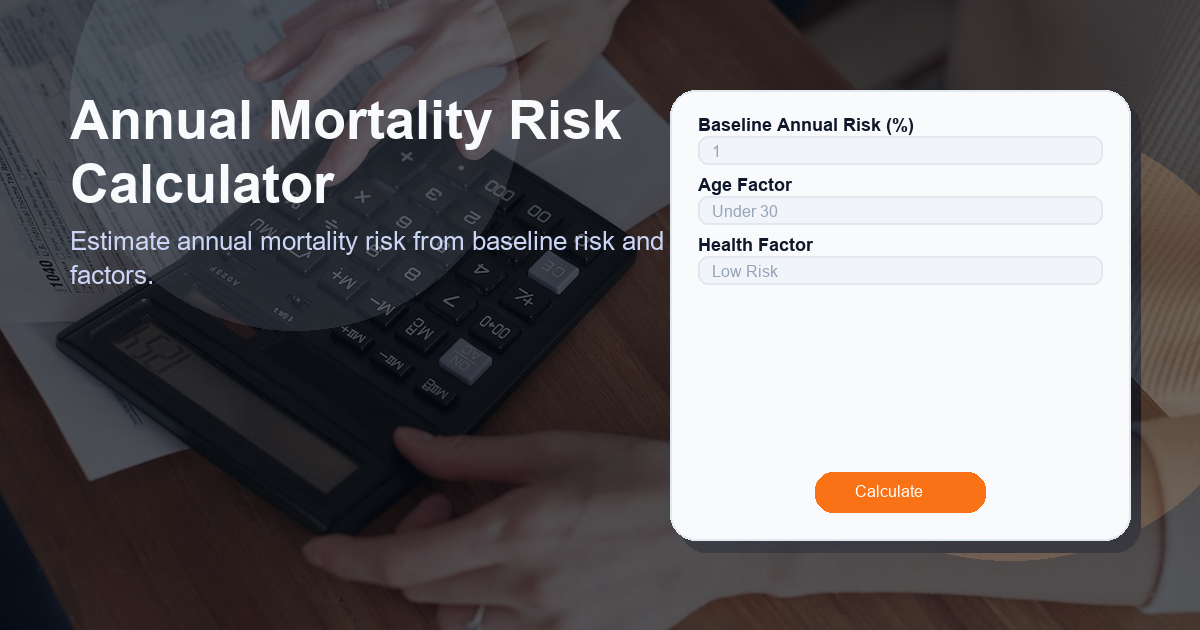
Annual Mortality Risk Calculator
What this Annual Mortality Risk Calculator calculator does
The Annual Mortality Risk Calculator is a simple, transparent tool designed to help you estimate an individual’s annual risk of mortality using a baseline percentage risk adjusted by two multiplicative factors: age and health. This calculator converts a known or assumed baseline annual risk into a personalized annual risk by applying the Age Factor and the Health Factor.
Key capabilities include:
- Quick estimation of an annual mortality risk expressed as a percentage.
- Clear, auditable calculation using the formula:
baseline_risk * age_factor * health_factor. - Actionable output labeled Annual Mortality Risk for use in planning, communication, or basic risk comparison.
How to use the Annual Mortality Risk Calculator calculator
Using the Annual Mortality Risk Calculator involves three straightforward inputs. The calculator is designed for clarity and reproducibility.
Provide the following inputs:
- Baseline Annual Risk (%) — the baseline probability of mortality over one year expressed as a percent (for example, 1.2 for 1.2%).
- Age Factor — a multiplier reflecting how age alters the baseline risk (for example, 1.3 if the person’s age increases risk by 30%).
- Health Factor — a multiplier reflecting health status, comorbidities, or lifestyle factors (for example, 0.8 for healthier-than-baseline, or 1.5 for multiple risk-increasing conditions).
Steps to compute the result:
- Enter the Baseline Annual Risk (%). Use a decimal percent (e.g., type 1.2 to represent 1.2%).
- Enter the Age Factor. Typical values range from 0.5 to 3.0 depending on model and population.
- Enter the Health Factor. Typical values also often range from 0.5 to 3.0 depending on relative health status.
- Multiply the three values using the formula below to get the Annual Mortality Risk as a percent.
Example: Baseline Annual Risk = 1.2%, Age Factor = 1.5, Health Factor = 1.2. Result = 1.2 * 1.5 * 1.2 = 2.16% Annual Mortality Risk.
How the Annual Mortality Risk Calculator formula works
The formula behind the Annual Mortality Risk Calculator is intentionally simple and multiplicative:
Annual Mortality Risk (%) = baseline_risk * age_factor * health_factor
Why multiplicative?
- Proportional adjustments: Multiplying by factors scales the baseline risk proportionally. If age doubles the risk relative to baseline, an age factor of 2.0 will double the baseline risk.
- Interpretability: Each factor is interpretable as a relative risk multiplier (e.g., 1.25 = 25% higher risk, 0.8 = 20% lower risk).
- Composability: Multiple independent effects can be combined by sequential multiplication without re-centering the baseline.
Important details about inputs and units:
- Baseline Annual Risk (%) should be given as a percentage, not a probability between 0 and 1. For clarity, type 2.5 for 2.5%.
- Age Factor and Health Factor are unitless multipliers. They can be less than 1 (reducing risk) or greater than 1 (increasing risk).
- The final output is an Annual Mortality Risk expressed as a percentage per year.
Edge cases and interpretation:
- If any factor equals 0, the calculated risk will be zero — interpret with caution; a zero factor is rarely meaningful clinically.
- Very large multipliers can produce unrealistically high annual risks; always validate factors against epidemiological data where available.
- Because the model is multiplicative and simplified, it is best used for relative comparisons and rough estimates rather than definitive clinical decisions.
Use cases for the Annual Mortality Risk Calculator
The Annual Mortality Risk Calculator is useful across a variety of practical scenarios where a fast, interpretable mortality estimate is helpful:
- Public health planning: Estimate expected mortality rates for population subgroups by applying age and health multipliers to a known baseline.
- Insurance underwriting (preliminary): Provide quick, transparent risk adjustments for initial assessments before more complex actuarial models are applied.
- Personal health planning: Help individuals and caregivers understand how age and health conditions might change annual risk relative to a population baseline.
- Risk communication: Create simple visualizations or handouts that explain how relative changes in age or health status translate to percentage changes in annual risk.
- Scenario analysis: Compare “what-if” scenarios — for example, how improving health factors (smoking cessation, improved management of chronic disease) could lower annual risk.
Benefits include:
- Transparency — the formula and inputs are clear and auditable.
- Speed — results are immediate and easy to compute for multiple scenarios.
- Comparability — use the same baseline to compare risks across ages and health profiles.
Other factors to consider when calculating annual mortality risk
While the Annual Mortality Risk Calculator is useful for quick estimates, real-world mortality is influenced by a broad range of additional variables. Consider these when interpreting results:
- Socioeconomic status: Income, education, and access to healthcare strongly affect mortality but are not captured directly by the simple age/health multipliers.
- Genetics and family history: Hereditary risks for specific conditions can materially change lifetime and annual risk.
- Acute events: Recent hospitalizations, surgeries, or infections can spike short-term risk beyond what a baseline multiplier would capture.
- Environmental factors: Pollution, occupational hazards, and geographic location can adjust risk independently of age and baseline health.
- Treatment and adherence: Effective management of chronic disease (medication adherence, timely interventions) can lower actual risk compared to a naive multiplier.
- Baseline source accuracy: Ensure the baseline annual risk you use is applicable to the population in question (general population vs. clinical cohort vs. specific age bracket).
Because of these considerations, the calculator should be treated as an estimating tool rather than a definitive prognostic instrument. For clinical decision making, consult detailed models or healthcare professionals who can integrate comprehensive patient data.
Short FAQ — Annual Mortality Risk Calculator
What is the Annual Mortality Risk Calculator used for?
The calculator is used to estimate a yearly mortality percentage by adjusting a baseline risk with an Age Factor and a Health Factor. It provides quick, comparable risk estimates for planning, communication, and high-level analysis.
How do I choose a baseline annual risk?
Choose a baseline risk from reliable epidemiological sources, registry data, or population studies that match the demographic you are assessing. The baseline should reflect the annual mortality for a defined reference population.
Can I use decimal multipliers less than 1?
Yes. Multipliers less than 1 decrease the baseline risk (for example, 0.8 reduces risk by 20%). Use values greater than 1 to increase risk and values between 0 and 1 to indicate a lower-than-baseline risk.
Is the output clinically definitive?
No. The output is an estimate based on a simple multiplicative model. It should not replace clinical judgment, detailed prognostic modeling, or individualized medical assessment.
How accurate is the formula baseline_risk * age_factor * health_factor?
Accuracy depends on the quality and relevance of the baseline and the appropriateness of the factors. The model is intentionally simple for transparency; for more precision, use complex risk models that incorporate multiple covariates and validated coefficients.
For best results, pair the Annual Mortality Risk Calculator with validated baseline data and carefully chosen factors based on published literature or domain expertise. Use the output to inform discussions, plan scenarios, and prioritize further analysis rather than as a final diagnosis.