Age at Death Calculator
What this Age at Death Calculator calculator does
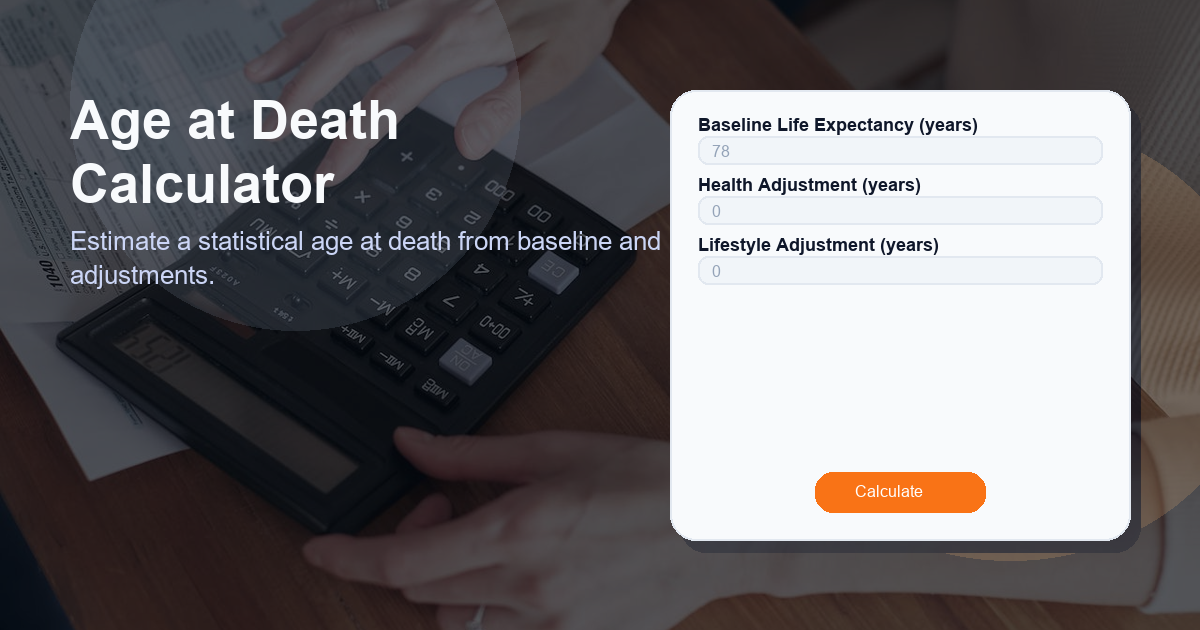
This Age at Death Calculator provides a simple, transparent way to estimate a statistical age at death based on a baseline life expectancy and user-specified adjustments for health and lifestyle. The tool is not a prediction of an individual’s exact time of death—rather, it produces an estimate rooted in a straightforward additive model that makes transparent how different factors shift an expected lifespan.
At its core, the calculator combines three numerical values:
- Baseline Life Expectancy (years) — a starting point drawn from population life tables, actuarial data, or an individual’s current actuarial expectation.
- Health Adjustment (years) — a positive or negative number representing known medical conditions, overall fitness, or health interventions.
- Lifestyle Adjustment (years) — a positive or negative number capturing behaviors such as smoking, alcohol use, diet, exercise, and occupational hazards.
The result is displayed with the label Estimated Age at Death, giving users an easy-to-read output that reflects the combined impact of baseline expectancy and adjustments.
How to use the Age at Death Calculator calculator
Using the Age at Death Calculator is straightforward. Follow these steps to get an estimate:
- Choose a baseline: Start by entering a Baseline Life Expectancy in years. This can come from national life tables, actuarial tables, or default values provided by the tool.
- Enter a health adjustment: Add a positive number if health conditions or interventions are expected to extend life, or a negative number for chronic illnesses or severe risk factors.
- Enter a lifestyle adjustment: Add a positive number for protective lifestyle choices (regular exercise, healthy diet) or a negative number for high-risk behaviors (heavy smoking, extreme stress, dangerous work environment).
- Compute the result: The calculator applies the formula and returns your Estimated Age at Death.
Example:
- Baseline Life Expectancy: 80 years
- Health Adjustment: -3 years (chronic illness)
- Lifestyle Adjustment: +2 years (healthy lifestyle)
- Estimated Age at Death: 79 years
This simple workflow keeps the interface and assumptions clear so users can experiment with different scenarios and see how small changes to health or lifestyle assumptions change the outcome.
How the Age at Death Calculator formula works
Formula: base_expectancy + health_adjustment + lifestyle_adjustment
The model behind the Age at Death Calculator is an additive linear formula. Each input contributes directly to the final estimate:
- base_expectancy — anchors the estimate in population-level or actuarial expectations.
- health_adjustment — captures known health deviations from the baseline (for example, a diagnosis that shortens expected lifespan by a certain number of years).
- lifestyle_adjustment — reflects the cumulative impact of daily behaviors and environmental exposures that historically shift life expectancy.
Why an additive model?
- Transparency: Users can see the direct contribution of each factor.
- Simplicity: It avoids complex interactions that can obscure how values affect the estimate.
- Flexibility: Users or analysts can plug in alternative baselines or adjustments based on new evidence.
Limitations of the formula should be acknowledged: real-world longevity is shaped by complex, often non-linear interactions between genetics, environment, social determinants, medical care, and random events. This calculator intentionally provides a tractable, interpretable estimate rather than a probabilistic lifespan distribution.
Use cases for the Age at Death Calculator
The Age at Death Calculator is useful across a range of personal, professional, and educational scenarios. Common use cases include:
- Personal planning: Individuals can explore how lifestyle changes might impact a broad expectation of lifespan and plan retirement or long-term care accordingly.
- Financial modeling: Planners and actuaries can use the estimate as a simple input to cash-flow models for retirement savings, annuities, or insurance reserves.
- Public health education: Demonstrating the relative impact of population-level health and lifestyle shifts on life expectancy can help communicate the value of interventions.
- Research prototypes: Researchers often use simple, interpretable calculators to run sensitivity analyses before deploying more sophisticated models.
- Risk communication: Health counselors can illustrate how specific behaviors typically shift life expectancy, using the tool to motivate evidence-based changes.
Because the model is intentionally simple, it’s best used for high-level planning and education rather than clinical decision-making or forensic analysis.
Other factors to consider when calculating age at death
While the Age at Death Calculator gives a clear, easy-to-understand estimate, many additional factors influence longevity. Consider these when interpreting results:
- Genetics: Family history can strongly affect lifespan and disease risk—sometimes in ways not captured by health or lifestyle adjustments.
- Socioeconomic status: Income, education, access to healthcare, and neighborhood environment correlate with life expectancy.
- Medical advances: New treatments or preventive measures can change population baselines over time.
- Random events: Accidents, infectious outbreaks, and other stochastic events can alter an individual’s survival independently of baseline factors.
- Data accuracy: Baseline life expectancy depends on the quality of the source (national life tables, actuarial tables, etc.). Choosing appropriate baseline data matters.
- Interactions and non-linear effects: Many risk factors interact multiplicatively rather than additively—something this calculator does not model.
Important caution: This calculator is a statistical estimator, not a medical or legal prediction. It is designed for education, planning, and exploratory use. For clinical advice, diagnosis, or personalized risk assessments, consult qualified healthcare or actuarial professionals.
FAQ: Age at Death Calculator
Q: Is the Age at Death Calculator accurate for an individual?
A: The calculator provides a simple statistical estimate based on the inputs you supply. It is not a precise prediction for any one person because it does not model complex genetic, environmental, or random factors that influence actual lifespan.
Q: Where should I get the Baseline Life Expectancy value from?
A: Use reliable sources such as national life tables, WHO life expectancy data, Social Security actuarial tables, or reputable actuarial publications. Choose a baseline that matches the population most similar to the individual (country, sex, birth cohort).
Q: How should I decide values for Health Adjustment and Lifestyle Adjustment?
A: These adjustments are subjective and ideally informed by evidence. For example, known conditions with established life-expectancy impacts can be converted to year adjustments based on clinical studies. Lifestyle changes can be estimated from epidemiological research. When in doubt, use conservative values and treat results as approximate.
Q: Can this calculator be used for financial planning?
A: Yes, the calculator can provide a simple input for financial and retirement planning models. However, financial planners often use probabilistic life tables or stochastic models for more robust planning—consider combining outputs from this tool with professional advice.
Q: Does the calculator account for advances in medicine or future changes?
A: Not automatically. You can manually adjust the Baseline Life Expectancy to reflect anticipated medical advances or trends. For dynamic projections, more complex actuarial or epidemiological models are required.
Summary: The Age at Death Calculator is a transparent, easy-to-use estimator that helps you explore how baseline expectancy and simple adjustments for health and lifestyle combine to produce an Estimated Age at Death. Use it for planning, education, and scenario analysis, and pair it with professional guidance when making consequential decisions.