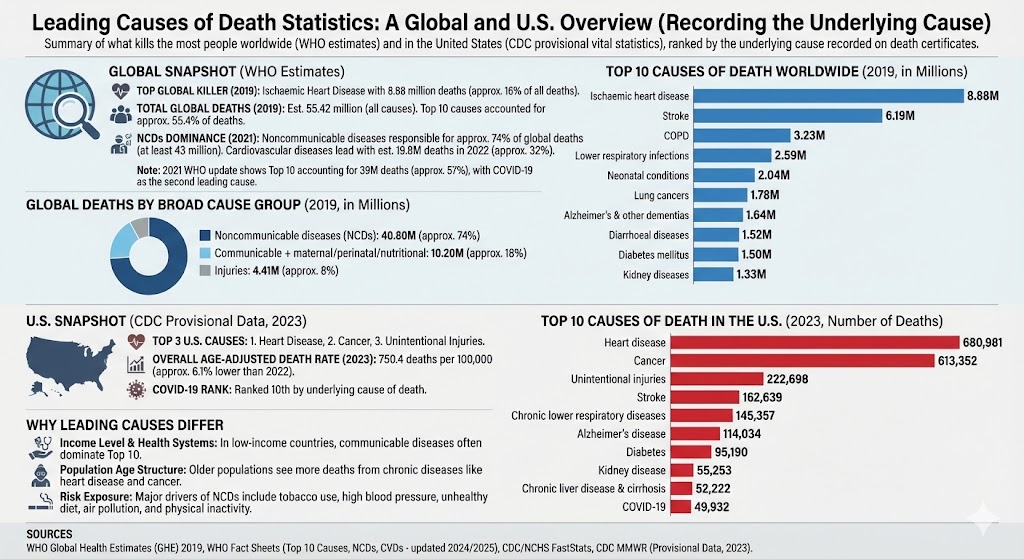
These statistics summarize what kills the most people worldwide (global estimates) and in the United States (national vital statistics). “Leading causes” are typically ranked by the underlying cause of death recorded on death certificates.
leading causes of death statistics
Key leading-cause-of-death stats (quick facts)
Globally, an estimated 55.42 million people died in 2019 (all causes).
The single biggest global killer in 2019 was ischaemic heart disease with 8.88 million deaths (about 16.03% of all deaths).
In 2019, the top 10 causes of death accounted for about 55.42% of all deaths worldwide.
In 2021 (latest WHO “top 10” update), the top 10 causes accounted for 39 million deaths (about 57% of 68 million total deaths), with COVID-19 emerging as the second leading cause.
Noncommunicable diseases (NCDs) are responsible for about 74% of deaths worldwide; WHO estimates at least 43 million NCD deaths in 2021.
Cardiovascular diseases (CVDs) are the leading cause of death globally, with an estimated 19.8 million deaths in 2022 (about 32% of global deaths).
In the U.S. in 2023, the top 3 causes by number of deaths were heart disease, cancer, and unintentional injuries.
The overall U.S. age-adjusted death rate in 2023 was 750.4 deaths per 100,000, about 6.1% lower than in 2022.
Global leading causes of death
WHO’s Global Health Estimates show that cardiovascular diseases dominate the global rankings, followed by major respiratory diseases, neonatal conditions, and cancers.
Top 10 causes of death worldwide (2019, deaths in millions)
In the United States, heart disease and cancer remain the top two causes. In 2023, COVID-19 ranked 10th by underlying cause of death (provisional data).
Top 10 causes of death in the U.S. (2023, number of deaths)