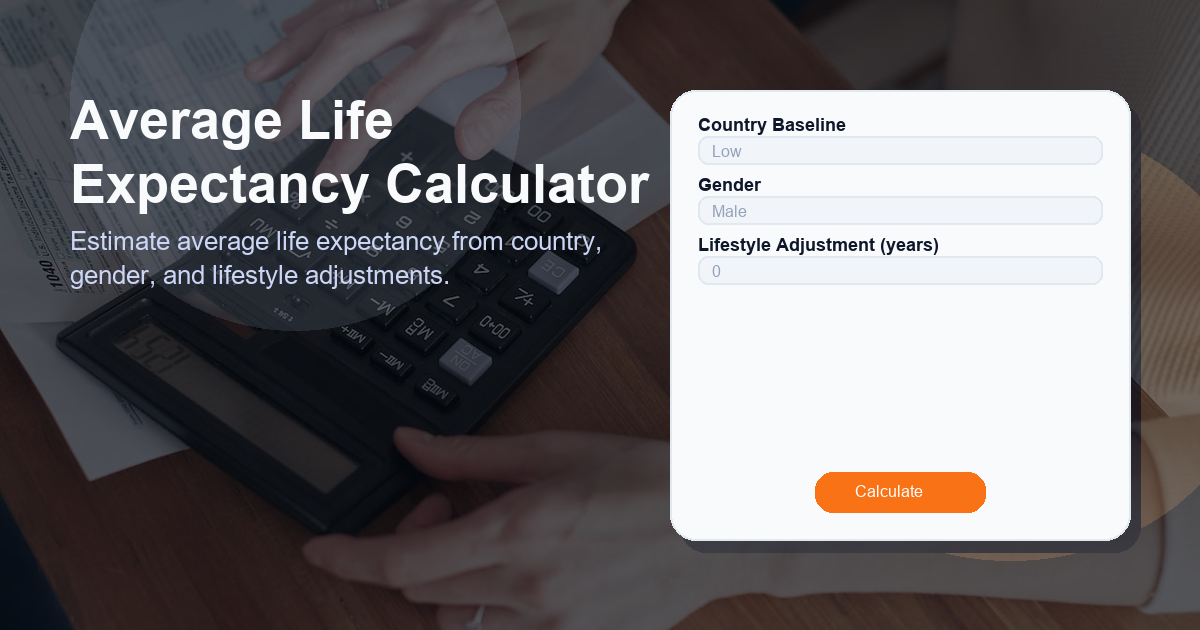
Average Life Expectancy Calculator
Description: Estimate average life expectancy from country, gender, and lifestyle adjustments. Use this Average Life Expectancy Calculator to generate a simple, transparent estimate based on a country baseline, a gender adjustment, and a lifestyle adjustment in years.
What this Average Life Expectancy Calculator calculator does
The Average Life Expectancy Calculator provides a quick, easy-to-understand estimate of a person’s expected lifespan using three straightforward inputs:
- Country Baseline – the average life expectancy for the selected country (usually derived from national statistics or international datasets).
- Gender – a simple adjustment (positive, negative or zero) that reflects typical differences in life expectancy by gender in that country.
- Lifestyle Adjustment (years) – a user-specified positive or negative number that represents the net effect of personal habits and choices (exercise, diet, smoking, alcohol, stress, etc.).
The calculator returns an estimated Average Life Expectancy, giving you a snapshot figure suitable for planning, comparisons, and exploratory analysis. It is designed for clarity and transparency rather than precision: the aim is to provide a reproducible, explainable estimate rather than a medically definitive prediction.
How to use the Average Life Expectancy Calculator calculator
Using the Average Life Expectancy Calculator is straightforward. Follow these steps:
- Select or enter the Country Baseline. Use an official source like the World Bank, WHO, or national statistics bureau to get the most recent average life expectancy for the country. Enter the number in years (for example, 78.6).
- Choose the Gender adjustment. Enter the appropriate adjustment value in years for the selected gender. For example, if females on average live 4 years longer than the baseline in that country, enter +4 for female or -4 for male depending on how the baseline is defined.
- Provide the Lifestyle Adjustment. Estimate how lifestyle choices affect longevity and enter that as a number of years (positive for healthier-than-average behaviors, negative for riskier behaviors). Typical inputs might be between -10 and +10, but use professional guidance if available.
- Submit or calculate. The calculator will apply the formula and show the Average Life Expectancy result in years.
Example: Country Baseline = 80, Gender Adjustment = -2 (male), Lifestyle Adjustment = -3 (smoker, sedentary). Result = 80 + (-2) + (-3) = 75 years (Average Life Expectancy).
How the Average Life Expectancy Calculator formula works
The calculation used by this tool is intentionally simple and transparent. The formula is:
Formula: country_expectancy + gender_adjustment + lifestyle_adjustment
Where:
- country_expectancy is the baseline average lifespan for the country in years.
- gender_adjustment is a signed value (positive, negative, or zero) representing typical gender differences relative to the baseline.
- lifestyle_adjustment is a signed value in years that captures the net effect of personal choices, medical conditions, and behavioral risk factors.
The output is labeled Average Life Expectancy and represents a central estimate. Because the formula is additive and linear, it is easy to understand how each input changes the result. This simplicity is a strength when you want a reproducible estimate or to illustrate the relative impact of country-level versus personal factors.
Use cases for the Average Life Expectancy Calculator
This calculator is useful in several practical scenarios:
- Personal planning: Inform retirement timing, savings targets, and long-term health planning by getting a quick estimate of expected lifespan.
- Health coaching: Demonstrate the potential impact of lifestyle changes (e.g., quitting smoking or increasing activity) by adjusting the lifestyle factor.
- Insurance and financial modeling: Create simple scenarios for life insurance needs, annuities, or pension forecasting where a transparent life expectancy input is required.
- Comparative research: Compare life expectancy estimates across countries or between demographic groups to highlight disparities and prioritize interventions.
- Education and awareness: Teach students or clients how baseline population data combined with personal factors influence expected longevity.
Because the model is simple, it is best used for scenario-building and high-level estimates rather than clinical diagnosis or precise actuarial tables. Use it as part of a broader planning process that also considers uncertainty and variability.
Other factors to consider when calculating life expectancy
While the Average Life Expectancy Calculator captures country-level and personal adjustments, many additional factors can influence real-world outcomes. Consider these limitations and additional variables when interpreting results:
- Genetics: Family history of chronic diseases can strongly affect lifespan but is hard to quantify in a single-year adjustment.
- Socioeconomic status: Income, education, and occupation affect access to healthcare, nutrition, and healthy environments.
- Access to healthcare: Availability, quality, and timeliness of care (preventive and emergency) dramatically impact outcomes.
- Environmental exposures: Air quality, water safety, and neighborhood safety contribute to long-term risk.
- Acute events and epidemics: Pandemics or regional health crises can change average life expectancy rapidly.
- Age at assessment: Baseline life expectancy is often reported as “at birth.” If you are older, conditional life expectancy (remaining years given current age) is more accurate.
- Mental health and social support: Loneliness, depression, and social networks influence longevity and quality of life.
- Data quality: Country baselines vary by source and year. Always cite the dataset and year used for the Country Baseline input.
Because of these complexities, treat the calculator output as a starting point. For high-stakes decisions—medical, financial, or legal—consult specialists and use more detailed actuarial or clinical models.
FAQ
Q: How accurate is the Average Life Expectancy Calculator?
A: The calculator provides a simple, explainable estimate but is not a precise prediction. Accuracy depends on the quality of the Country Baseline and the reasonableness of the Gender and Lifestyle Adjustment values. Use it for scenario analysis and planning, not as a clinical prognosis.
Q: Where can I find reliable Country Baseline values?
A: Use authoritative sources such as the World Health Organization (WHO), the World Bank, or your country’s national statistics office. Ensure you use the most recent year available and note whether the baseline is life expectancy at birth or conditional on a specific age.
Q: How should I choose the Lifestyle Adjustment value?
A: Estimate the lifestyle adjustment based on known risk factors. For example, long-term heavy smoking might warrant a negative adjustment (e.g., -5 to -10 years), while consistently healthy habits could justify a positive adjustment (e.g., +1 to +5 years). When in doubt, use conservative values or consult a health professional.
Q: Does the calculator handle non-binary genders or other demographic groups?
A: The calculator accepts any numeric Gender adjustment you choose. For non-binary individuals, use an adjustment that reflects the best available data for the relevant population or leave it at zero if no data exists. The tool is flexible but relies on user-supplied adjustments.
Q: Can I use this for financial planning or insurance purposes?
A: Yes, as a high-level input for scenario modeling. However, for actuarial-grade results, use specialized actuarial tables and consult financial or insurance professionals who can incorporate uncertainty, conditional probabilities, and regulatory requirements.
Result label: The output of this tool is displayed as Average Life Expectancy (measured in years).
Use this Average Life Expectancy Calculator to create transparent, repeatable estimates that help you plan and compare scenarios. Always combine its output with professional advice for decisions that require precision or legal standing.