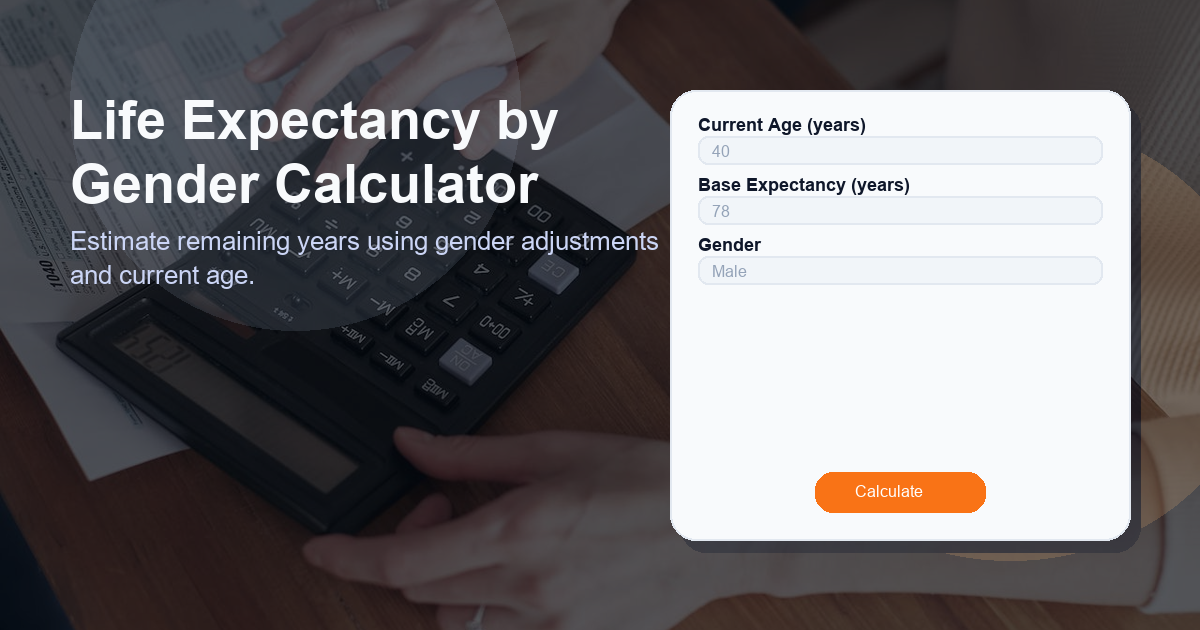
Life Expectancy by Gender Calculator
Description: Estimate remaining years using gender adjustments and current age. Use this Life Expectancy by Gender Calculator to get a quick, adjustable estimate of how many years you may have left, based on a starting base expectancy and a gender-based adjustment.
What this Life Expectancy by Gender Calculator calculator does
This calculator provides a simple and transparent estimate of remaining life years by combining three core inputs:
- Current Age (years) — how old you are now.
- Base Expectancy (years) — a population-level average life expectancy (for example, national life tables or a custom baseline).
- Gender — used to apply a numeric gender adjustment that reflects average longevity differences between genders in the chosen population.
The output is labeled Estimated Remaining Years. The calculator is intended as an informational tool: it is not a medical or actuarial prediction but a straightforward way to apply gender adjustments to a baseline life expectancy and subtract current age.
How to use the Life Expectancy by Gender Calculator calculator
Using this calculator is easy and designed to be intuitive. Follow these steps:
- Enter your current age in years. Use whole years or decimals if you want more precision (e.g., 45.5).
- Provide a base expectancy — this is usually the average life expectancy for the relevant population (country, region, or cohort). If you don’t have a specific number, a commonly used value is the national life expectancy published by statistical agencies.
- Select a gender option. Each gender choice applies a numeric adjustment (positive or negative) to the base expectancy. The exact adjustment values can be customized; the tool usually ships with a set of example values you can change.
- Read the result: the calculator displays Estimated Remaining Years, a single figure representing the difference between the adjusted expectancy and current age.
Practical tips:
- If your Estimated Remaining Years is negative, that indicates the adjusted life expectancy is below your current age — consider updating the base expectancy or adjustment values.
- Use local life tables for the most accurate Base Expectancy.
- Adjust the gender offsets if you are using more granular or recent studies that report different longevity gaps.
How the Life Expectancy by Gender Calculator formula works
The calculator uses a simple linear formula that is easy to understand and explain. The formula is:
Estimated Remaining Years = base_expectancy + gender_adjustment – current_age
Where:
- base_expectancy is the baseline average life expectancy for the reference population (in years).
- gender_adjustment is a numeric value added to the baseline to reflect average longevity differences for the selected gender (can be positive, negative, or zero).
- current_age is your present age in years.
Example calculations (illustrative):
- Example A (Female): base_expectancy = 82, gender_adjustment = +3, current_age = 40
- Estimated Remaining Years = 82 + 3 – 40 = 45 years
- Example B (Male): base_expectancy = 78, gender_adjustment = -1, current_age = 40
- Estimated Remaining Years = 78 – 1 – 40 = 37 years
- Example C (Custom scenario): base_expectancy = 80, gender_adjustment = 0 (no adjustment), current_age = 50
- Estimated Remaining Years = 80 + 0 – 50 = 30 years
The formula is intentionally simple so users can easily understand how each input influences the result. It also makes the calculator transparent and customizable: change the base expectancy or gender adjustment and see the impact immediately.
Use cases for the Life Expectancy by Gender Calculator
This tool can be useful in many everyday scenarios. Typical use cases include:
- Financial planning: Estimate the time horizon for retirement savings, pension planning, or long-term care funding.
- Health tracking and goal-setting: Use the estimate to set realistic long-term lifestyle or health goals, understanding it is an average-based projection, not a personal prognosis.
- Insurance and estate planning: Assess whether current policies and beneficiary arrangements match likely time horizons.
- Educational and research projects: Teach or demonstrate how gender adjustments affect population-level life expectancy calculations.
- Scenario modeling: Compare multiple scenarios by varying base life expectancies and gender adjustments to see how the estimated remaining years change.
Other factors to consider when calculating life expectancy
While the Life Expectancy by Gender Calculator offers a quick estimate, many other factors influence individual longevity. Consider these when interpreting the result:
- Health status: Chronic conditions, current health metrics, and medical history can drastically change an individual’s expected lifespan compared with population averages.
- Lifestyle: Smoking, alcohol use, diet, exercise, and sleep habits are strong predictors of longevity.
- Socioeconomic factors: Income, education, access to healthcare, and neighborhood safety can change life expectancy by years or even decades.
- Genetics and family history: Hereditary conditions and family longevity trends can raise or lower personal expectations.
- Geography and environment: Country, region, pollution, climate, and occupational hazards matter for life expectancy calculations.
- Advances in medicine: New treatments, screenings, and public health initiatives change life expectancy over time — periodically update your base expectancy to reflect these trends.
- Statistical uncertainty: Averages and adjustments are population-level statistics; individual outcomes vary. Treat the result as an estimate with inherent uncertainty.
Because of these additional factors, many professionals use this type of calculator as a first-pass tool and then refine estimates using clinical data, actuarial tables, or personalized risk models.
FAQ
Is the Life Expectancy by Gender Calculator accurate for individuals?
No. This calculator provides a population-based estimate. It is useful for planning and comparison, but it cannot predict an individual’s exact lifespan. Use medical advice and detailed actuarial analysis for personalized predictions.
Where do the gender adjustment numbers come from?
Gender adjustment values are derived from observed differences in life expectancy between genders in population statistics and life tables. You can use published values from your national statistics office or customize the adjustment based on specific studies.
Can I use this calculator for non-binary or other gender identities?
Yes. The calculator supports custom numeric adjustments. If you want to estimate for a non-binary identity, set the gender adjustment to the most appropriate value or use zero if no adjustment is needed. Always document your assumptions.
What should I use for Base Expectancy?
Use the most relevant average life expectancy for your population — national life tables, regional statistics, or cohort-specific data. If you don’t have a specific number, use an official national average as a starting point.
Can the result change over time?
Absolutely. As base life expectancy and population trends change due to medical advances or public health shifts, and as you age, the Estimated Remaining Years will change. Recalculate periodically with updated inputs.