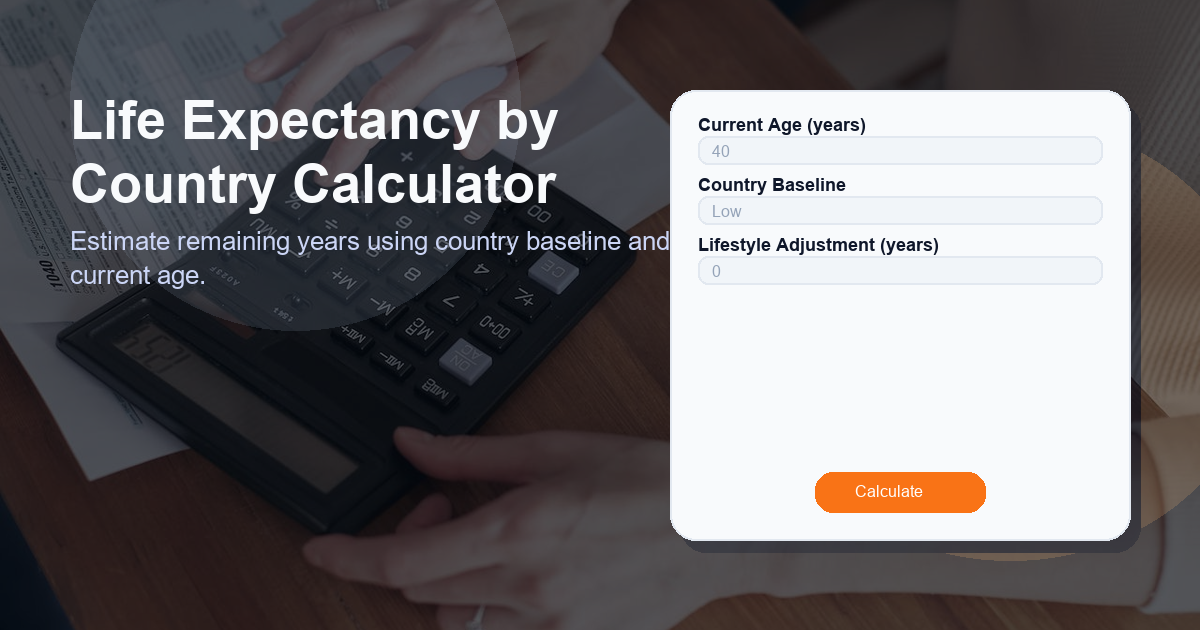
Life Expectancy by Country Calculator
Estimate remaining years using country baseline and current age. The Life Expectancy by Country Calculator helps you quickly approximate how many years you might expect to live based on a national baseline expectancy, your current age, and an adjustment for lifestyle. This article explains what the calculator does, how to use it, the formula behind it, practical use cases, and additional factors you should consider when interpreting results.
What this Life Expectancy by Country Calculator calculator does
The Life Expectancy by Country Calculator provides a simple, transparent estimate of your remaining years by combining three inputs:
- Current Age (years) — your present age in full years.
- Country Baseline — the average life expectancy at birth or period expectancy for the country you select.
- Lifestyle Adjustment (years) — a positive or negative modifier that reflects your personal health, habits, access to care, or socioeconomic situation.
Using these inputs, the calculator returns a single output labeled Estimated Remaining Years. It does not replace professional actuarial tools, medical advice, or personalized life-planning services, but it is a useful starting point for planning and awareness.
How to use the Life Expectancy by Country Calculator calculator
Using the calculator is straightforward. Follow these steps for a clear estimate:
- Enter your Current Age (years). Use whole numbers or decimals if you prefer a more precise entry (for example, 45 or 45.5).
- Select or enter the Country Baseline. This value typically comes from national statistics (for example, 82.4 for Japan or 78.9 for the United States). If you don’t know the exact baseline, use a credible source such as the World Bank or national statistical office.
- Provide a Lifestyle Adjustment (years). Positive numbers add to the baseline (e.g., +3 years for exceptionally healthy habits), negative numbers subtract (e.g., -2 years for high-risk factors).
- Calculate. The result will appear as the Estimated Remaining Years, which you can use for retirement planning, health goal setting, or curiosity.
Example: If you are 50 years old, the Country Baseline is 80 years, and your Lifestyle Adjustment is -2, the calculator shows Estimated Remaining Years: 28 (see formula section below).
How the Life Expectancy by Country Calculator formula works
The calculator uses a simple arithmetic formula to produce an intuitive estimate. The formula is:
country_expectancy + lifestyle_adjustment - current_age
Broken down:
- country_expectancy: the baseline average lifespan for the country.
- lifestyle_adjustment: your personal modifier in years (can be positive or negative).
- current_age: your age at the time of calculation.
This approach effectively shifts the national average up or down according to personal circumstances and then subtracts your current age to yield the number of remaining years.
Important details about the formula:
- Straightforward interpretation: If the result is positive, it represents an expected number of remaining years. If it is zero or negative, it indicates that the adjusted baseline is at or below your current age.
- Not probabilistic: This is an expectancy-based calculation, not a probability distribution. It gives a central estimate, not a guarantee.
- Adjustments are subjective: The lifestyle adjustment is intentionally flexible so you can account for well-known risk factors (smoking, chronic disease, etc.) or protective factors (regular exercise, preventive care).
Example calculation:
- Country Baseline = 78.9
- Lifestyle Adjustment = +2.0
- Current Age = 45
- Formula: 78.9 + 2.0 − 45 = 35.9 → Estimated Remaining Years: 35.9
Use cases for the Life Expectancy by Country Calculator
This calculator has many practical, everyday applications for individuals, planners, and educators. Common use cases include:
- Retirement planning: Quickly gauge how many years you might need income for, aiding in savings and pension decisions.
- Health goal-setting: Use the Lifestyle Adjustment field to see how improvements in habits could change your estimated remaining years.
- Financial modeling: Incorporate the estimated remaining years in simple cash flow scenarios, insurance considerations, or inheritance planning.
- Educational purposes: Teachers and students can explore how national averages and personal factors influence life expectancy.
- Population comparisons: Compare how the same age and lifestyle adjustments produce different outcomes across country baselines.
Because it is easy to use, the calculator is ideal for quick “what if” scenarios or as a conversation starter for deeper planning with professionals.
Other factors to consider when calculating life expectancy
While the Life Expectancy by Country Calculator is a useful estimate, there are many additional factors that can affect real-world lifespan. Consider the following:
- Gender and genetics: Many life tables show different expectancies by sex, and family history can be a major influence.
- Healthcare access: Quality and accessibility of medical care can substantially shift outcomes beyond the national average.
- Socioeconomic status: Income, education, and neighborhood safety correlate strongly with longevity.
- Comorbidities: Chronic diseases such as diabetes or heart disease will lower personal expectancy beyond what a simple lifestyle adjustment may capture.
- Temporal changes: National baselines change over time due to public health improvements, pandemics, or policy changes—use recent data.
For detailed planning or clinical decision-making, consult actuarial tables, medical professionals, or certified financial planners who can incorporate probabilistic modeling, cohort life tables, and individualized medical history.
Frequently asked questions
Q: Is the Life Expectancy by Country Calculator accurate for individuals?
A: It provides a simple estimate based on national averages and a subjective lifestyle adjustment. It is not a personalized medical prognosis. For accurate individual predictions, seek professional actuarial or medical assessments.
Q: Where do I get the Country Baseline value?
A: Use reputable sources such as the World Bank, WHO, or national statistical agencies. Many sources publish life expectancy at birth or period life tables by year and sex—choose the figure that best matches your intended baseline.
Q: How should I choose a Lifestyle Adjustment value?
A: The lifestyle adjustment is meant to capture relative differences from average conditions. Consider factors like smoking status, exercise frequency, chronic illnesses, and diet. Small adjustments (±1–5 years) are common; large adjustments should be justified with clear evidence.
Q: What if the calculator returns a negative number?
A: A negative result means the adjusted baseline is less than your current age. Interpret this as an indicator that either the baseline or lifestyle adjustment may not reflect your situation accurately. Re-check inputs and consider using a different baseline or consulting a professional.
Q: Can this calculator replace life insurance or retirement advice?
A: No. This tool is for quick estimates and education. Life insurance underwriting and retirement planning require detailed financial, health, and actuarial analysis that goes beyond a simple expectancy formula.
Start using the Life Expectancy by Country Calculator as a first step in planning and curiosity. Keep its limitations in mind, update country baselines regularly, and treat the result as a helpful guideline rather than a prediction.