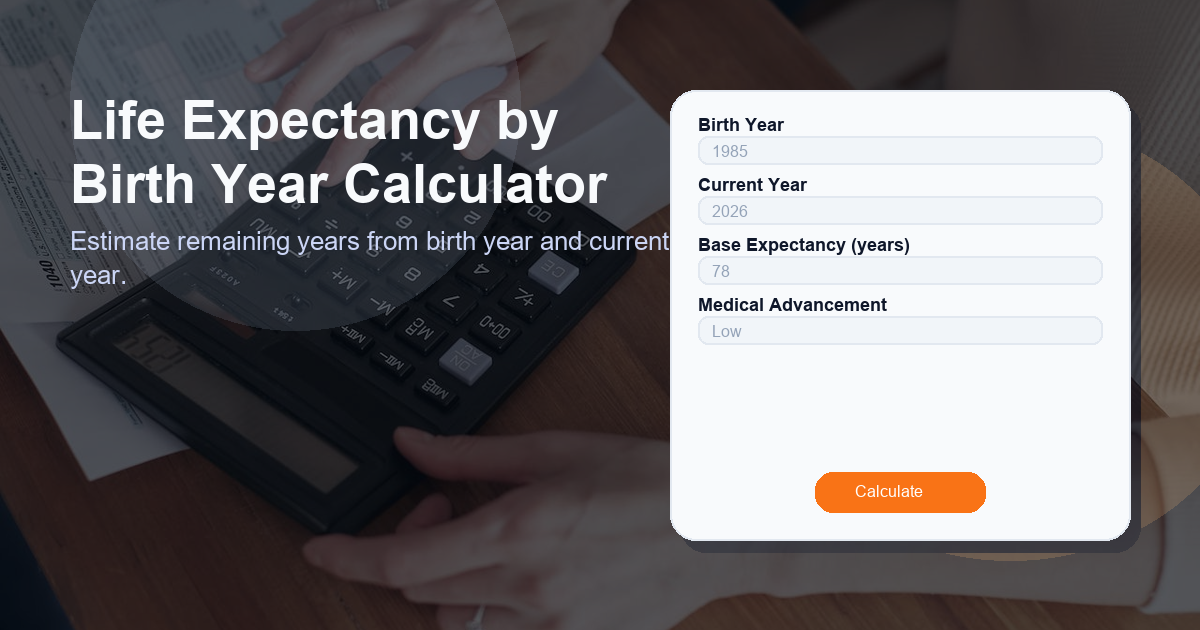
Life Expectancy by Birth Year Calculator
The Life Expectancy by Birth Year Calculator is a simple, transparent tool designed to help you estimate remaining years of life based on your birth year, the current year, a baseline life expectancy, and an adjustment for medical advancement. This calculator provides a quick, conservative projection labeled as Estimated Remaining Years. Use it for planning, comparison, educational purposes, or to understand how small changes in assumptions affect lifetime estimates.
What this Life Expectancy by Birth Year Calculator calculator does
This calculator computes an approximate remaining lifespan from an individual’s birth year by combining four inputs:
- Birth Year — the year you were born.
- Current Year — the present year or a year you want to evaluate.
- Base Expectancy (years) — a baseline average life expectancy (for example, national average life expectancy at birth).
- Medical Advancement — an adjustment (positive or negative) in years that reflects expected net effects of future medical progress or setbacks on longevity.
The calculator applies a straightforward arithmetic formula to produce a single output: the Estimated Remaining Years. It is intentionally simple so that users can quickly see how changes in assumptions affect results. This simplicity makes it ideal for high-level planning and demonstrations, but not a substitute for personalized actuarial or medical advice.
How to use the Life Expectancy by Birth Year Calculator calculator
Using the Life Expectancy by Birth Year Calculator is easy. Follow these steps:
- Enter your Birth Year. Example: 1980.
- Enter the Current Year. Example: 2026.
- Set a Base Expectancy (years). This is usually taken from published averages (e.g., 78 years). You can substitute a value that matches your region or cohort.
- Choose a Medical Advancement value. Enter a positive number if you expect improvements (e.g., +2 years), or a negative number if you want to be conservative.
- Calculate to get the result labeled “Estimated Remaining Years”. The output may be positive (years remaining), zero, or negative (indicating the base expectancy has been surpassed by current age under the chosen assumptions).
Tips for best use:
- Use realistic Base Expectancy figures: check reputable sources like government life tables or WHO statistics.
- Be cautious with Medical Advancement: large speculative values will produce optimistic estimates that may not be realistic.
- Compare scenarios: run multiple values for medical advancement to understand sensitivity.
How the Life Expectancy by Birth Year Calculator formula works
The mathematical formula the calculator uses is intentionally simple and transparent. It is:
(base_expectancy + medical_advancement) – (current_year – birth_year)
Breaking that down:
- base_expectancy + medical_advancement represents the adjusted expected lifespan (in years) from birth, after accounting for projected medical improvements or declines.
- current_year – birth_year calculates the individual’s current age using the two year inputs.
- The subtraction yields the Estimated Remaining Years, i.e., how many more years are expected relative to the adjusted life expectancy.
Example calculation:
- Birth Year = 1980
- Current Year = 2026
- Base Expectancy = 78 years
- Medical Advancement = 2 years
- Calculation: (78 + 2) – (2026 – 1980) = 80 – 46 = 34 years
So, under those assumptions the Estimated Remaining Years would be 34. If the result is negative, it means that based on the chosen base expectancy and medical advancement the person has already exceeded the adjusted life expectancy.
Use cases for the Life Expectancy by Birth Year Calculator
This calculator is useful in multiple contexts. Common use cases include:
- Financial planning: Quick estimates for retirement horizon, savings needs, and long-term care planning.
- Insurance and actuarial education: Teaching how age, baseline expectancy, and small improvements in medicine change lifetime projections.
- Public health communication: Illustrating the impact of incremental medical advancements on population lifespans.
- Personal curiosity: Comparing different birth cohorts, regions, or assumed medical progress scenarios.
- Sensitivity analysis: Running many scenarios to see how life expectancy estimates change when assumptions vary.
Because the model is straightforward, it is particularly well suited for high-level scenarios where interpretability is important. Analysts can embed this calculator in documentation, blogs, or planning tools to help non-experts understand trade-offs in assumptions.
Other factors to consider when calculating life expectancy
While the Life Expectancy by Birth Year Calculator provides a quick, transparent estimate, many important factors are not captured by its simple inputs. Consider these limitations and additional influences:
- Individual health status: Chronic conditions, genetics, lifestyle (smoking, diet, exercise) and socio-economic status can dramatically alter life expectancy from population averages.
- Gender and demographic differences: Life expectancy can differ by sex, ethnicity, and region; a single base expectancy may not reflect these variations.
- Advances in technology and medicine: Medical breakthroughs can be non-linear and cohort-specific; they are difficult to compress into a single “medical advancement” number.
- Environmental and societal changes: Pollution, pandemics, climate change, and healthcare access can either reduce or increase life expectancy over time.
- Statistical uncertainty: National averages are estimates with margins of error; using them without acknowledging uncertainty can be misleading.
Practical recommendations:
- Use multiple base expectancy sources and consider separate calculations for different demographic groups.
- Run scenario analyses with conservative, moderate, and optimistic medical advancement values.
- Consult experts for decisions with high financial or medical stakes; this calculator is a heuristic, not professional advice.
FAQ
Q: What is the Life Expectancy by Birth Year Calculator best used for?
A: It is best used for quick, high-level estimates to explore how birth year, current year, a baseline expectancy, and assumed medical progress combine to produce an Estimated Remaining Years. Use it for scenario planning and educational purposes rather than precise actuarial predictions.
Q: How do I choose a realistic Base Expectancy (years)?
A: Use authoritative sources such as national life tables, the World Health Organization, or government statistical agencies. Choose the value that matches the cohort (country, sex, and birth year cohort) you are analyzing.
Q: What should I enter for Medical Advancement?
A: Medical Advancement is a judgment call. Enter a small positive number to reflect modest future improvements (e.g., 0–5 years) or zero if you want to use the current baseline alone. Avoid very large values unless you have strong evidence to support them.
Q: Can the result be negative and what does that mean?
A: Yes. A negative Estimated Remaining Years means the person’s current age exceeds the adjusted life expectancy given your inputs. It indicates that, under those assumptions, the typical life expectancy would have already passed.
Q: Is this calculator a substitute for professional advice?
A: No. This tool provides a simplified numerical estimate. For medical, legal, or financial decisions that depend on precise life expectancy forecasts, consult qualified professionals such as actuaries, physicians, or financial planners.