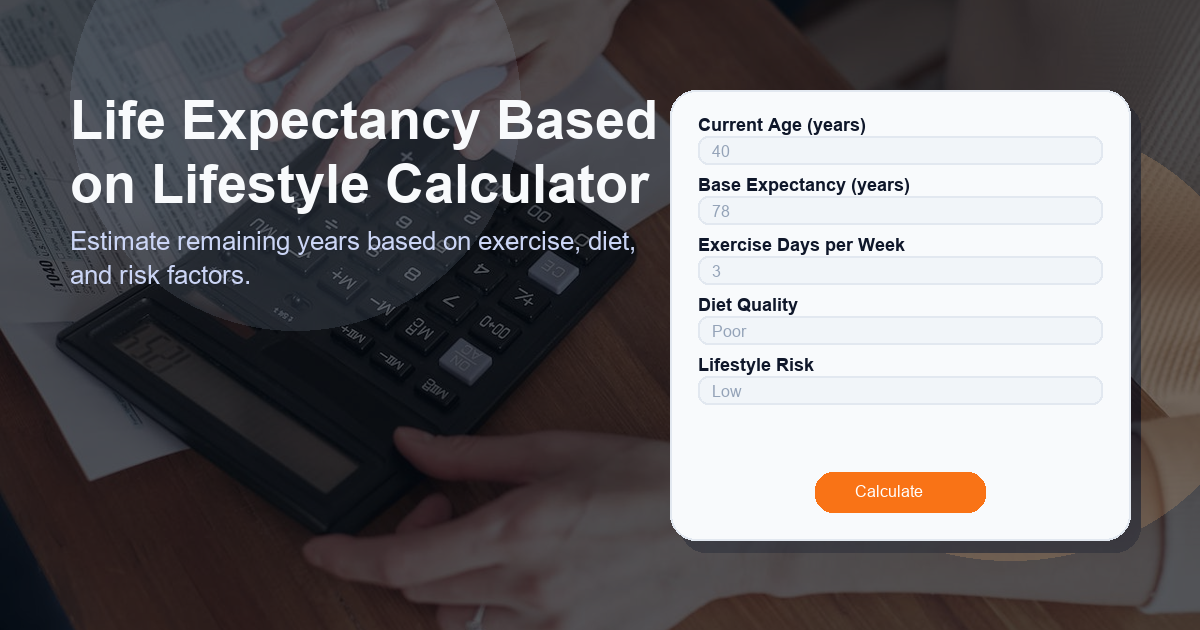
Life Expectancy Based on Lifestyle Calculator
Description: Estimate remaining years based on exercise, diet, and risk factors using the Life Expectancy Based on Lifestyle Calculator. This practical tool combines your current age, base life expectancy, exercise frequency, diet quality, and lifestyle risk to produce an accessible estimate labeled as Estimated Remaining Years.
What this Life Expectancy Based on Lifestyle Calculator calculator does
The Life Expectancy Based on Lifestyle Calculator provides a simple, transparent estimate of how many years an individual might have remaining based primarily on modifiable lifestyle variables. It is meant to be an illustrative guide — not medical advice — and can help users understand how changes in exercise, diet, and risk behaviors could affect theoretical remaining lifespan.
Key outcomes:
- Estimated Remaining Years: A numeric estimate of remaining lifespan derived from the input variables.
- Clear breakdown of how each factor (exercise, diet, and risk) contributes to the result.
- A quick, easy-to-use mental model to motivate healthier choices.
How to use the Life Expectancy Based on Lifestyle Calculator calculator
Using this calculator is straightforward. Provide five inputs and the formula returns your estimated remaining years. The calculator is designed to be intuitive for non-experts while being explicit about how each variable affects the outcome.
Required inputs:
- Current Age (years) — your current chronological age in years.
- Base Expectancy (years) — a baseline life expectancy for your population or chosen benchmark (for example, local average life expectancy at birth or expected lifespan for similar demographics).
- Exercise Days per Week — number of days per week you exercise (0–7).
- Diet Quality — a numeric score representing overall diet quality (use a consistent scale; for example, -2 for poor up to +5 for excellent, or any scale you choose consistently).
- Lifestyle Risk — a numeric penalty representing negative lifestyle risks (smoking, heavy alcohol use, unmanaged chronic disease, dangerous occupation). Higher values reduce remaining years more.
Calculator formula (as implemented by this tool):
base_expectancy + diet_quality + (exercise_days - 3) * 0.4 - risk_factor - current_ageResult label: Estimated Remaining Years
Example: If you are 50 years old, have a base expectancy of 80, exercise 5 days/week, diet quality +2, and lifestyle risk 3:
- base_expectancy = 80
- diet_quality = 2
- exercise_days = 5 → (5 − 3) × 0.4 = 0.8
- risk_factor = 3
- current_age = 50
Calculation: 80 + 2 + 0.8 − 3 − 50 = 29.8 Estimated Remaining Years (rounded as desired).
How the Life Expectancy Based on Lifestyle Calculator formula works
The formula is intentionally simple so that the influence of each input is clear and interpretable. Below is a breakdown of each term and why it is included:
- base_expectancy: Serves as the starting point — typically a population-level life expectancy or a benchmark you choose.
- + diet_quality: Adds or subtracts years based on dietary quality. Good nutrition can incrementally increase longevity in the model; poor nutrition decreases it.
- + (exercise_days − 3) × 0.4: Provides a moderate benefit for exercising more than three days per week and a penalty for exercising less. The multiplier 0.4 approximates a modest per-day effect; exercising two more days than the 3-day baseline gives +0.8 years, for example.
- − risk_factor: Subtracts a penalty for negative lifestyle elements such as smoking, hazardous occupations, heavy alcohol use, or uncontrolled chronic conditions. This is intentionally a direct subtraction to reflect tangible harms.
- − current_age: Converts the absolute expected lifespan into the number of remaining years by subtracting current age.
Why these choices? The model assumes a simple additive structure so users can easily see the marginal effect of each variable. Exercise and diet are treated as incremental adjustments to a base expectancy, while risk factors are direct penalties. The benchline of three exercise days per week is arbitrary but reflects a moderate activity baseline; adjust the baseline and coefficients if you want a different sensitivity.
Use cases for the Life Expectancy Based on Lifestyle Calculator
This calculator has multiple practical uses across personal planning, health coaching, and education:
- Personal motivation: See a numeric estimate that links concrete lifestyle choices (exercise or diet) to potential changes in remaining years. It can motivate gradual improvements.
- Health coaching: Coaches can use the tool to demonstrate the comparative value of different behavior changes (e.g., improving diet vs. increasing exercise frequency).
- Planning and financial decisions: Use an estimated remaining lifespan to inform retirement planning scenarios, long-term care preparation, or insurance considerations.
- Educational demonstration: Teachers and public health communicators can use the simple model to illustrate population health concepts and how multiple factors combine.
Note: Because the calculator is intentionally simplified, it is most useful for scenario comparison and motivation rather than precise actuarial or medical decision-making.
Other factors to consider when calculating life expectancy
While this calculator focuses on exercise, diet, and lifestyle risk, many other variables influence true life expectancy. Consider the following when interpreting results:
- Genetics: Family history of disease, genetic predispositions, and inherited conditions can strongly affect lifespan.
- Medical care: Access to preventive care, early diagnosis, and treatment of chronic illnesses changes outcomes significantly.
- Socioeconomic factors: Income, education, housing, and social support networks correlate with long-term health.
- Mental health and stress: Chronic stress, depression, and social isolation have measurable impacts on longevity.
- Environment: Air quality, pollution, and occupational hazards can augment or reduce risk.
- Data and scale selection: The meaning of “base_expectancy” and numeric scales for diet_quality and risk_factor matter. Inconsistent scaling will produce misleading results.
Because of these factors, use the Life Expectancy Based on Lifestyle Calculator as a guide, not a definitive forecast. Discuss medical concerns with a qualified healthcare professional.
FAQ
Q: Is this calculator medically accurate?
A: No. This calculator is a simplified model for educational and planning purposes. It does not replace personalized medical advice, diagnostic tools, or actuarial life tables. For precise medical or financial planning, consult professionals.
Q: What scale should I use for Diet Quality and Lifestyle Risk?
A: The calculator accepts any consistent numeric scale. A practical approach is to use a small integer range (for example, diet_quality from −2 to +5 and risk_factor from 0 to 10). The important part is consistency: use the same scale each time you compare scenarios.
Q: Why does exercise use (exercise_days − 3) × 0.4?
A: The (exercise_days − 3) term sets three days per week as a neutral baseline. Each day above or below that baseline changes the estimate by 0.4 years. This coefficient is an adjustable sensitivity parameter; you may calibrate it to reflect stronger or weaker exercise effects.
Q: Can the result be negative?
A: Yes. If inputs imply a remaining years value below zero (for example, current age exceeds the adjusted base expectancy), the calculator will yield a negative number. Interpret negative results as an indicator that the chosen base expectancy and adjustments do not align with the current age and should be reviewed.
Q: How can I use this tool to improve my estimate?
A: Try scenario comparisons: increase exercise_days, improve diet_quality, or reduce risk_factor to see how the estimate changes. Use realistic, evidence-based changes and consult health professionals for meaningful long-term planning.
Final note: The Life Expectancy Based on Lifestyle Calculator is a clear, editable way to visualize the relationship between lifestyle choices and expected remaining years. Use it responsibly and as a prompt for healthier decisions rather than a definitive prognosis.