Life Expectancy Based on BMI Calculator
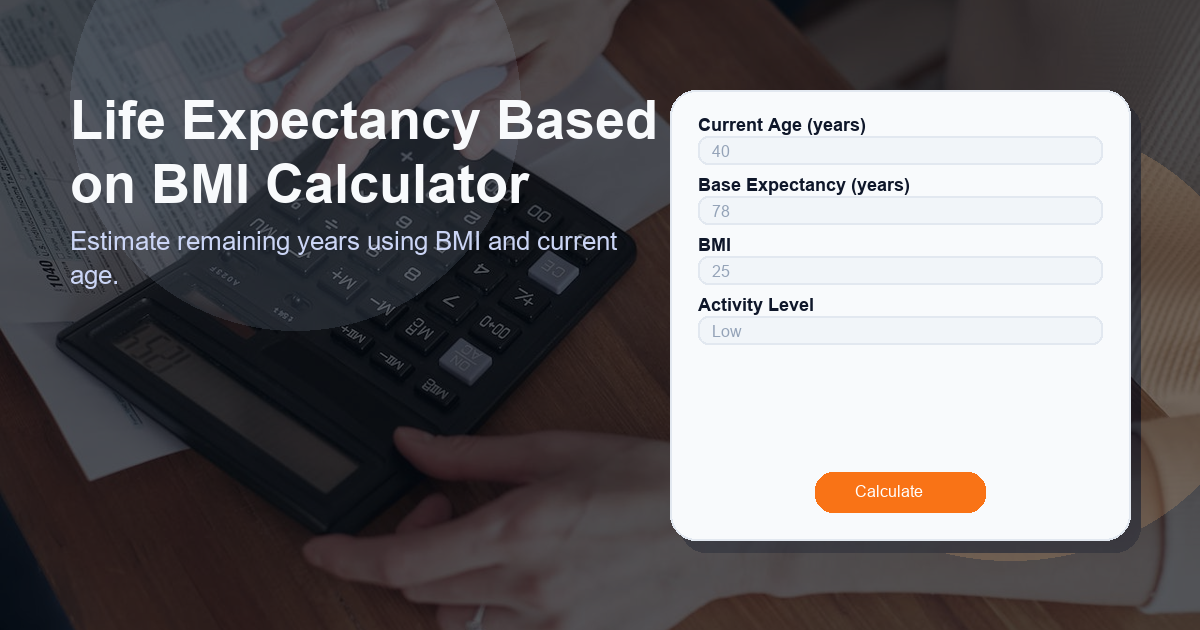
Life Expectancy Based on BMI Calculator is a simple tool to help you estimate your remaining years of life using four inputs: Current Age, Base Expectancy, BMI, and Activity Level. This calculator provides a quick, intuitive estimate labeled Estimated Remaining Years so you can better understand how body mass index and lifestyle factors might relate to longevity. Use this estimator as a high-level guide — not a medical diagnosis.
What this Life Expectancy Based on BMI Calculator calculator does
This Life Expectancy Based on BMI Calculator uses a straightforward formula to combine a baseline life expectancy with the impact of BMI above a healthy threshold, adjusted by a self-reported activity-level boost, and then subtracts your current age to return an estimate of remaining years. In short, the calculator helps you:
- Estimate remaining life years given current age and BMI
- See the relative impact of being above the BMI threshold (BMI > 25)
- Understand how increased activity may add to expected years
- Provide a simple planning metric for lifestyle changes
Important: This tool is an approximate model and does not replace medical advice, genetic testing, or a comprehensive health assessment.
How to use the Life Expectancy Based on BMI Calculator calculator
Using the calculator is easy. Enter the following inputs and the calculator will output your Estimated Remaining Years.
- Current Age (years) — your age now in full years.
- Base Expectancy (years) — a baseline life expectancy for your demographic (for example, a national average or a professionally provided life expectancy).
- BMI — your body mass index (weight in kg / height in m²). If you only have pounds/inches, convert to metric first, or use an online converter.
- Activity Level — a simple numeric adjustment to represent physical activity. This can be a positive number to reflect protective benefits (e.g., +1 to +5 years), or zero if not accounted for.
Step-by-step:
- Enter your Current Age, Base Expectancy, BMI, and a numeric Activity Level.
- Click calculate and read the Estimated Remaining Years result.
- Interpret the result as an estimate. If the output is negative, that indicates you’ve already exceeded the provided base expectancy after accounting for BMI and activity adjustments.
Example:
- Current Age = 45
- Base Expectancy = 82
- BMI = 30 (5 points over 25)
- Activity Level = +2
Using the formula (explained below), the calculator would provide an Estimated Remaining Years value you can use for planning or comparison.
How the Life Expectancy Based on BMI Calculator formula works
The calculator uses the formula:
Estimated Remaining Years = base_expectancy – ((Math.max(0, bmi – 25)) * 0.3) + activity_level – current_age
Explanation of each part:
- base_expectancy — the starting life expectancy in years. This is the baseline from which adjustments are made.
- Math.max(0, bmi – 25) — this ensures only BMI points above the threshold of 25 reduce life expectancy. If BMI ≤ 25, this term is zero (no penalty).
- 0.3 — the factor that converts each BMI point above 25 into a reduction of 0.3 years of expected life. For example, 5 BMI points over 25 reduces expectancy by 1.5 years (5 × 0.3).
- activity_level — a positive or zero adjustment representing protective effects from physical activity. Higher activity levels increase estimated years.
- current_age — subtracting current age yields the remaining years relative to the baseline expectation.
Interpretation notes:
- If bmi ≤ 25, then the BMI penalty is zero — the calculator does not add years for BMI below 25 in this model, but you can reflect healthy BMI via a higher base expectancy or activity value.
- The BMI penalty is linear: each BMI point above 25 reduces life expectancy by 0.3 years.
- Activity level is additive: it increases the final estimate directly in years.
- The output label is Estimated Remaining Years. If the value is negative, it indicates the computed life expectancy is less than your current age given the inputs.
Example calculation (continued):
- BMI over 25 = 30 − 25 = 5
- BMI penalty = 5 × 0.3 = 1.5 years
- Adjusted expectancy = 82 − 1.5 + 2 = 82.5
- Estimated Remaining Years = 82.5 − 45 = 37.5 years
Result shown as: Estimated Remaining Years: 37.5
Use cases for the Life Expectancy Based on BMI Calculator
This calculator has many practical uses. Typical scenarios include:
- Personal planning: Individuals estimating retirement timelines, long-term care needs, or life insurance considerations.
- Behavioral change motivation: Comparing estimated years before and after a projected BMI reduction or increased activity can motivate healthier habits.
- Health coaching: Coaches can show clients how activity-level improvements and weight changes may influence their estimated longevity.
- Public health communications: Simple demonstrations of population-level effects of higher BMI on life expectancy.
- Preliminary screening: A first-pass tool to spotlight when a clinical evaluation might be warranted based on large negative impacts.
Use this tool as a conversation starter and planning aid rather than a precise predictor.
Other factors to consider when calculating life expectancy
While the Life Expectancy Based on BMI Calculator provides a focused estimate, many additional factors influence actual longevity. Consider these when interpreting results:
- Genetics: Family history and inherited conditions can profoundly affect lifespan.
- Smoking, alcohol, and substance use: These can substantially decrease life expectancy independent of BMI.
- Chronic conditions: Diabetes, cardiovascular disease, cancer, and other conditions change risk profiles.
- Sociodemographic factors: Income, education, and access to healthcare influence outcomes.
- Diet quality and body composition: BMI doesn’t distinguish fat vs. muscle. Athletic individuals with higher BMI might not have the same risks as individuals with excess fat.
- Mental health and stress: Chronic stress and mental illness can affect longevity.
- Environmental exposures: Pollution, occupational hazards, and geographic location matter.
- Medical advances: New treatments and preventive measures can change population life expectancy over time.
Tip: To get a fuller picture, combine this calculator’s estimate with clinical screening, biometric data, and professional medical advice.
FAQ
Is the Life Expectancy Based on BMI Calculator accurate?
No calculator can predict an individual’s exact lifespan. This model provides a simplified estimate designed for comparison and planning. It uses BMI and activity-level adjustments to modify a baseline expectancy, so its accuracy depends on how well the base expectancy and activity adjustment reflect your real situation.
Can my BMI increase estimated remaining years?
In this formula, only BMI values above 25 reduce life expectancy (via a penalty). BMI below or equal to 25 does not increase expectancy in the BMI term. However, you can reflect beneficial effects through a higher Activity Level or by choosing an appropriate Base Expectancy.
How should I choose the Activity Level number?
Activity Level is a user-provided numeric adjustment representing protective benefits of exercise. There’s no universal scale built into the calculator, but common practice is to use small positive integers (e.g., 0–5) to reflect none to high activity. Be consistent when comparing scenarios.
What is Base Expectancy and where do I get it?
Base Expectancy is a baseline life expectancy value such as a national average for your age/gender or an estimate from actuarial tables. Use reputable sources like government life tables, actuarial tables, or clinician-provided estimates.
Can I use this for children or adolescents?
This calculator is intended for adults. BMI interpretation and life expectancy considerations differ for children and adolescents; use age-appropriate pediatric growth charts and consult healthcare providers for youth-specific assessments.
Final note: The Life Expectancy Based on BMI Calculator is a useful tool for quick insight but should be used alongside professional guidance and a holistic view of health. Always consult a healthcare professional for personalized medical advice.