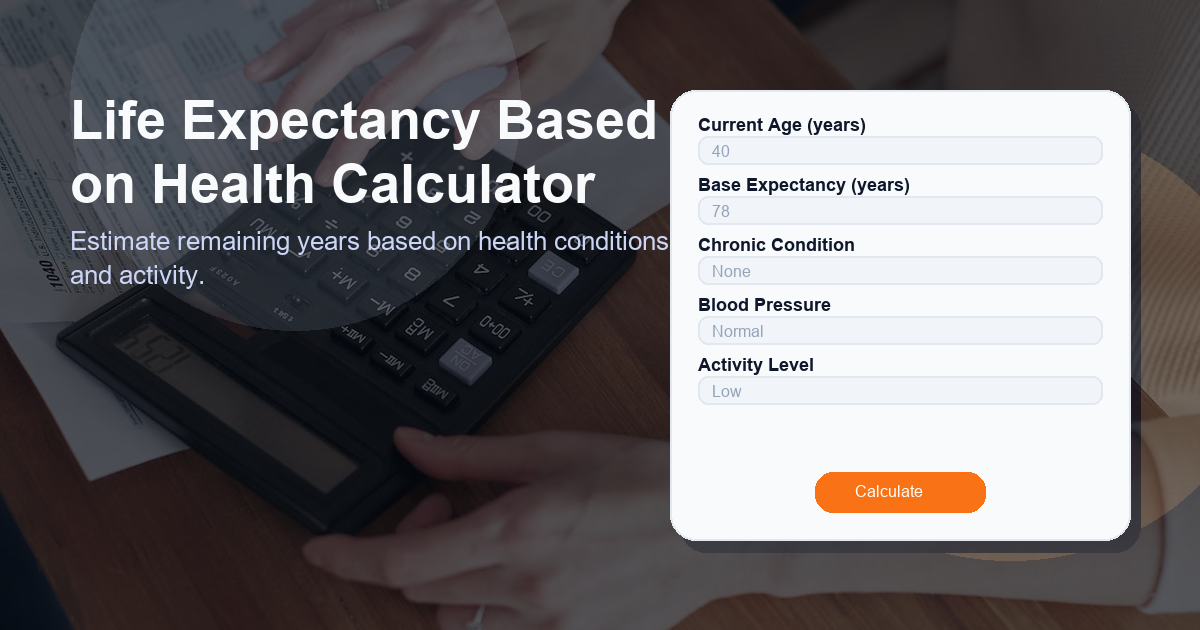
Life Expectancy Based on Health Calculator
Estimate remaining years based on health conditions and activity with the Life Expectancy Based on Health Calculator. This article explains what the calculator does, how to use it, the exact formula behind it, practical use cases, and other factors to consider when interpreting results. If you want a quick, health-centered estimate of your remaining years, this calculator provides an accessible way to combine key inputs into an easy-to-read projection labeled Estimated Remaining Years.
What this Life Expectancy Based on Health Calculator calculator does
The Life Expectancy Based on Health Calculator produces a simple numeric estimate of how many years you may have remaining, based on a few customizable inputs. It is not a medical diagnostic tool but a quick predictive model designed to reflect how chronic conditions, blood pressure, and activity levels can influence expected lifespan relative to a baseline.
Key outcomes:
- Numeric estimate of remaining years: the result is presented as Estimated Remaining Years.
- Comparative adjustment from a base expectancy using your health indicators.
- Fast, easy-to-understand output designed for personal planning and awareness.
The calculator is ideal for individuals who want a high-level sense of how specific health factors might shift their expected lifespan from a baseline value.
How to use the Life Expectancy Based on Health Calculator calculator
Using the Life Expectancy Based on Health Calculator is straightforward. You only need five inputs:
- Current Age (years) — your present chronological age.
- Base Expectancy (years) — a baseline life expectancy figure (for example, the national average or a medically recommended baseline).
- Chronic Condition — a numerical penalty representing the impact of long-term illnesses (for instance, 0 for none, 1–10 scale for severity/number of conditions).
- Blood Pressure — a numerical penalty for blood pressure issues (e.g., 0 if normal, higher values for unmanaged hypertension).
- Activity Level — a positive numerical adjustment for physical activity (e.g., 0 for sedentary, higher values for more active lifestyles).
Step-by-step:
- Enter your Current Age in years.
- Select or input an appropriate Base Expectancy (for example, 80 years).
- Assign values for Chronic Condition and Blood Pressure based on severity.
- Choose an Activity Level value to reflect your typical exercise and movement.
- Apply the formula (explained below) to calculate your Estimated Remaining Years.
Example: If you are 50 years old, set Base Expectancy = 80, Chronic Condition = 5, Blood Pressure = 2, Activity Level = 3. Then the calculator returns an Estimated Remaining Years based on those inputs (see formula section for the arithmetic).
How the Life Expectancy Based on Health Calculator formula works
The formula used by the Life Expectancy Based on Health Calculator is intentionally simple and transparent:
Estimated Remaining Years = base_expectancy – chronic_condition – blood_pressure + activity_level – current_age
Breakdown of formula components:
- base_expectancy: The starting point in years from which adjustments are made.
- chronic_condition: Subtracts years to reflect the impact of long-term illnesses.
- blood_pressure: Subtracts years to account for hypertension or other blood-pressure-related risk.
- activity_level: Adds years to reflect the positive impact of regular physical activity.
- current_age: Subtracts your current age to give the remaining years from now.
Why this structure? The model is additive and subtractive to make it easy to understand: start with an expected total lifespan, subtract penalties for risk factors, add benefits for healthy behaviors, and subtract your current age to arrive at remaining years.
Worked example:
- Base Expectancy = 82
- Chronic Condition = 4
- Blood Pressure = 3
- Activity Level = 5
- Current Age = 60
Estimated Remaining Years = 82 – 4 – 3 + 5 – 60 = 20 years
The result label returned by the calculator is Estimated Remaining Years, which tells you how many years, on average and according to the input assumptions, you might expect to live beyond your current age.
Use cases for the Life Expectancy Based on Health Calculator
This calculator is useful in several practical scenarios:
- Personal planning — helps with retirement planning, long-term care decisions, and goal-setting based on a health-influenced projection.
- Health awareness — provides a simple way to see the relative impact of activity and health issues, motivating lifestyle changes.
- Education — useful for teaching basic risk-adjusted life expectancy concepts in health classes or workshops.
- Comparative analysis — compare the effect of reducing blood pressure or increasing activity level on your remaining years.
Because the model is transparent and easy to manipulate, users can run scenarios: for example, see how increasing Activity Level by 3 points changes Estimated Remaining Years, or how reducing Chronic Condition penalties through improved care shifts projections.
Other factors to consider when calculating x
Note: in this section, “x” refers to life expectancy. The Life Expectancy Based on Health Calculator simplifies many complex influences into a few inputs. Before relying on the output for critical decisions, consider these other important factors that the calculator does not fully capture:
- Genetics: Family history of disease can strongly influence longevity but is not directly modeled here.
- Socioeconomic status: Access to healthcare, nutrition, and living conditions can change life expectancy.
- Mental health and stress: Chronic stress and mental health conditions impact physical health and longevity.
- Medication and medical treatment: Effective management of conditions can reduce their penalty on lifespan.
- Diet, sleep, and lifestyle: The calculator uses Activity Level as a proxy, but diet quality and sleep duration have independent effects.
- Environmental exposures: Pollution, occupational hazards, and location-specific risks are not included.
- Random variation: Chance events and unpredictable illnesses mean any single estimate has uncertainty.
Because of these additional variables, treat the calculator as an informative guide rather than a definitive prediction. Use it to explore trends, not to replace medical advice. For precise health planning, consult a qualified healthcare professional who can integrate medical history, tests, and clinical judgment.
FAQ
Is the Life Expectancy Based on Health Calculator medically accurate?
No. The calculator provides a simplified estimate using a transparent formula. It is useful for comparisons and awareness but is not a substitute for clinical evaluation or personalized medical advice.
How should I choose values for Chronic Condition and Blood Pressure?
Choose values that meaningfully reflect severity in your view. A common approach is a scale (e.g., 0–10) where 0 = none and higher numbers indicate greater severity. Be consistent when comparing scenarios.
Can improving my Activity Level increase my Estimated Remaining Years?
Yes. Activity Level is added in the formula, so raising this value will increase the calculated Estimated Remaining Years. Use the calculator to model the potential benefits of becoming more active.
What does Base Expectancy mean and how do I pick it?
Base Expectancy is a starting life expectancy, often a national or demographic average (e.g., 78 or 82 years). Choose a baseline that matches your population or a medically informed estimate for better context.
What should I do if my result is a negative number?
A negative Estimated Remaining Years suggests the modeled penalties exceed the base expectancy minus your current age. It indicates either very high penalties or a baseline mismatch. Re-evaluate inputs or consult a professional for interpretation rather than assuming immediate risk.
For consistent, clear use, always label results as Estimated Remaining Years and treat them as scenario-based projections to guide conversations with healthcare providers or personal planning.