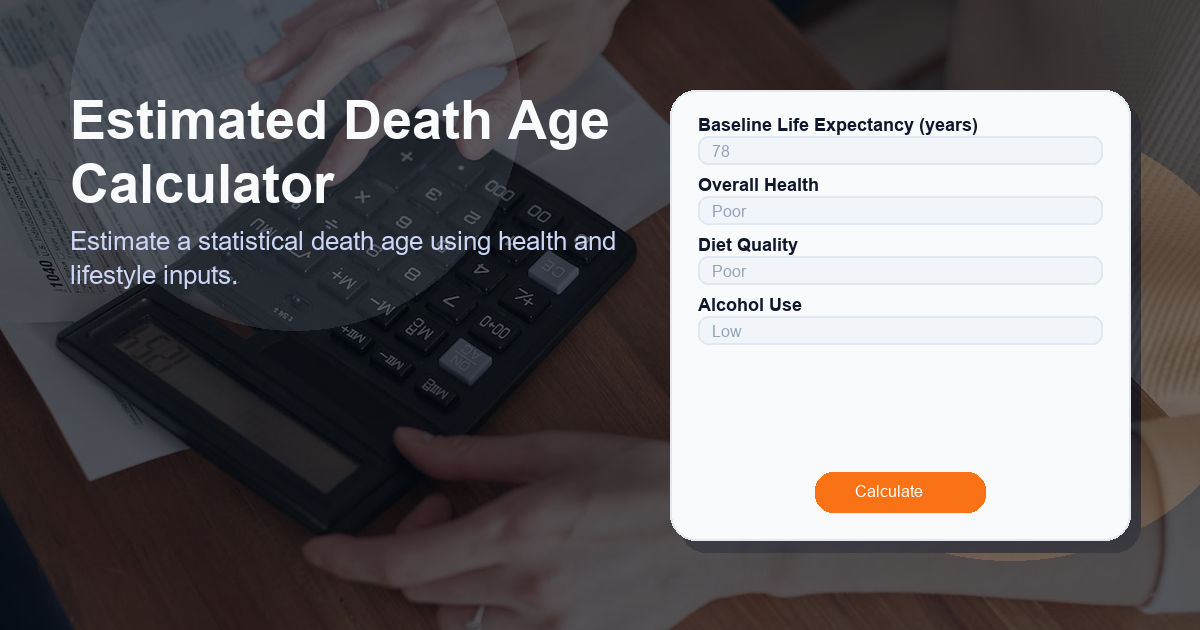
Estimated Death Age Calculator
Description: Estimate a statistical death age using health and lifestyle inputs with the Estimated Death Age Calculator. This simple tool uses a baseline life expectancy plus adjustments for overall health, diet quality, and alcohol use to produce an Estimated Age at Death.
What this Estimated Death Age Calculator calculator does
The Estimated Death Age Calculator provides a quick, statistical estimate of an individual’s likely age of death based on a compact set of inputs. It is designed for educational and planning purposes only and should not be interpreted as a clinical or deterministic prediction.
This calculator:
- Starts from a baseline life expectancy (you provide a baseline in years).
- Adds or subtracts adjustments for overall health, diet quality, and alcohol use.
- Produces a clear, single output labeled Estimated Age at Death.
Use the result as a way to understand how lifestyle factors might statistically shift your expected lifespan, and to guide conversations with healthcare providers or life planners.
How to use the Estimated Death Age Calculator calculator
Using the Estimated Death Age Calculator is straightforward. You need four inputs. Enter realistic values to get a meaningful estimate.
- Baseline Life Expectancy (years) — Typically an average value based on your country, sex, and demographic factors. Example: 78 years.
- Overall Health — A numeric index reflecting your general health status. Positive values increase life expectancy; negative values decrease it. Example scale: -5 to +10.
- Diet Quality — A numeric score representing how healthy your diet is. Higher positive values represent healthier diets that can extend life expectancy.
- Alcohol Use — A numeric penalty representing the negative impact of alcohol consumption. Higher values reduce expected lifespan.
After entering values for each input, the calculator applies the formula and displays the Estimated Age at Death as a single number in years.
Example: If Baseline Life Expectancy = 78, Overall Health = +4, Diet Quality = +2, Alcohol Use = 3, then:
- Estimated Age at Death = 78 + 4 + 2 – 3 = 81 years.
How the Estimated Death Age Calculator formula works
The calculator uses a simple, transparent formula to combine inputs into a single age estimate. The formula is:
base_expectancy + health_index + diet_quality - alcohol_use
Breakdown of the formula components:
- base_expectancy: The starting point (in years). This is often an average life expectancy for a population or a personalized baseline based on demographics.
- health_index: A numeric adjustment derived from the individual’s overall health. Better health adds years; poorer health subtracts years.
- diet_quality: A positive adjustment for nutritious, balanced diets known to support longevity.
- alcohol_use: A subtraction to reflect the increased health risks associated with heavier alcohol consumption.
The formula is intentionally linear and additive for clarity. It provides a rapid, understandable estimate rather than a complex probabilistic model. That simplicity makes it useful for educational comparisons and scenario planning (for example, “what if I improve my diet by 2 points?”).
Important: the numeric scales for Overall Health, Diet Quality, and Alcohol Use should be consistent. Decide on a consistent range (for example, -10 to +10 for health, 0 to +10 for diet, and 0 to 10 for alcohol penalty) before using the calculator for comparisons.
Use cases for the Estimated Death Age Calculator
The Estimated Death Age Calculator can be used in several practical and educational contexts:
- Personal planning: Assess how lifestyle changes—improvements in diet or reductions in alcohol—might influence your estimated lifespan.
- Health coaching: Coaches can use the tool to demonstrate the relative impact of different behaviors on expected longevity.
- Workshops and classes: Educators can quickly illustrate statistical concepts related to life expectancy and risk reduction.
- Financial planning: Use the estimated age to explore long-term savings, retirement, and insurance needs under different lifestyle scenarios.
- Comparative experiments: Try multiple input sets to compare how changing one factor (for example, alcohol use) alters the projected age.
Because the calculator is transparent and easy to use, it’s particularly good for “what-if” scenarios and to motivate incremental behavioral changes.
Other factors to consider when calculating Estimated Death Age
While the calculator focuses on four inputs, many additional factors influence real-world life expectancy. Consider these before treating the output as a precise forecast:
- Genetics and family history: Hereditary conditions and familial longevity can significantly affect actual outcomes.
- Access to healthcare: Preventive care and timely treatment profoundly influence lifespan.
- Socioeconomic status: Income, education, and environment shape health behaviors and access to resources.
- Physical activity: Exercise and mobility are strong predictors of longevity but are not explicitly modeled here unless incorporated into the health index.
- Mental health and stress: Chronic stress and mental health conditions can shorten lifespan over time.
- Environmental exposures: Pollution, occupational hazards, and living conditions matter.
- Random events: Accidents and acute illnesses are unpredictable and can dramatically alter outcomes.
Because of these additional influences, interpret the Estimated Age at Death as an informative but limited snapshot. Use it alongside professional medical advice and other predictive tools for a more comprehensive view.
FAQ
1. Is the Estimated Death Age Calculator medically accurate?
No. The calculator provides a statistical and simplified estimate based on the inputs you provide. It is not a substitute for professional medical assessment. Use it as an educational or planning aid rather than a definitive medical prediction.
2. What scale should I use for Overall Health, Diet Quality, and Alcohol Use?
There is no single required scale, but consistency matters. A common approach is to use a health index between -10 and +10, diet quality between 0 and +10, and alcohol penalty between 0 and 10. Document your scale before comparing results across different runs.
3. Can lifestyle changes change the Estimated Age at Death significantly?
Yes, improving aspects such as diet and reducing harmful alcohol use can increase the calculated estimate. The tool is useful for demonstrating relative impacts; however, real-life changes in longevity depend on many interacting factors and often happen over years.
4. Should I include other behaviors like smoking or exercise?
You can incorporate additional behaviors by translating them into the existing input categories (for example, include smoking effects in the health index or alcohol penalty) or by extending the calculator. Be transparent about how you map behaviors to numeric adjustments.
5. Is this calculator suitable for financial retirement planning?
It can be a helpful starting point for scenario planning, but financial planners typically use a range of life expectancy assumptions. Combine this tool’s output with actuarial tables and professional financial advice for retirement decisions.
Disclaimer: The Estimated Death Age Calculator is intended for informational and educational use only. It simplifies complex health and demographic relationships and should not replace personalized advice from qualified healthcare or financial professionals.