When Will I Die Calculator
Description: Provide a statistical estimate of year of death based on inputs. The When Will I Die Calculator gives a simple, transparent projection of an Estimated Year of Death using your current age, the present year, a baseline life expectancy, and a health adjustment factor. This page explains what the calculator does, how to use it, the formula behind it, practical use cases, and additional factors you should consider.
What this When Will I Die Calculator calculator does
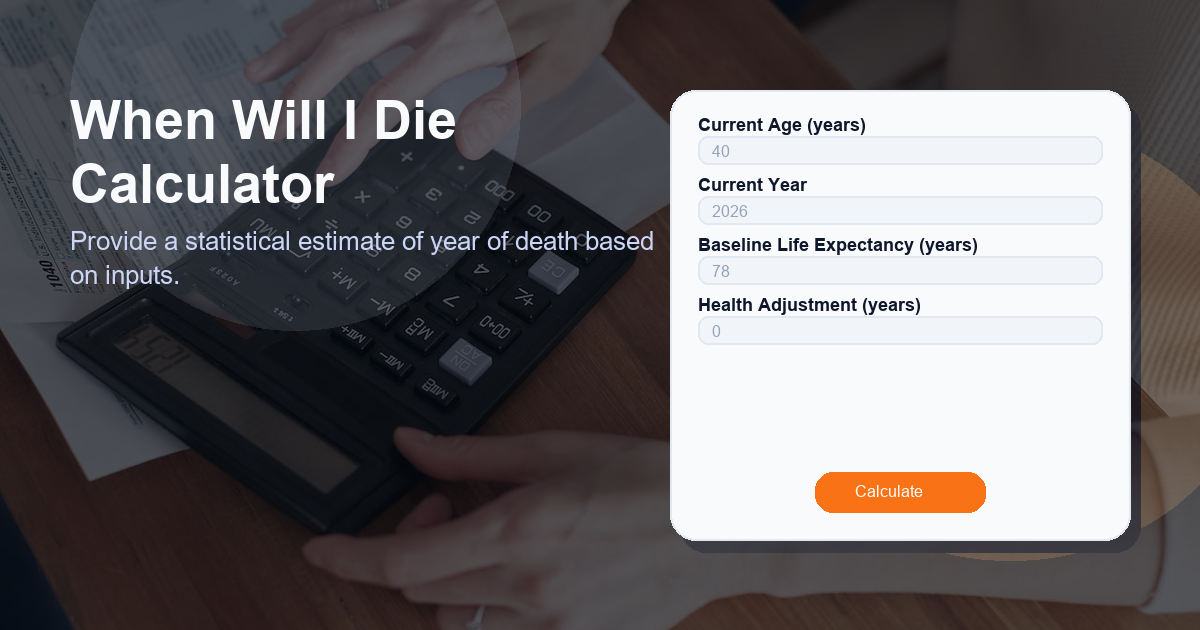
The When Will I Die Calculator produces a straightforward, statistically informed estimate of the year you are likely to die based on four inputs:
- Current Age (years)
- Current Year
- Baseline Life Expectancy (years) — typically drawn from national life tables or actuarial data
- Health Adjustment (years) — a positive or negative adjustment to reflect personal health, lifestyle, or medical conditions
Using these inputs, the calculator computes an Estimated Year of Death using a clear formula. It is important to understand that this is a statistical estimate, not a definitive prediction. The estimate helps with planning, research, and making informed choices — but it cannot account for every individual variation or random event.
How to use the When Will I Die Calculator calculator
Using the When Will I Die Calculator is simple. Follow these steps to produce your estimate:
- Enter your Current Age in years. This should be a whole or decimal number representing your age now.
- Enter the Current Year (for example, 2026). The calculation anchors the estimate to a calendar year.
- Provide a Baseline Life Expectancy. Use a value from reputable sources such as national life expectancy tables, social security actuarial tables, or published longevity research. For example, many developed countries have baseline life expectancies between 75 and 85 years.
- Choose a Health Adjustment. This is a modifier in years. Enter a positive number if your personal health/lifestyle suggests you might outlive the baseline (for example, +5), or a negative number if you have health risks that could shorten your life expectancy (for example, -7).
- Compute the result — the calculator will output the Estimated Year of Death using the formula described below.
Example: Current Age = 30, Current Year = 2026, Baseline Life Expectancy = 82, Health Adjustment = -3. The calculator returns an estimated year of death of 2026 + (82 + (-3) – 30) = 2055. That is, Estimated Year of Death: 2055.
How the When Will I Die Calculator formula works
The formula used by the calculator is deliberately transparent and easy to audit:
Formula: current_year + (base_expectancy + health_adjustment – current_age)
Breaking this down:
- base_expectancy + health_adjustment produces a personalized life expectancy in years from birth (for example, 82 years).
- base_expectancy + health_adjustment – current_age calculates the remaining expected years of life from now.
- current_year + remaining expected years converts that remaining lifespan into a calendar year — the Estimated Year of Death.
Why this simple arithmetic makes sense:
- Life expectancy values are typically expressed as an expected age at death (for example, 82 years old).
- Subtracting your current age gives expected remaining years.
- Adding the remaining years to the current year gives the likely calendar year of death, under the assumptions of the model.
Example calculations demonstrate edge cases and validation steps:
- If the result produces a year less than the current year, the model suggests that the baseline and adjustments are inconsistent with survival to today — validate your inputs.
- If the health adjustment is extremely large (positive or negative), consider whether that value is realistic. The model is linear and sensitive to large adjustments.
Use cases for the When Will I Die Calculator
This calculator can be useful for a variety of practical and investigative purposes. Typical use cases include:
- Financial and retirement planning: Estimate whether your savings horizon aligns with expected lifespan.
- Estate planning: Roughly time wills, trusts, or beneficiary arrangements based on likely lifetime horizons.
- Health and lifestyle decisions: Evaluate the potential impact of a healthier lifestyle (e.g., exercise, quitting smoking) by changing the health adjustment and comparing outcomes.
- Research and teaching: Demonstrate basic actuarial calculations for students or in presentations about population mortality trends.
- Curiosity and personal planning: Satisfy curiosity in a structured way while recognizing the estimate’s limitations.
Each use case benefits from understanding that the calculator is a communication tool — it frames expectations using available statistics, but it is not a substitute for professional actuarial, medical, or legal advice.
Other factors to consider when calculating your estimate
While the When Will I Die Calculator is intentionally simple, many additional factors can influence actual lifespan. Consider the following before relying on the estimate:
- Genetics: Family history can significantly shift individual risk but is hard to quantify in years without genetic risk models.
- Socioeconomic status: Income, access to healthcare, education, and environment all correlate with life expectancy.
- Medical interventions: New treatments or surgeries can extend life beyond historical baselines.
- Random events: Accidents, natural disasters, or sudden illnesses are inherently unpredictable.
- Population-level changes: Pandemics, environmental changes, or advances in public health can raise or lower baseline life expectancy quickly.
Because of these variables, use the calculator as a planning aid rather than a precise prophecy. If you need a rigorous projection for legal, financial, or medical planning, consult qualified professionals who can incorporate more detailed data and stochastic modeling.
FAQ
Q: Is the When Will I Die Calculator accurate?
A: The calculator provides a statistical estimate based on input parameters. It is only as accurate as the baseline life expectancy and health adjustment you provide. It does not account for unpredictable events or all individual-specific risk factors. Use it for high-level planning, not definitive answers.
Q: Where do I get a reliable baseline life expectancy?
A: Reliable sources include national life tables from government statistics agencies, actuarial tables from pension providers, or reputable global datasets like the World Bank or World Health Organization life expectancy reports. Choose a baseline that matches your country, sex, and cohort where possible.
Q: How should I choose the Health Adjustment value?
A: The health adjustment is a subjective modifier to reflect personal health and lifestyle relative to the baseline. Use small, conservative adjustments (for example, +/- 1–10 years) unless you have clinical or actuarial justification for larger changes. Consider consulting a healthcare provider for more precise risk estimates.
Q: Can this calculator replace medical or actuarial advice?
A: No. This tool is informational and educational. For legal, financial, or medical decisions that depend on precise longevity estimates, consult licensed professionals who can provide tailored modeling and assessment.
Q: What happens if my input values create unrealistic results?
A: If the calculated Estimated Year of Death appears implausible (for example, earlier than the current year or extremely far in the future), re-check your inputs for typos, review your baseline life expectancy and health adjustment, and consider if the model’s assumptions are appropriate for your situation.
Summary: The When Will I Die Calculator is a simple, transparent tool that converts life expectancy inputs into a calendar year estimate. Use it to inform planning and conversations, but always pair the results with professional advice and awareness of real-world uncertainty.