Predicted Death Age Calculator
What this Predicted Death Age Calculator calculator does
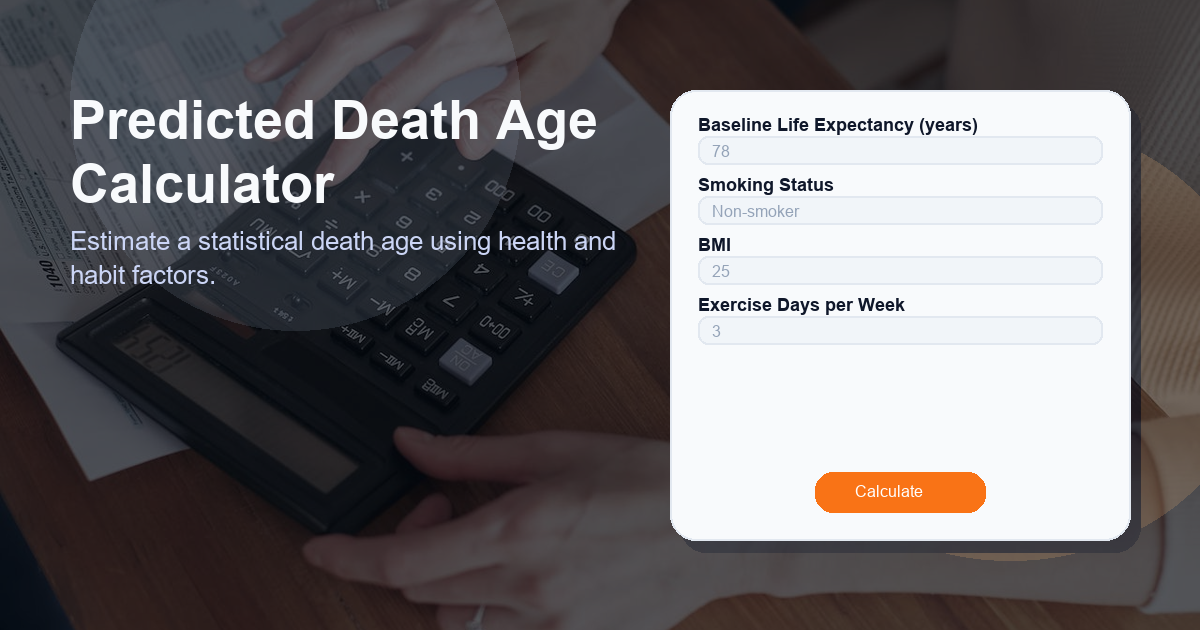
The Predicted Death Age Calculator is a simple, evidence-informed tool designed to provide an estimated, statistical age at death based on a few core lifestyle and body metrics. This calculator uses a baseline life expectancy you provide and adjusts it using three health and habit factors: BMI (body mass index), smoking status, and exercise days per week. The output is labeled as the Predicted Age at Death, which is intended as an approximate, comparative figure—not a medical prognosis.
Use this Predicted Death Age Calculator to explore how changing habits or body metrics could affect a statistical estimate of life expectancy. It’s most useful for understanding relative impacts, planning lifestyle changes, or illustrating public-health concepts.
How to use the Predicted Death Age Calculator calculator
Using the calculator is straightforward. You enter four inputs and the formula computes the estimate. The inputs required are:
- Baseline Life Expectancy (years) – your starting, average life expectancy (for a population or individual estimate).
- Smoking Status – a numeric penalty based on smoking behavior (see recommended mapping below).
- BMI – body mass index (kg/m²).
- Exercise Days per Week – number of days you exercise moderately or vigorously per week.
Recommended numeric mapping for Smoking Status (enter as the calculator input):
- Non-smoker: 0
- Former smoker: 2
- Light smoker (occasional): 4
- Current regular smoker: 8
After entering the inputs, the calculator applies the formula and returns the Predicted Age at Death. Example: If Baseline Life Expectancy = 82, BMI = 30, Smoking Status = 8 (current smoker), and Exercise Days = 1, the calculator will display the estimated age in years.
How the Predicted Death Age Calculator formula works
The calculator uses a linear adjustment formula designed to reflect commonly observed statistical associations between BMI, smoking, exercise and life expectancy. The formula is:
Predicted Age = base_expectancy - (bmi - 25) * 0.2 - (smoking_status) + (exercise_days - 3) * 0.3Breakdown of the terms:
- base_expectancy: your starting life expectancy in years.
- (bmi – 25) * 0.2: adjusts for weight relative to a reference BMI of 25. Each BMI point above 25 reduces the prediction by 0.2 years; each point below 25 increases it by 0.2 years.
- -(smoking_status): applies a fixed penalty in years depending on smoking behavior. The mapping above suggests typical values (0 for non-smoker, up to ~8 for current heavy smoker).
- (exercise_days – 3) * 0.3: adjusts for activity relative to 3 exercise days per week. Each additional day adds ~0.3 years; each fewer day subtracts ~0.3 years.
Example calculation:
- Baseline Life Expectancy = 82
- BMI = 30 → (30 – 25) * 0.2 = 1.0 years subtracted
- Smoking Status = 8 → subtract 8 years
- Exercise Days = 1 → (1 – 3) * 0.3 = -0.6 years (so subtract 0.6)
Predicted Age = 82 – 1.0 – 8 – 0.6 = 72.4 years (displayed as the Predicted Age at Death).
Use cases for the Predicted Death Age Calculator
This calculator is useful in several practical contexts. Typical use cases include:
- Personal health planning: Individuals can see how changes in BMI, smoking habits, or exercise frequency might affect a statistical life expectancy estimate.
- Health coaching and counseling: Health professionals can use the tool to motivate clients by showing the approximate effect of risk factor changes.
- Public health education: Demonstrating the relative impact of smoking and inactivity on population-level life expectancy.
- Comparative scenario modeling: Quickly compare “what if” scenarios — e.g., quitting smoking or increasing weekly exercise — and see projected differences.
- Data-driven conversations: Supporting discussions about priority lifestyle interventions by providing a simple quantitative anchor.
Other factors to consider when calculating x
While the formula behind this Predicted Death Age Calculator captures three important and actionable variables, many other factors materially affect life expectancy. Consider these before placing too much weight on the numerical result:
- Genetics and family history: Inherited conditions, familial longevity patterns, and genetic predispositions can substantially shift outcomes.
- Chronic diseases: Diabetes, heart disease, cancer histories, and other long-term conditions often dominate risk profiles.
- Socioeconomic status: Income, education, housing, and employment influence access to care and overall health.
- Access to healthcare: Preventive care, early treatment, and medical management change real-world outcomes.
- Diet, alcohol, and substance use: Nutrition quality and other substance exposures are important independent drivers.
- Mental health and stress: Chronic stress, depression, and social support affect morbidity and mortality.
- Environmental exposures: Air pollution, occupational hazards, and local safety conditions matter.
- Random events: Accidents, infections, and other unpredictable events are not predicted by the formula.
Keep in mind the Predicted Age at Death from this calculator is a statistical, simplified estimate. It is best used as a comparative tool to explore how behavioral changes might influence average life expectancy, not a statement of individual destiny.
Frequently Asked Questions
Q: Is the Predicted Death Age Calculator accurate for an individual?
A: No. The calculator provides a simplified, statistical estimate based on selected lifestyle factors. It does not account for many individual variables (genetics, chronic illness, socioeconomic factors) and should not replace medical advice.
Q: How should I choose the Baseline Life Expectancy input?
A: Use a relevant average (national life expectancy for your sex/region or a personalized estimate from healthcare data). If unsure, start with a general population life expectancy and adjust as you learn more about your personal risk profile.
Q: What values should I enter for Smoking Status?
A: Use the recommended numeric mapping: Non-smoker = 0, Former smoker = 2, Light smoker = 4, Current regular smoker = 8. These are approximations to reflect typical risk penalties in the formula.
Q: Can changing exercise or BMI really change my predicted age by much?
A: Yes, small changes in BMI and exercise frequency can alter the estimate modestly. In this model, each BMI point above 25 reduces the estimate by 0.2 years and each additional exercise day beyond three increases it by 0.3 years. The cumulative effect over several changes can be meaningful.
Q: Should I use this calculator for medical decisions?
A: No. Use the Predicted Death Age Calculator for education and planning only. For medical decisions, consult a healthcare professional who can integrate comprehensive clinical data.