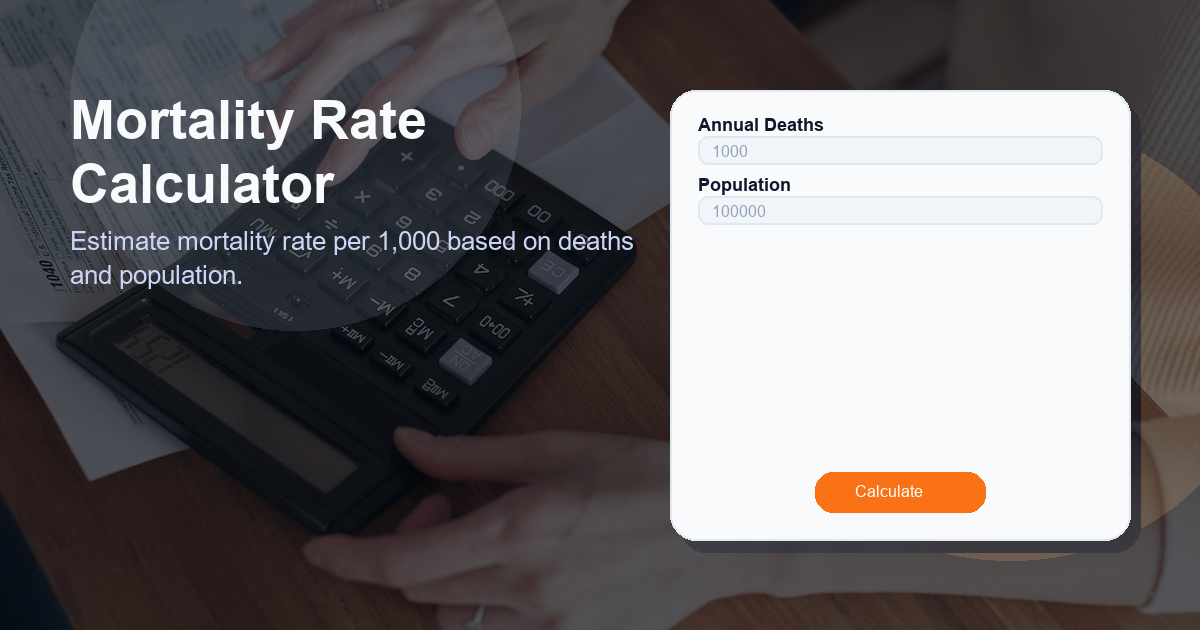
Mortality Rate Calculator
Description: Estimate mortality rate per 1,000 based on deaths and population using the Mortality Rate Calculator. Enter the number of Annual Deaths and the Population to compute the Mortality Rate per 1,000.
What this Mortality Rate Calculator calculator does
The Mortality Rate Calculator provides a straightforward, standardized way to estimate how many deaths occur per 1,000 people in a given population over the course of one year. This tool is designed for public health practitioners, researchers, policy makers, demographers, students, and administrators who need a quick and reliable estimate of overall mortality intensity within a population.
Specifically, the calculator:
- Accepts two inputs: Annual Deaths and Population.
- Applies a simple formula to compute mortality per 1,000: (annual_deaths / population) * 1000.
- Returns a single metric labeled Mortality Rate per 1,000, which is easy to compare across time periods and populations.
By producing a normalized rate, the Mortality Rate Calculator allows you to compare mortality between regions or groups of different sizes without being misled by absolute counts.
How to use the Mortality Rate Calculator calculator
Using the Mortality Rate Calculator is quick and intuitive. Follow these steps to get an accurate estimate:
- Gather your data: Obtain the total number of deaths that occurred in the target population during one calendar year (or the chosen 12-month period). This is your Annual Deaths input.
- Estimate the population: Use a reliable population estimate for the same period (mid-year population is commonly used). This is your Population input.
- Enter the values: Input both numbers into the calculator fields labeled Annual Deaths and Population.
- Run the calculation: The calculator applies the formula and displays the result as Mortality Rate per 1,000.
- Interpret: The resulting value tells you how many deaths occurred for every 1,000 individuals in the population during the year.
Example: If Annual Deaths = 2,500 and Population = 1,000,000, then the calculation is:
(2,500 / 1,000,000) * 1000 = 2.5
So the Mortality Rate per 1,000 = 2.5.
Tips:
- If your time period is different from one year, adjust the deaths to an annual equivalent before entering.
- If the population is very small, consider expressing rates with more precision or using confidence intervals.
- Never divide by zero—if population = 0, the rate is undefined.
How the Mortality Rate Calculator formula works
The underlying formula used by the Mortality Rate Calculator is purposely simple and widely used in epidemiology and demography:
Mortality Rate per 1,000 = (annual_deaths / population) * 1000
Why multiply by 1,000? Multiplying by 1,000 standardizes the rate to a common, easy-to-interpret scale: the number of deaths per 1,000 people per year. Alternatives include rates per 100,000 (useful for rare events or large-area comparisons) or per 100 (percent), but per 1,000 is commonly used for overall mortality in many demographic reports.
Breaking the formula down:
- annual_deaths / population calculates the proportion of the population that died during the year (a fraction between 0 and 1).
- * 1000 converts that fraction into deaths per 1,000 people, yielding an interpretable number such as 3.2 deaths per 1,000.
Example calculation (step-by-step):
- Annual deaths = 6,400
- Population = 2,000,000
- Divide: 6,400 / 2,000,000 = 0.0032
- Multiply by 1,000: 0.0032 * 1000 = 3.2
- Result: Mortality Rate per 1,000 = 3.2
Use cases for the Mortality Rate Calculator
The Mortality Rate Calculator is useful across multiple domains. Common use cases include:
- Public health surveillance: Quickly monitoring overall mortality trends to detect changes that may indicate epidemics, disasters, or other health crises.
- Policy and planning: Helping officials allocate resources by understanding mortality intensity in different regions or population groups.
- Demography and research: Comparing mortality levels across countries, years, or subpopulations in research papers and reports.
- Healthcare administration: Assessing institutional or regional performance over time and planning for end-of-life care capacities.
- Insurance and actuarial analysis: Supporting rate-setting and risk assessments by providing base mortality estimates.
- Education: Teaching the basics of mortality measurement in epidemiology and demography classes.
Because the calculator returns a normalized value, it is especially valuable when comparing areas with different population sizes or when tracking trends over time.
Other factors to consider when calculating mortality rate
While the Mortality Rate Calculator provides a robust basic estimate, there are additional considerations that affect accuracy and interpretation. Key factors to consider include:
- Age structure: Crude mortality rates do not account for age differences. An older population will typically have a higher mortality rate. Consider using age-standardized mortality rates for fair comparisons.
- Cause-specific mortality: Overall mortality masks patterns by cause. For targeted interventions, calculate cause-specific mortality rates (e.g., cardiovascular deaths per 1,000).
- Data completeness: Underreporting of deaths or inaccurate population estimates bias the rate. Use the best available vital registration or census data.
- Time frame alignment: Ensure deaths and population refer to the same time period (often mid-year population for annual rates).
- Migration and population dynamics: High migration or rapidly changing populations can distort annual rates; adjust if necessary.
- Small numbers and statistical variation: In small populations, rates can fluctuate widely; use confidence intervals and multi-year averages to stabilize estimates.
- Seasonality and events: Short-term events (pandemics, natural disasters) can temporarily spike mortality; contextualize spikes before drawing long-term conclusions.
Considering these factors will help you interpret the Mortality Rate per 1,000 more accurately and make better-informed decisions.
Frequently Asked Questions (FAQ)
What is the Mortality Rate Calculator used for?
The Mortality Rate Calculator is used to estimate the number of deaths per 1,000 people in a population during one year. It standardizes death counts so you can compare regions, time periods, and population groups.
What inputs do I need?
You need two inputs: Annual Deaths (the total deaths in the period) and Population (the population size for that period). The calculator computes (annual_deaths / population) * 1000 and returns the Mortality Rate per 1,000.
Can I convert the rate to per 100,000?
Yes. To convert a per-1,000 rate to per-100,000, multiply the result by 100 (because 100,000 / 1,000 = 100). For example, 2.5 per 1,000 is 250 per 100,000.
How do I compare mortality rates between populations with different age structures?
Use age-standardized mortality rates or age-specific rates to control for differences in age structure. The crude Mortality Rate per 1,000 can be misleading if populations differ substantially in age distribution.
What should I do if the population estimate is uncertain?
If population estimates are uncertain, consider sensitivity analyses using lower and upper bounds, calculate confidence intervals, or average rates across multiple years to reduce the impact of noise and estimation error.
If you need assistance interpreting a calculated rate, converting formats (per 1,000 to per 100,000), or estimating age-standardized rates, the Mortality Rate Calculator is a good starting point and can be paired with more advanced demographic tools for deeper analysis.