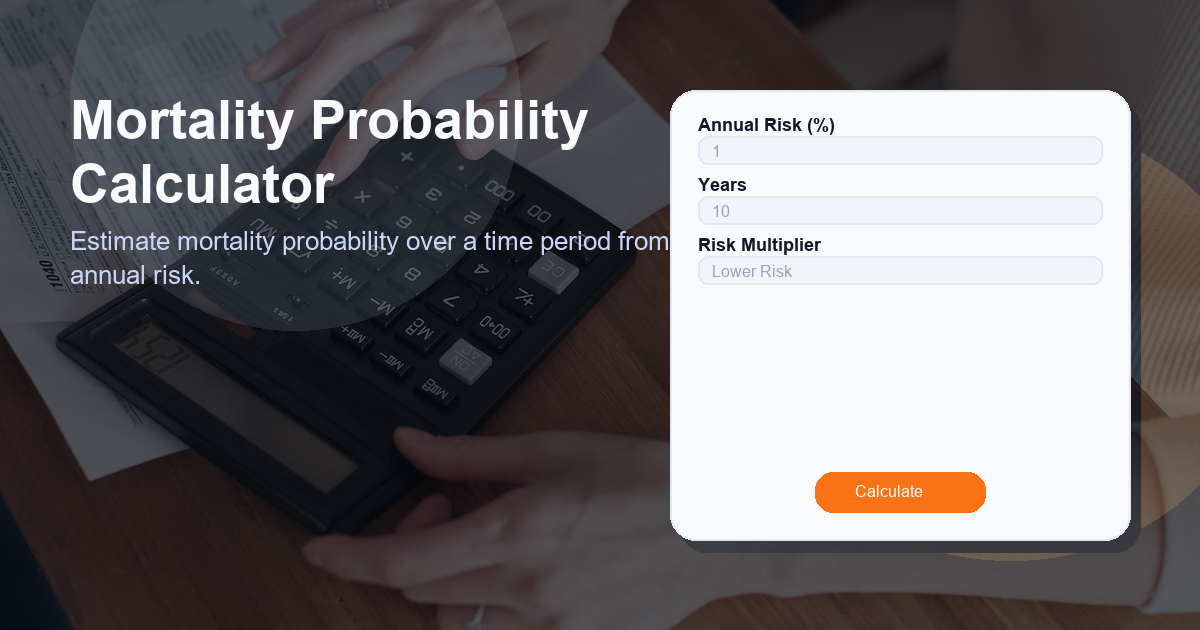
Mortality Probability Calculator
Description: Estimate mortality probability over a time period from annual risk using the Mortality Probability Calculator. Enter an Annual Risk (%), the number of Years, and an optional Risk Multiplier to model changes in baseline annual risk. The result is displayed as Mortality Probability — the cumulative probability of the event (death) occurring over the specified period.
What this Mortality Probability Calculator calculator does
The Mortality Probability Calculator converts a simple, annualized risk into a cumulative probability over a multi-year timeframe. Many published risks and rates are provided on an annual basis (for example, “2% annual mortality”). This calculator answers the question:
- “If the annual risk is X%, what is the chance of the event occurring at least once over Y years?”
Instead of naively multiplying the annual risk by years (which overestimates probability as risks compound), this calculator uses the appropriate compounding complement formula to compute the correct multi-year probability. It also allows a Risk Multiplier input to model scenarios where the baseline annual risk should be adjusted up or down (for example, due to health changes, interventions, or population differences).
How to use the Mortality Probability Calculator calculator
Using the Mortality Probability Calculator is simple and practical for both quick estimates and scenario planning. Follow these steps:
- Enter Annual Risk (%): Input the baseline annual risk as a percentage (for example, 2 for 2%).
- Enter Years: Specify the number of years over which you want to estimate the cumulative probability (for example, 10).
- Enter Risk Multiplier: Provide a multiplier to adjust the annual risk. Use 1 for no change, 1.5 for a 50% higher annual risk, or 0.8 for a 20% reduction. This is optional but useful for sensitivity analysis.
- Compute: The calculator applies the formula and returns the Mortality Probability as a percent — the probability that the event will occur at least once during the chosen period.
Example: If you enter Annual Risk = 2%, Years = 10, and Risk Multiplier = 1, the calculator returns the cumulative chance of occurrence over 10 years, accounting for compound probability.
How the Mortality Probability Calculator formula works
The underlying formula used by the Mortality Probability Calculator is:
(1 - Math.pow(1 - (annual_risk_percent * risk_multiplier / 100), years)) * 100Breakdown of the formula:
- annual_risk_percent * risk_multiplier / 100 converts the annual percentage into a decimal probability and adjusts it by the multiplier.
- 1 – (adjusted annual probability) is the probability of surviving (i.e., not experiencing the event) in a single year.
- Math.pow(…, years) raises the single-year survival probability to the power of years, giving the probability of surviving every year for the entire period.
- 1 – (survival over years) converts that to the probability of experiencing the event at least once during the period.
- Multiplying by 100 returns the final value as a percentage: the Mortality Probability.
Why this approach is correct: probabilities for repeated independent trials do not add linearly. A 2% chance every year does not mean a 20% chance over 10 years. Instead, you calculate the complement: the chance of never experiencing the event throughout the period, and subtract that from 1.
Step-by-step numeric example:
- Annual risk = 2% → 0.02 (decimal)
- Risk multiplier = 1 → adjusted annual risk = 0.02
- Chance of surviving one year = 1 – 0.02 = 0.98
- Chance of surviving 10 years = 0.98^10 ≈ 0.8171
- Mortality Probability = 1 – 0.8171 = 0.1829 → 18.29%
Use cases for the Mortality Probability Calculator
The Mortality Probability Calculator is valuable for multiple audiences and scenarios, including:
- Healthcare professionals: Quick scenario planning for patient counseling, comparing intervention impacts, or modeling long-term risk changes.
- Actuaries and financial planners: Estimating cumulative mortality risk for life insurance pricing, retirement planning, and annuity modeling.
- Researchers and epidemiologists: Translating annual incidence or mortality rates into multi-year probabilities for cohort studies and projections.
- Individuals and families: Understanding personal risk trajectories over time and making informed decisions about long-term care, insurance, or lifestyle changes.
- Policy analysts: Modeling population-level outcomes when annual risk estimates are available but multi-year impacts are needed.
The optional Risk Multiplier makes it suitable for sensitivity analyses: compare conservative vs optimistic scenarios simply by changing the multiplier.
Other factors to consider when calculating mortality probability
While the Mortality Probability Calculator provides a mathematically correct conversion from annual risk to cumulative probability under its assumptions, real-world interpretation requires attention to additional factors:
- Independence assumption: The formula assumes each year’s risk is independent and identical except for the multiplier. If risk changes systematically with age or time, apply time-varying rates or break the period into segments with different annual risks.
- Competing risks: In populations where multiple risks interact (for example, different causes of death), more advanced competing-risk models may be needed.
- Heterogeneity: Population-level averages may hide variation. Individual risks differ with comorbidities, genetics, and behavior; consider stratifying or adjusting inputs.
- Time-dependent interventions: If an intervention occurs partway through the period (e.g., a surgery or new medication), use segmented calculations with different annual risks before and after the intervention.
- Data source and uncertainty: Ensure the annual risk you input is from a reliable source. Confidence intervals or ranges are often more informative than single-point estimates; run the calculator across the plausible range to see sensitivity.
- Interpretation for individuals vs. populations: A 20% multi-year probability means one in five similar people would be expected to experience the event in that period, not that a specific individual has a deterministic outcome.
Frequently Asked Questions
Q: Is the Mortality Probability Calculator appropriate for calculating individual risk?
A: It provides an estimate based on the annual risk you supply. For individual-level clinical decisions, combine this with personalized information (age, comorbidities, treatment effects) and consult a clinician. The calculator assumes homogeneous annual risk across the time period unless you break the period into distinct segments.
Q: What does the Risk Multiplier do?
A: The Risk Multiplier scales the baseline annual risk up or down. Use it to model scenarios where the reported annual risk should be adjusted (for example, if a patient’s risk is 1.5 times the population average, set multiplier = 1.5).
Q: Can I use this calculator if risk changes with age?
A: If risk varies significantly by age, perform separate calculations for each age band with the appropriate annual risk, then combine using complement rules, or use more advanced actuarial life table methods. The single-formula approach assumes constant (or uniformly scaled) annual risk.
Q: Does the calculator account for competing risks?
A: No. This basic calculator estimates the probability of a single event type over time. Competing risks (other events that preclude the event of interest) require multistate or cause-specific hazard models.
Q: Why not just multiply annual risk by years?
A: Simple multiplication overestimates risk because it ignores the fact that once an event happens, subsequent years cannot contribute to additional occurrences for that same event. The correct method uses the complement of survival across years, which the calculator implements.
Conclusion: The Mortality Probability Calculator is a concise, robust tool for converting annualized risk into a multi-year cumulative probability. Use it for scenario planning, sensitivity analysis, and communication of risk over time, while being mindful of underlying assumptions and the need for more complex models when risks change over time or when competing risks are important.