Mortality by Age Calculator
What this Mortality by Age Calculator calculator does
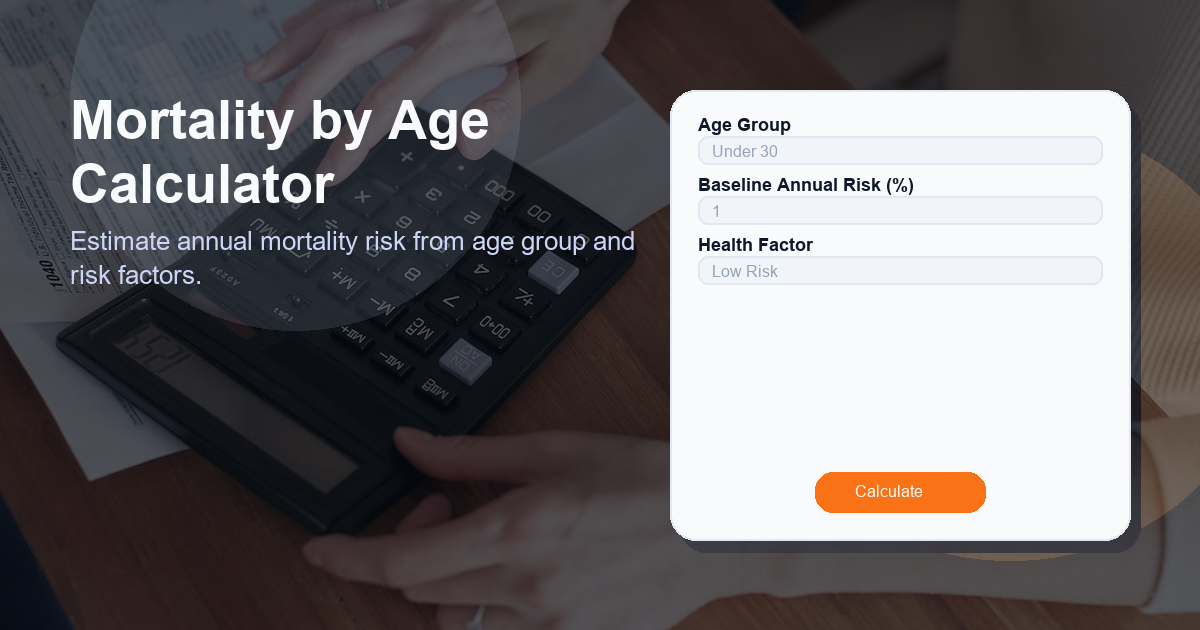
The Mortality by Age Calculator is a simple, transparent tool designed to help you estimate annual mortality risk by combining an age group multiplier with a baseline risk and a health-related adjustment. This calculator converts three inputs—Age Group, Baseline Annual Risk (%), and Health Factor—into a single, easy-to-interpret output labeled Annual Mortality Risk.
Use this calculator to get a quick, approximate picture of how age and health-related factors interact with an underlying baseline probability of death in a single year. It is intended for high-level assessment and comparison rather than precise actuarial or clinical decisions.
How to use the Mortality by Age Calculator calculator
Using the Mortality by Age Calculator is straightforward. Follow these steps to generate an Annual Mortality Risk estimate:
- 1) Choose an Age Group: Enter or select an age group multiplier. This value represents how much age increases or decreases risk relative to a baseline.
- 2) Enter Baseline Annual Risk (%): Provide a baseline annual mortality risk as a percentage. This is typically a population-level baseline for the cohort you are assessing.
- 3) Enter a Health Factor: Input a multiplicative health-related adjustment (for example, 1.2 for 20% higher risk, or 0.8 for 20% lower risk) to reflect comorbidities, lifestyle, or medical interventions.
- 4) Read the Result: The output labeled Annual Mortality Risk gives the estimated annual risk as a percent (or proportion, depending on your baseline input format).
Example: If the Baseline Annual Risk is 0.5% (0.005 in decimal form), the Age Group multiplier is 3, and the Health Factor is 1.1, the calculator provides a clear, single-year mortality estimate you can compare across scenarios.
How the Mortality by Age Calculator formula works
The calculator uses a simple multiplicative formula to combine the three inputs. The formula is intentionally transparent so users can understand how each component influences the result.
Formula: baseline_risk * age_group * health_factor
Breakdown of the formula components:
- Baseline Annual Risk (%): This is the starting probability (often expressed as a percentage) that an average person in a reference population will die in one year. When using a percent, you may convert to a proportion (divide by 100) before multiplying, depending on how you prefer to display results.
- Age Group: A multiplier that captures age-related change in mortality. For example, younger age groups might have multipliers less than 1, middle-age groups around 1, and older age groups larger than 1.
- Health Factor: A multiplicative adjustment reflecting health status, comorbid conditions, lifestyle, or treatment effects. Values greater than 1 indicate elevated risk; values less than 1 indicate reduced risk.
Interpreting the output (Annual Mortality Risk):
- If you input a baseline as a percent (e.g., 0.5%), the formula returns a result in the same units if you keep consistent formatting. Convert units as needed for clarity.
- The multiplicative structure means each factor scales the baseline—age group changes the baseline by an age-specific ratio and the health factor further scales that age-adjusted baseline.
Use cases for the Mortality by Age Calculator
The Mortality by Age Calculator is useful in several contexts where a quick, transparent mortality estimate is helpful. Typical use cases include:
- Personal risk comparison: Individuals who want to compare how different age-group assumptions and health adjustments change their estimated annual mortality risk.
- Preliminary planning: Financial planners, insurance hobbyists, and non-specialist analysts can use the calculator to run rough scenarios for retirement planning and life insurance comparisons.
- Public health education: Communicators and educators can demonstrate the relative impact of age and health on yearly mortality probabilities in a classroom or outreach setting.
- Scenario testing: Analysts performing sensitivity checks can quickly see how changing a baseline, age multiplier, or health factor alters outcomes without complex modeling.
Note: This tool is for approximate and illustrative purposes. It is best used for comparisons and educational scenarios rather than as a substitute for detailed actuarial modeling or clinical risk assessment.
Other factors to consider when calculating annual mortality risk
While the Mortality by Age Calculator captures the primary multipliers, real-world mortality estimation often requires consideration of additional elements beyond the three input factors:
- Demographic adjustments: Sex, ethnicity, geographic location, and socioeconomic status can materially influence baseline risk and may require separate multipliers.
- Comorbidities and medical history: The Health Factor can only approximate the effect of complex medical conditions. Detailed clinical models often use condition-specific risk weights.
- Temporal changes: Baseline mortality rates change over time due to medical advances, epidemics, or environmental conditions. Ensure baseline risk is current.
- Nonlinear interactions: Some factors interact in nonlinear ways (for example, the combined effect of multiple chronic diseases), which simple multiplication may not capture accurately.
- Data quality and assumptions: The accuracy of your estimate depends on the quality of the baseline and multipliers. Use credible sources and document assumptions.
Keeping these considerations in mind will help you use the Mortality by Age Calculator responsibly and interpret results with appropriate caution.
FAQ
Q: What inputs do I need for the Mortality by Age Calculator?
A: You need three inputs: Age Group (a multiplier), Baseline Annual Risk (%) (the starting probability), and Health Factor (a multiplicative adjustment). The result is labeled Annual Mortality Risk.
Q: How is the Annual Mortality Risk calculated?
A: The calculation uses the formula baseline_risk * age_group * health_factor. Each input multiplies the baseline to provide an adjusted annual risk estimate.
Q: Can I use this calculator for insurance underwriting?
A: This tool is intended for high-level estimates and scenario comparisons. It is not a substitute for formal actuarial models or underwriting processes, which require more detailed data and regulatory-compliant methods.
Q: Should I convert percentages to decimals before using the formula?
A: Be consistent with units. If you enter Baseline Annual Risk as a percent (e.g., 0.5%), either convert it to a proportion (0.005) before multiplying or convert the final result back to percent at the end. The calculator can be used either way so long as you stay consistent.
Q: How accurate is this estimate for individuals?
A: The estimate is approximate. It is most useful for relative comparisons across scenarios. Individual predictions require personalized clinical and actuarial assessment that account for many more variables than this simple model includes.