Death Statistics Calculator
The Death Statistics Calculator is a simple, transparent tool designed to help researchers, public health professionals, actuaries, and concerned individuals estimate the number of expected deaths in a population over a given time period based on a constant annual risk. This article explains what the Death Statistics Calculator does, how to use it, the formula behind it, practical use cases, and other important factors and limitations to consider when interpreting the result.
What this Death Statistics Calculator calculator does
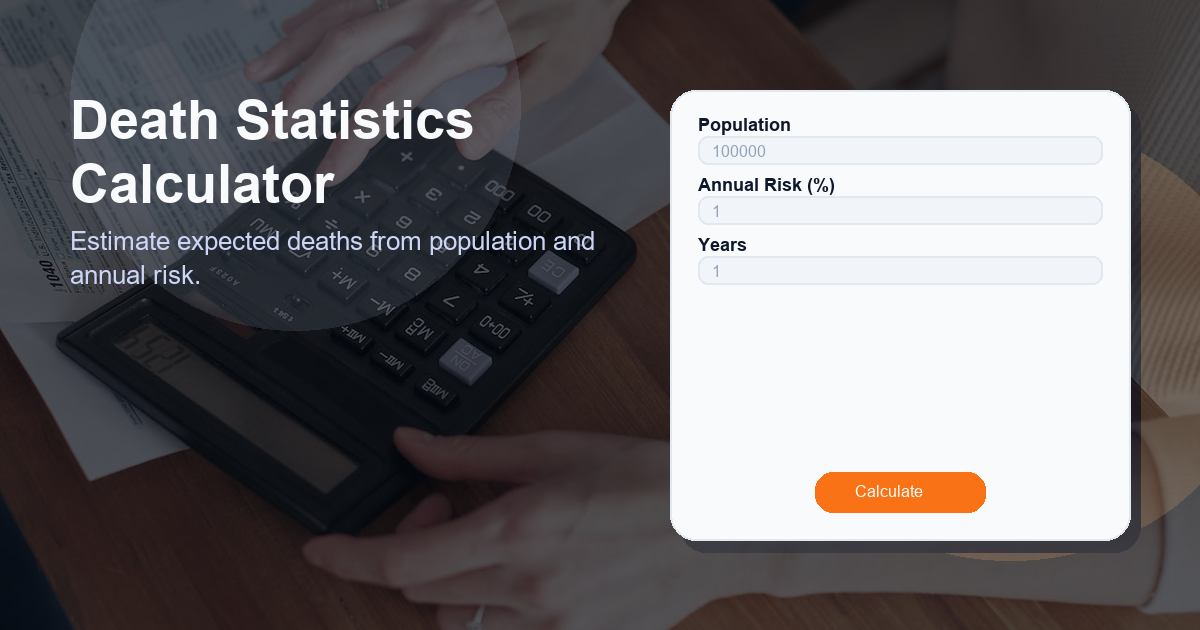
The Death Statistics Calculator computes an estimate of the number of deaths in a population by applying a constant annual risk percentage to a population size over a specified number of years. The result is labeled Expected Deaths. This calculator is useful for quick back-of-the-envelope projections where a constant risk is a reasonable assumption.
- Inputs: Population, Annual Risk (%), Years
- Formula used: population * (annual_risk_percent / 100) * time_years
- Output: Expected Deaths
This tool is intentionally straightforward: it does not incorporate changing risks over time, age structure, competing risks, or stochastic variation. Instead, it provides a deterministic estimate suitable for planning, communication, and high-level analysis.
How to use the Death Statistics Calculator calculator
Using the Death Statistics Calculator requires only three inputs. Follow these steps:
- Enter Population: Input the total number of people in the population you are analyzing. Use whole numbers (e.g., 1000000 for one million).
- Enter Annual Risk (%): Provide the risk of death per person per year expressed as a percentage. For example, 0.5 means a 0.5% chance per year for each person.
- Enter Years: Specify the number of years over which you want to estimate expected deaths. Use whole or fractional years if needed (e.g., 2.5 years).
Once you input these values, the calculator multiplies them according to the formula and returns the Expected Deaths. For clarity, here is an example:
Example: Population = 500,000; Annual Risk = 0.8%; Years = 3.
Calculation: 500000 * (0.8 / 100) * 3 = 500000 * 0.008 * 3 = 12,000
Expected Deaths: 12,000 over 3 years.
How the Death Statistics Calculator formula works
The working formula for the Death Statistics Calculator is intentionally simple:
Formula: population * (annual_risk_percent / 100) * time_years
Breaking the formula down:
- population — the number of individuals at risk.
- annual_risk_percent / 100 — converts the percentage risk into a decimal probability (for example 2% becomes 0.02).
- time_years — the number of years over which the risk is applied.
This formula assumes a constant per-person risk each year and aggregates the expected number of deaths by multiplying risk by population and duration. In probabilistic terms, if each individual has the same independent probability of death per year and that probability stays constant, the expected number of deaths equals the sum of individual probabilities across all people and years.
Key assumptions embedded in the formula:
- Risk is constant over time.
- Risk is the same for each individual in the population (no age stratification or subgroup differences).
- Deaths do not remove people from future risk calculations in the deterministic approach (this is an approximation; for short periods and small probabilities the difference is negligible).
Use cases for the Death Statistics Calculator
The Death Statistics Calculator is versatile for multiple high-level applications where a quick expected-death estimate is useful. Common use cases include:
- Public health planning: estimating expected deaths from a known background mortality rate to compare with observed deaths during an outbreak or disaster.
- Risk communication: providing a simple number to convey the scale of expected mortality to stakeholders and the public.
- Actuarial back-of-the-envelope calculations: quick checks during early-stage models or feasibility assessments.
- Research and reporting: baseline expectations for mortality in a population before applying more complex models.
- Policy analysis: scenario testing when evaluating potential interventions that would change the annual risk percentage.
Because of its simplicity, this calculator is best used for broad-stroke estimates rather than precise individual-level forecasts. It is particularly helpful when you want an immediate, transparent estimate without running complex simulations.
Other factors to consider when calculating deaths
While the Death Statistics Calculator is practical and transparent, a number of important factors can affect the accuracy and interpretation of the Expected Deaths result. Consider the following before relying on the output for high-stakes decisions:
- Age structure: Mortality risk varies dramatically by age. If your population contains subgroups with very different risks, use age-stratified rates rather than a single average risk.
- Changing risks over time: Annual risk may increase or decrease due to interventions, disease dynamics, seasonal patterns, or aging. A constant-risk model may misestimate long-term outcomes.
- Competing risks and events: Deaths from different causes can interact; removing a portion of the population through one cause reduces the number at risk for others in subsequent periods.
- Population dynamics: Migration, births, and non-death exits change the denominator over time. For multi-year projections, consider whether population size remains stable.
- Statistical uncertainty: The calculator returns an expected value, not a confidence interval. Real outcomes will vary; use stochastic models or confidence estimates when needed.
- Data quality: The reliability of the estimate depends on the accuracy of your population and risk inputs. Verify sources and consider ranges for sensitivity analysis.
For more advanced or long-term modeling, consider cohort life-table methods, age-specific mortality rates, or simulation models that incorporate changing risks and population dynamics.
FAQ
Q: What does the “Annual Risk (%)” input represent?
A: The Annual Risk (%) is the per-person probability of death in one year expressed as a percentage. For example, a 1% annual risk means each person has an expected 0.01 probability of dying in a single year.
Q: Can I use fractional years in the “Years” input?
A: Yes. The formula supports fractional years (e.g., 0.5 for six months). The calculation multiplies the time factor directly, so 0.5 years reduces the expected deaths proportionally.
Q: Does the Death Statistics Calculator account for age differences?
A: No. This calculator assumes a uniform risk across the entire population. For age-specific analysis, use age-stratified risks and sum expected deaths across age groups.
Q: Why might the expected deaths differ from actual observed deaths?
A: Observed deaths can differ due to random variation, changing risks, inaccuracies in inputs, demographic changes, and interactions between causes of death. The calculator gives an expected (average) value, not an exact prediction.
Q: Is this calculator suitable for long-term projections?
A: It can provide a quick estimate, but for long-term projections you should account for changing risks, population dynamics, and age structure. More sophisticated demographic or stochastic models are recommended for long horizons.