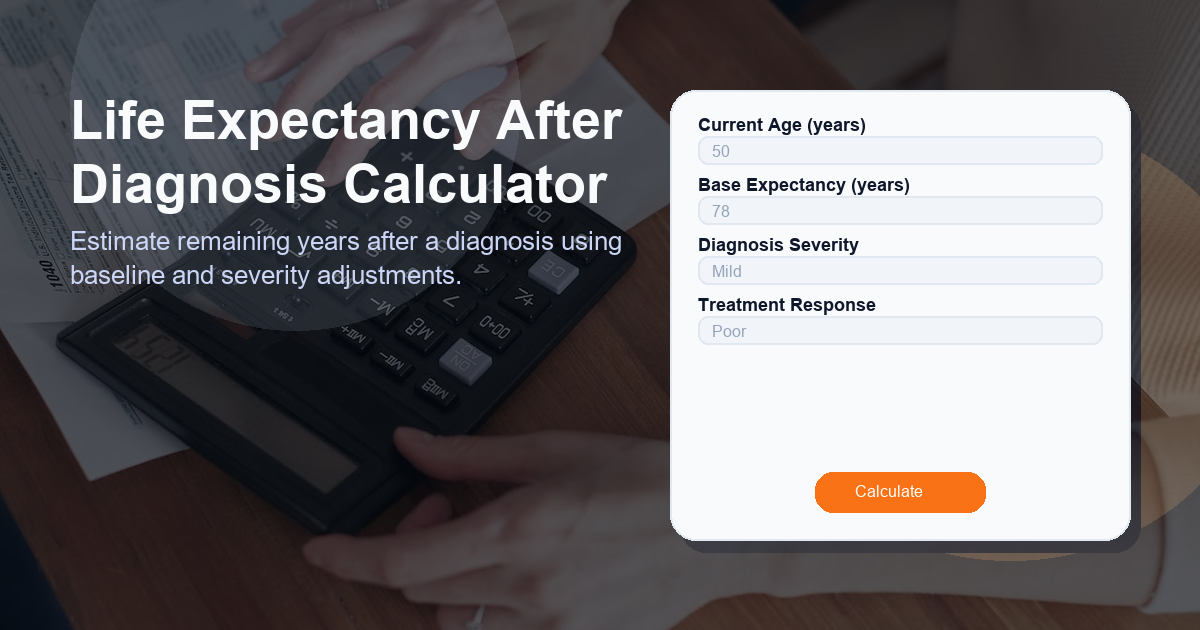
Life Expectancy After Diagnosis Calculator
Description: Estimate remaining years after a diagnosis using baseline and severity adjustments. The Life Expectancy After Diagnosis Calculator helps translate a baseline life expectancy into a personalized estimate by accounting for diagnosis severity and treatment response, then comparing that adjusted expectancy to the person’s current age.
What this Life Expectancy After Diagnosis Calculator calculator does
The Life Expectancy After Diagnosis Calculator provides a straightforward, transparent estimate of how many years a person might have remaining after receiving a medical diagnosis. It is not a clinical prognostic tool but a simple arithmetic model that combines:
- Baseline (base) expectancy — an initial estimate of years a typical person in a similar demographic might expect.
- Diagnosis severity adjustment — a positive or negative number representing how the diagnosis changes expectancy.
- Treatment response adjustment — a positive or negative number representing how well treatment is expected to modify the outcome.
- Current age — used to convert the adjusted lifetime into remaining years.
This calculator applies the formula below to return an easy-to-read label: Estimated Remaining Years. It is useful for planning, conversations with care teams, and framing expectations, but should always be used alongside clinical judgment and professional advice.
How to use the Life Expectancy After Diagnosis Calculator calculator
Using the calculator is a simple four-step process:
- Enter Current Age (years): The person’s present age in completed years.
- Enter Base Expectancy (years): Usually a population-based average life expectancy or an individualized baseline estimate from clinical data.
- Select or enter Diagnosis Severity: A numerical adjustment (positive or negative) that represents how the diagnosis affects lifetime. For example, a severe, life-shortening condition might be a large negative number; a mild diagnosis might be zero or slightly negative.
- Select or enter Treatment Response: A numerical adjustment reflecting anticipated improvements or declines due to treatment. Effective treatment may add years (positive), while poor response may subtract years (negative).
After inputting these fields, the calculator computes the result using the formula and displays the Estimated Remaining Years. If you receive a negative number, that indicates the adjusted life expectancy is less than the current age (which usually signals either that the baseline or adjustments need review or that the model indicates zero remaining years in simple arithmetic terms).
How the Life Expectancy After Diagnosis Calculator formula works
Formula:
base_expectancy + diagnosis_severity + treatment_response - current_age
What the formula does, step by step:
- base_expectancy is the starting point — the number of years expected from birth or from a reference point.
- diagnosis_severity is an additive adjustment: negative values shorten expected life, positive values lengthen it.
- treatment_response is another adjustment that captures expected benefit or harm from treatments.
- Subtracting current_age converts total expected years into the number of years remaining.
Example calculation:
- Current Age = 62
- Base Expectancy = 85
- Diagnosis Severity = -8 (a moderate reduction)
- Treatment Response = +2 (treatment adds back some years)
Plug into the formula:
Estimated Remaining Years = 85 + (-8) + 2 – 62 = 17 years
This result means the calculator estimates about 17 years remaining under the assumptions provided.
Important interpretation notes:
- If the result is negative, interpret it cautiously — often this signals that the base expectancy or adjustments are inconsistent with age, or indicate very limited remaining expectancy.
- The formula is linear and additive — it does not model complicated interactions, competing risks, or time-dependent treatment effects.
- Always combine this numeric result with clinical context, diagnostic tests, and shared decision-making.
Use cases for the Life Expectancy After Diagnosis Calculator
This calculator can support several practical scenarios:
- Patient counseling: Help patients and families understand a simple, numerical estimate during discussions about prognosis and planning.
- Advance care planning: Use estimated remaining years to inform legal, financial, and personal planning like wills, powers of attorney, or living arrangements.
- Shared decision making: Provide a baseline estimate when weighing aggressive treatments versus palliative approaches.
- Research and education: Demonstrate how severity and treatment response systematically affect expected lifespan in classrooms or community outreach.
- Healthcare operations and policy: Help program managers approximate needs for long-term support or hospice planning when aggregated over a population (with caution).
Because the model is simple, it is best used as a conversational or initial screening tool rather than definitive prognostication.
Other factors to consider when calculating life expectancy
Real-world life expectancy is influenced by many factors beyond the inputs in this simple calculator. Consider the following when interpreting results:
- Comorbidities: Additional chronic diseases (heart disease, diabetes, COPD) can substantially change outcomes and may require additional, separate adjustments.
- Functional status: Mobility, independence in activities of daily living, and frailty are strong predictors of survival and quality of life.
- Socioeconomic and environmental factors: Access to care, social support, nutrition, housing, and environmental exposures affect longevity.
- Diagnostic uncertainty: Staging, subtype, and test accuracy can change the expected trajectory of a disease.
- Time-dependent effects: Some treatments may offer short-term benefit but long-term harm, or vice versa — the simple additive model does not capture these dynamics.
- Lifestyle changes: Smoking cessation, exercise, diet, and adherence to therapy can alter outcomes meaningfully.
- Psychosocial factors: Mental health, caregiver availability, and community resources influence both survival and quality of life.
Because of these complexities, clinicians often use validated prognostic indices, survival curves, and individualized clinical judgment to complement or replace simple calculators.
Short FAQ
Q: Is the Life Expectancy After Diagnosis Calculator a medical diagnosis tool?
A: No. The Life Expectancy After Diagnosis Calculator is an arithmetic tool that provides a simple estimated number of remaining years based on the inputs you provide. It is not a substitute for clinical judgment, diagnostic workup, or personalized prognostic models used by healthcare professionals.
Q: How should I choose values for Diagnosis Severity and Treatment Response?
A: Choose numerical adjustments based on best-available clinical information or guidance from medical professionals. Typical practice is to use negative values for severity that shortens life and positive values for beneficial treatment effects. When in doubt, consult the treating clinician or use conservative estimates.
Q: What does a negative Estimated Remaining Years mean?
A: A negative result generally means the adjusted life expectancy (base + adjustments) is less than the current age. This may indicate inconsistent inputs or that the simple model predicts minimal or no remaining years. Interpret negative values with caution and verify inputs and assumptions.
Q: Can this calculator be used for policy or insurance decisions?
A: The calculator can provide rough, illustrative estimates but should not be the sole basis for policy, insurance underwriting, or legal decisions. Use validated actuarial or clinical models and professional advice for high-stakes decision-making.
Q: How can I improve accuracy when estimating life expectancy?
A: Improve accuracy by using evidence-based baseline expectancy, informed adjustments from clinical data, accounting for comorbidities and functional status, and consulting validated prognostic models or clinicians. Use the calculator as a starting point, not the final answer.