Life Expectancy with Chronic Illness Calculator
What this Life Expectancy with Chronic Illness Calculator does
The Life Expectancy with Chronic Illness Calculator is a simple, transparent tool designed to help people estimate remaining years of life when living with a chronic condition. By combining a baseline life expectancy with clinician- or self-assessed modifiers for illness severity and management quality, this calculator produces an easily interpretable result labeled Estimated Remaining Years.
This calculator is intended to be a planning and educational aid — not a replacement for professional medical evaluation. It helps users quantify how changes in disease severity or treatment quality might affect projected lifespan and supports conversations about care priorities, advanced planning, and lifestyle decisions.
How to use the Life Expectancy with Chronic Illness Calculator
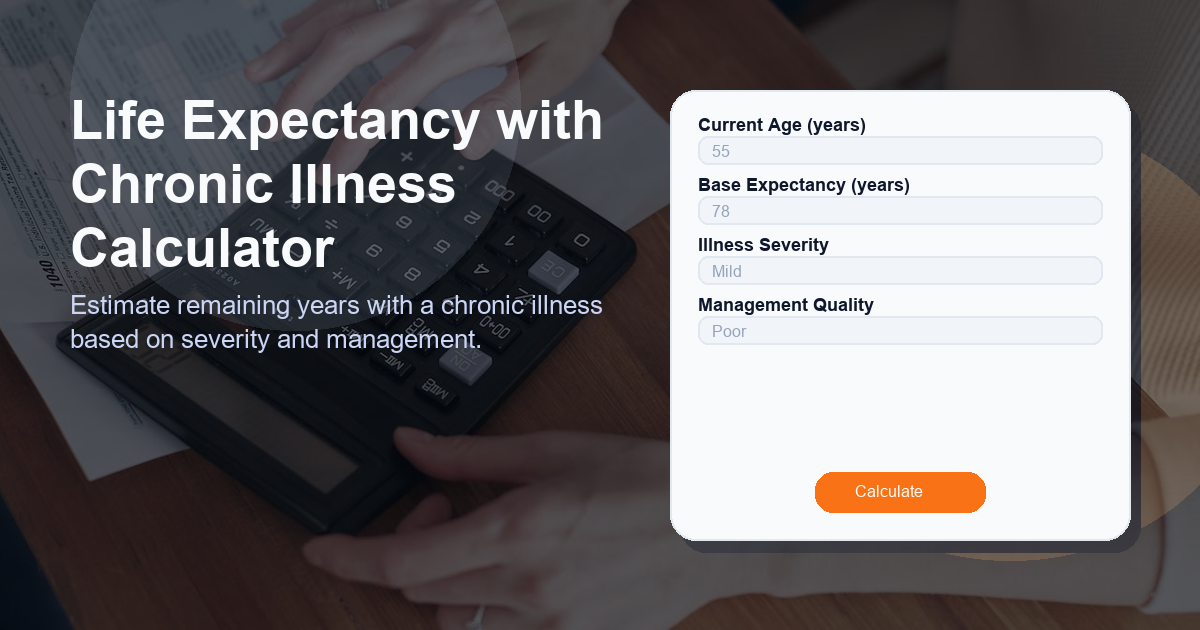
Using the Life Expectancy with Chronic Illness Calculator requires just four inputs:
- Current Age (years) — Your present age in years.
- Base Expectancy (years) — The average expected lifespan for someone of your sex, country, and population group without the specific chronic condition (often drawn from actuarial tables or clinical estimates).
- Illness Severity — A numeric modifier that reflects how much the chronic illness reduces life expectancy. Typically entered as a negative number if severity shortens expectancy (for example, -8 years).
- Management Quality — A numeric modifier that reflects how effective treatment, lifestyle, or care management is. This can be positive (improving expectancy) or negative (poor management reducing expectancy).
Step-by-step:
- Enter your Current Age.
- Choose a sensible Base Expectancy from reliable actuarial or public health sources (e.g., national life tables).
- Estimate Illness Severity as the likely years of life lost because of the condition (negative number) or years gained if the condition is unusually mild (rarely positive).
- Estimate Management Quality as years gained (positive) or lost (negative) due to treatment adherence, access to care, lifestyle modifications, and social support.
- Review the resulting Estimated Remaining Years and use it to inform decisions, notes, or to discuss with a clinician.
How the Life Expectancy with Chronic Illness Calculator formula works
The calculator uses a straightforward linear formula:
Estimated Remaining Years = base_expectancy + illness_severity + management_quality – current_age
Explanation of each term:
- base_expectancy — the baseline lifespan typically expected for someone of your demographic without the chronic disease.
- illness_severity — the net effect of the chronic illness expressed in years. If the illness shortens life, this is a negative value (for example, -7). If the illness negligibly affects lifespan or is expected to slightly increase survival relative to the baseline (rare), this might be zero or slightly positive.
- management_quality — the effect of how well the disease is managed. Effective, guideline-based care and healthy lifestyle changes can produce positive values (e.g., +3). Poor management, lack of access to treatment, or uncontrolled symptoms can produce negative values.
- current_age — subtracting the current age converts total expected lifespan to remaining years.
Example calculation:
- Current Age = 60
- Base Expectancy = 85
- Illness Severity = -10 (the condition is estimated to shorten life by 10 years)
- Management Quality = +3 (good treatment and lifestyle improvements add back 3 years)
- Estimated Remaining Years = 85 + (-10) + 3 − 60 = 18 years
This simple structure makes the calculation transparent and easy to adjust: update the severity or management values to immediately see how interventions or disease progression could change the Estimated Remaining Years.
Use cases for the Life Expectancy with Chronic Illness Calculator
The Life Expectancy with Chronic Illness Calculator is useful in several practical contexts:
- Clinical conversations: Helping patients and clinicians frame discussions about prognosis, treatment intensity, and goals of care.
- Care planning: Informing decisions about advanced care directives, long-term care planning, and financial or legal arrangements.
- Behavioral motivation: Demonstrating how improvements in management quality (medication adherence, smoking cessation, weight loss, rehabilitation) can extend estimated remaining years.
- Population health analysis: Allowing health planners to model the impact of interventions across groups with chronic illnesses by varying severity and management parameters.
- Personal reflection: Helping individuals and families understand the likely time horizon for major life choices like retirement timing, legacy planning, or bucket-list goals.
Other factors to consider when calculating life expectancy
While the calculator offers a clear numerical estimate, many additional factors influence real-world outcomes. Consider these before relying on a single number:
- Medical complexity: Many people have more than one chronic condition. Interactions between diseases can amplify risk beyond a simple additive model.
- Data source for base expectancy: National life tables vary by sex, ethnicity, socio-economic status, and region — choose a base expectancy that best matches your demographic profile.
- Nonlinear effects: Some illnesses affect mortality risk in non-additive ways (e.g., exponential risk increases with age or disease stage), which a linear calculator cannot fully capture.
- Acute events: Sudden complications or hospitalizations can change prognosis quickly; an estimate should be updated after significant health changes.
- Quality of life vs. quantity of life: Years lived with significant disability may be weighted differently in personal decisions. This calculator estimates time, not function.
- Social determinants of health: Access to care, housing stability, and support networks strongly influence outcomes and may not be reflected in severity or management inputs.
Always discuss prognosis and care planning with qualified healthcare professionals. Use the calculator as a conversation starter and a way to model scenarios, not as definitive medical advice.
FAQ
1. Is the Life Expectancy with Chronic Illness Calculator medical advice?
No. The Life Expectancy with Chronic Illness Calculator provides an estimate based on user-supplied numbers. It is an educational and planning tool and should not replace diagnosis, treatment, or prognosis provided by licensed healthcare professionals.
2. How do I choose values for illness severity and management quality?
These values are subjective estimates informed by clinical guidance, physician input, or evidence-based reviews. A useful approach is to consult your clinician for an estimated years-lost value for the illness (typically negative) and then adjust for management quality based on your treatment adherence and access to care (positive for good management, negative for poor).
3. What if the calculator returns a negative number?
A negative Estimated Remaining Years suggests the inputs imply a total expected lifespan that is less than the current age — in other words, the combination of base expectancy and modifiers is inconsistent with being alive at the current age. Re-check your inputs or consult a clinician to refine the base expectancy and modifiers.
4. Can this calculator account for multiple chronic illnesses?
Yes — but with caution. You can combine the net effect of multiple conditions into a single illness severity value (sum of each condition’s estimated years lost) and an overall management quality value. However, interactions between conditions can be complex; consult a clinician for more accurate multi-condition prognostication.
5. Where can I find a reliable base expectancy?
Use national or regional life tables published by government agencies, public health organizations, or actuarial services. Choose tables that match your demographic characteristics (age, sex, country) and update the estimate as new population data become available.
Summary: The Life Expectancy with Chronic Illness Calculator is a practical tool for estimating remaining years when living with a chronic condition. Keep inputs realistic, use the result as a guide, and pair findings with clinical advice and personal values when making important life and care decisions.