Life Expectancy by Lifestyle Choices Calculator
1) What this Life Expectancy by Lifestyle Choices Calculator calculator does
The Life Expectancy by Lifestyle Choices Calculator is a simple tool designed to provide a rough estimate of your remaining years based on a few lifestyle inputs. It is not a medical or actuarial prediction but a quick way to see how factors you can influence — like diet, exercise, smoking, and alcohol use — may be associated with changes in expected lifespan. The output is displayed as Estimated Remaining Years, a single, easy-to-understand number.
This calculator is ideal for people who want a practical, immediate sense of how incremental changes to lifestyle choices could affect their time horizon, helping motivate healthier decisions or inform conversations with healthcare professionals.
2) How to use the Life Expectancy by Lifestyle Choices Calculator calculator
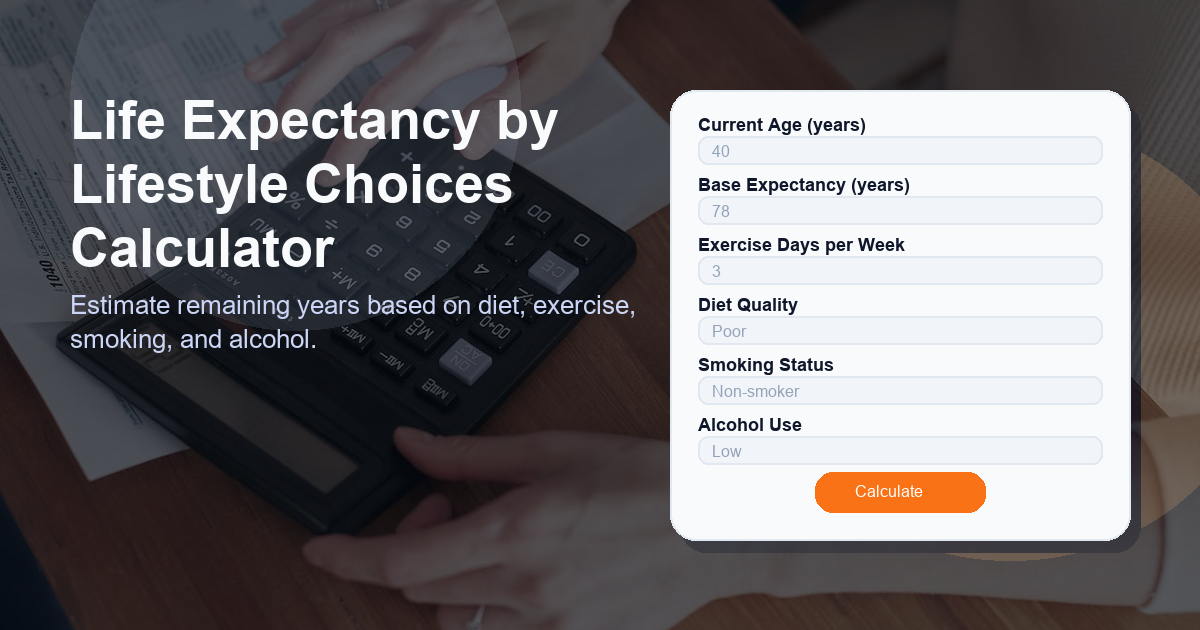
Using the calculator is straightforward. You provide six inputs and receive one numeric result:
- Current Age (years) — your age in years.
- Base Expectancy (years) — a baseline life expectancy for your demographic or the average life expectancy you want to use (for example, national average or personalized estimate).
- Exercise Days per Week — how many days per week you perform purposeful exercise (0–7).
- Diet Quality — a numeric value representing diet habits (positive for above-average diet, negative for poor diet, or 0 for average).
- Smoking Status — a numeric penalty representing smoking behavior (0 for non-smoker, higher values for light to heavy smoking).
- Alcohol Use — a numeric penalty representing alcohol consumption (0 for none, higher values for moderate or heavy use).
After entering these values, the calculator computes your Estimated Remaining Years using a transparent formula (explained below). If you prefer, you can manually calculate the result by applying the formula to your inputs.
3) How the Life Expectancy by Lifestyle Choices Calculator formula works
The calculator uses a linear formula that starts with a base life expectancy and adjusts it up or down according to lifestyle choices and current age. The formula is:
base_expectancy + diet_quality + (exercise_days - 3) * 0.4 - smoking_status - alcohol_use - current_age
Breaking this down:
- base_expectancy: The starting point for expected total years of life before adjustments.
- diet_quality: A direct additive adjustment. Positive values increase expectancy; negative values decrease it. For example, a value of +2 could represent a very healthy, nutrient-dense diet; -2 could represent a diet high in ultra-processed foods and low in fruits and vegetables.
- (exercise_days – 3) * 0.4: Exercise is treated relative to a baseline of 3 days per week. Each additional day above 3 adds 0.4 years to life expectancy; each day below 3 subtracts 0.4 years. For example, exercising 5 days/week adds (5-3)*0.4 = 0.8 years.
- smoking_status and alcohol_use: These are subtractions. Typical values could be 0 for no use, small positive numbers for light users, and larger numbers for heavier use to reflect greater negative impact on life expectancy.
- current_age: Finally, we subtract your current age to produce the Estimated Remaining Years rather than an expected total lifespan.
Example: if your base expectancy is 82, your diet_quality is +1, exercise 4 days/week, you are a non-smoker (0), moderate alcohol use 1, and current age 45, the calculation is:
82 + 1 + (4 - 3) * 0.4 - 0 - 1 - 45 = 82 + 1 + 0.4 - 1 - 45 = 37.4
The calculator would display Estimated Remaining Years: 37.4.
4) Use cases for the Life Expectancy by Lifestyle Choices Calculator
This calculator has several practical uses:
- Goal setting: See how changes in exercise frequency or diet quality could increase your estimated remaining years and set realistic health goals.
- Behavioral motivation: Quantifying the effect of a single habit (e.g., quitting smoking) can be a compelling motivator to make lasting changes.
- Comparison scenarios: Compare “what if” scenarios side-by-side (for example, current habits vs improved habits) to visualize potential gains.
- Educational tool: Use the results to spark conversations with friends, family, or healthcare providers about lifestyle impacts and risk-reduction strategies.
- Planning: While not a substitute for professional financial or medical planning, the estimate can feed into broader retirement or long-term care planning discussions.
5) Other factors to consider when calculating x
The calculator is intentionally simple and uses a few measurable lifestyle factors. However, many additional variables influence life expectancy that this tool does not account for:
- Genetics: Family history and genetic predispositions can substantially change individual risk.
- Chronic conditions: Existing diseases (diabetes, cardiovascular disease, cancer) often have large, specific impacts on life expectancy beyond lifestyle adjustments.
- Socioeconomic factors: Access to healthcare, education, income, and neighborhood environment all play major roles.
- Mental health and stress: Chronic stress, depression, and social isolation are linked to worse health outcomes.
- Environmental exposures: Pollution, occupational hazards, and local infectious disease prevalence can affect lifespan.
- Quality and nuance of inputs: Numeric inputs like diet_quality, smoking_status, and alcohol_use are simplifications of complex behaviors — their chosen values will influence the result greatly.
Because of these omitted factors, treat the output as an illustrative estimate rather than a definitive prediction. For individualized medical or actuarial advice, consult a qualified professional.
FAQ
Q: Is this calculator medically accurate?
A: No. The Life Expectancy by Lifestyle Choices Calculator provides an approximate estimate based on a simplified formula. It is useful for high-level comparisons and motivation but not a substitute for a medical evaluation or actuarial assessment.
Q: How should I choose values for Diet Quality, Smoking Status, and Alcohol Use?
A: These inputs are subjective by design. Use a simple scale: Diet Quality could be -3 (poor) to +3 (excellent). Smoking Status could be 0 (non-smoker) to 6 (heavy smoker). Alcohol Use could be 0 (none) to 4 (heavy). Consistency matters — pick a scale and apply it uniformly when comparing scenarios.
Q: What if the calculator returns a negative number?
A: A negative Estimated Remaining Years means the formula’s recommended combination of inputs yields a current-age-adjusted expectancy less than your current age, which reflects limitations of the simplified model or extreme input values. In practice, negative results indicate the need for a more detailed assessment.
Q: Can this calculator show the effect of quitting smoking or improving diet?
A: Yes. Run two scenarios — one with your current inputs and one with the modified inputs (e.g., smoking_status set to 0 for quitting). Compare the two Estimated Remaining Years to see the modeled difference. This can help illustrate potential benefits of lifestyle change.
Q: Where should I go for a more accurate life expectancy estimate?
A: For a thorough evaluation, consult healthcare professionals, genetic counselors, or actuaries. They can incorporate medical history, diagnostic tests, and validated risk models that are far more precise than a simple lifestyle-based calculator.
If you’d like, try entering different values and compare results. Small, consistent improvements in diet and exercise and reductions in smoking and alcohol use often yield measurable gains in Estimated Remaining Years.