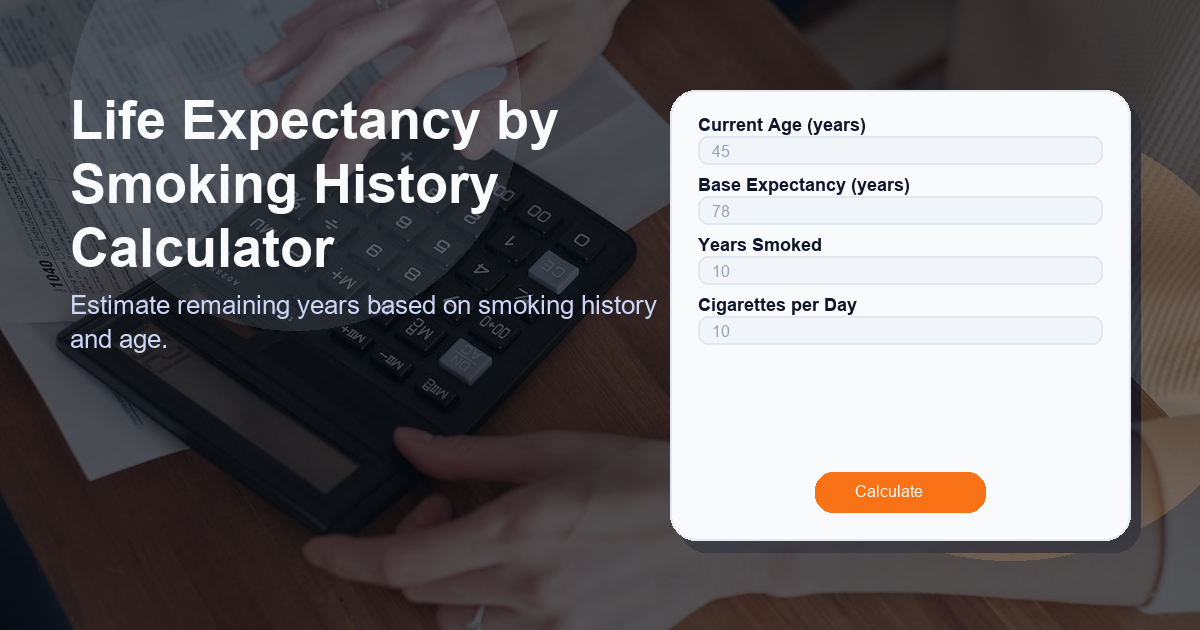
Life Expectancy by Smoking History Calculator
Description: Estimate remaining years based on smoking history and age with the Life Expectancy by Smoking History Calculator. This straightforward tool uses a simple formula to approximate how many years you might have left, given your current age, lifetime smoking exposure, and a baseline life expectancy.
What this Life Expectancy by Smoking History Calculator does
The Life Expectancy by Smoking History Calculator provides a quick, approximate estimate of the number of years a person may have remaining based on four inputs. It is designed for general informational and educational purposes, helping users understand the relative impact of smoking behaviors on projected remaining lifespan.
Key outcomes and characteristics:
- Quick estimate: Returns an approximate figure labeled Estimated Remaining Years.
- Comparative insight: Shows how additional years smoked or higher cigarettes-per-day can reduce the projected remaining years.
- Easy to use: Requires only four inputs most users already know.
- Non-clinical: Not intended as a medical diagnosis or replacement for professional advice.
How to use the Life Expectancy by Smoking History Calculator
To use this calculator, enter the following four inputs:
- Current Age (years) — your present age in years.
- Base Expectancy (years) — the baseline life expectancy used as a starting point (for example, average national life expectancy or a personalized estimate).
- Years Smoked — total number of years you have smoked.
- Cigarettes per Day — average number of cigarettes smoked per day.
After entering the values, the calculator applies the formula and outputs the Estimated Remaining Years. The interface typically shows the result instantly and may include a short interpretation (e.g., “Above average”, “Below average”, or “Very low”).
Example usage:
- Current Age: 45
- Base Expectancy: 82
- Years Smoked: 20
- Cigarettes per Day: 15
Calculation (see formula section below):
Estimated Remaining Years = 82 - (20 * 0.2) - (15 * 0.1) - 45
Compute step-by-step:
- 20 * 0.2 = 4
- 15 * 0.1 = 1.5
- Estimated Remaining Years = 82 – 4 – 1.5 – 45 = 31.5
So the calculator would return Estimated Remaining Years: 31.5 in this example.
How the Life Expectancy by Smoking History Calculator formula works
The calculator uses a simple linear formula designed for clarity and interpretability:
Estimated Remaining Years = base_expectancy - (years_smoked * 0.2) - (cigarettes_per_day * 0.1) - current_age
Explanation of each term:
- base_expectancy: This is the starting life expectancy value (in years). It can be the average life expectancy for your country or a customized baseline.
- (years_smoked * 0.2): This term subtracts 0.2 years (about 2.4 months) of remaining life for each year of smoking history. It reflects a simplified estimate of cumulative damage from years of smoking.
- (cigarettes_per_day * 0.1): This subtracts 0.1 years (about 1.2 months) per cigarette per day — capturing intensity of daily use. The more cigarettes per day, the greater the estimated reduction.
- current_age: The formula deducts the current age from the baseline-adjusted life expectancy to produce an estimate of remaining years.
Important notes on the formula:
- Simplicity: The coefficients (0.2 per year smoked, 0.1 per cigarette per day) are simplified parameters meant to illustrate relative impact rather than precise actuarial values.
- Linearity: The model is linear — it assumes each year smoked and each additional cigarette per day reduces life expectancy by fixed amounts. Real-world risk relationships can be nonlinear.
- Interpreting results: Use the output as an approximate guide. If the formula produces a negative result, interpret it as indicating a very low remaining life expectancy estimation in the simplified model; in practice, consult a professional for personalized evaluation.
Use cases for the Life Expectancy by Smoking History Calculator
This calculator is useful in several contexts:
- Personal awareness: For individuals curious about how their smoking history might influence remaining years.
- Motivation to quit: Seeing a numerical impact can provide a tangible incentive to reduce or stop smoking.
- Health education: Teachers, counselors, and public health communicators can use the calculator to demonstrate smoking’s cumulative effects.
- Comparative scenarios: Users can run “what-if” analyses (e.g., if I quit now, how does years_smoked change the projection?) to visualize potential gains from quitting or reducing cigarettes per day.
- Non-medical planning: People using baseline expectancy for financial or retirement planning can include adjusted life expectancy estimates for scenario analysis — but should not rely on this alone for critical decisions.
Other factors to consider when calculating life expectancy
While the Life Expectancy by Smoking History Calculator captures important smoking-related effects, many other factors influence real-world life expectancy. Consider these when interpreting results:
- Genetics: Family history of longevity or hereditary diseases can strongly affect outcomes.
- Diet and exercise: Regular physical activity and a healthy diet can increase life expectancy significantly.
- Alcohol and other substance use: Patterns of alcohol consumption and other substances interact with smoking to modify risk.
- Access to healthcare: Preventive care, early detection, and treatment of chronic conditions change expected outcomes.
- Chronic conditions: Existing illnesses (e.g., diabetes, cardiovascular disease) substantially alter life expectancy projections.
- Socioeconomic and environmental factors: Income, education, workplace exposures, and local environmental quality (air pollution) matter.
- Smoking cessation and timing: Quitting smoking has immediate and long-term benefits — risk declines over time after cessation.
Because of these complexities, treat the calculator as a simple, educational tool rather than a definitive measure. For personalized medical advice, consult a healthcare professional.
FAQ
Q: Is the Life Expectancy by Smoking History Calculator accurate?
A: This calculator provides a simplified approximation. It is useful for awareness and comparison but not a substitute for clinical assessments or actuarial calculations. The formula uses fixed coefficients and does not account for many health, genetic, or environmental factors.
Q: Can quitting smoking improve the Estimated Remaining Years?
A: Yes. Reducing years smoked (by stopping earlier) and lowering cigarettes per day will increase the estimated remaining years in the model. Real-world benefits of quitting can be substantial and accumulate over time.
Q: What should I use for Base Expectancy?
A: You can use national average life expectancy from statistical agencies, or a personalized baseline if you have one. The choice of base expectancy will change the absolute result, so use a realistic baseline for meaningful interpretation.
Q: Can I use this for medical or legal decisions?
A: No. This tool is for general informational and educational use only. For medical, legal, or insurance decisions, seek professional advice and validated actuarial assessments.
Q: What if the calculator returns a negative number?
A: A negative Estimated Remaining Years indicates the simplified model projects a very low remaining life expectancy given the inputs. In practice, negative or extremely low outputs signal that the model is not suitable for detailed predictions — consult a healthcare professional for accurate evaluation.