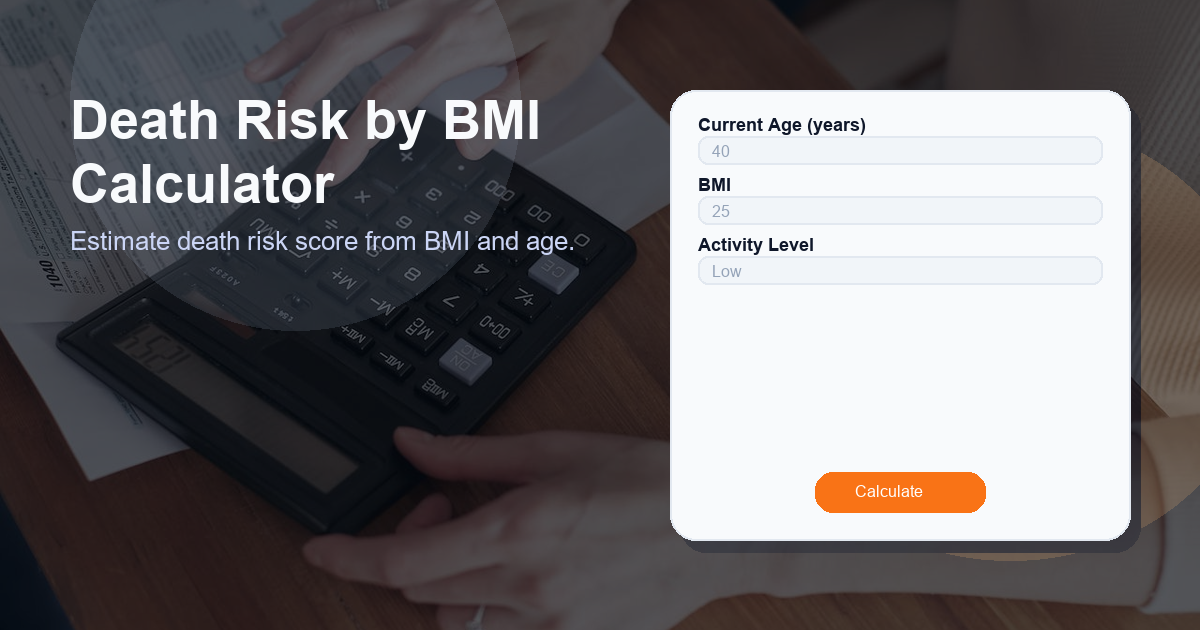
Death Risk by BMI Calculator
Estimate death risk score from BMI and age using a simple, transparent formula. The Death Risk by BMI Calculator provides a quick, evidence-informed proxy to help you understand how body mass index (BMI), age, and activity level together contribute to a compact risk score labeled the BMI Risk Score. This tool is intended for educational and screening purposes only and is not a substitute for medical advice.
Death Risk by BMI Calculator
Description: Estimate death risk score from BMI and age.
What this Death Risk by BMI Calculator does
The Death Risk by BMI Calculator is a compact tool designed to convert three simple inputs — Current Age (years), BMI, and a numeric Activity Level — into a single score: the BMI Risk Score. It uses an explicit, linear formula so you can see how each component contributes to the final result.
Key outputs and features:
- BMI Risk Score: A single numeric value computed from the formula provided.
- Interpretation bands: A friendly textual interpretation (lower, mild, moderate, higher) to help you contextualize the score.
- Transparent mapping: Activity levels are mapped to numeric adjustments so the calculator remains predictable and reproducible.
How to use the Death Risk by BMI Calculator
Using the Death Risk by BMI Calculator is straightforward. Follow these steps:
- Enter your current age in years. Use whole numbers for simplicity (e.g., 34).
- Enter your BMI in kg/m². If you don’t know your BMI, you can calculate it from weight and height: BMI = weight (kg) / (height (m))².
- Select your activity level from the dropdown. The calculator maps descriptive categories to numeric adjustments (e.g., Very active = -1, Average = 0, Very sedentary = +1).
- Click “Calculate BMI Risk Score”. The calculator applies the formula and shows the numeric result along with a short interpretation.
Example: A 50-year-old with a BMI of 30 who is sedentary (activity level = 0.5) produces a score calculated as (30-25)*0.3 + (50/50) + 0.5 = 1.5 + 1 + 0.5 = 3.0 → interpreted as a higher risk band.
How the Death Risk by BMI Calculator formula works
The calculator uses the explicit formula:
(bmi - 25) * 0.3 + (current_age / 50) + activity_level
Breaking this down:
- (bmi - 25) * 0.3: This term centers BMI at 25 (a common reference point) and scales differences by 0.3. A BMI above 25 increases the score; below 25 decreases it.
- (current_age / 50): Age is scaled by dividing by 50, so a 50-year-old contributes 1.0 to the score, while a 25-year-old contributes 0.5.
- activity_level: A numeric modifier where higher values denote less activity and therefore a higher adjustment to the risk score. We provide descriptive mapping to numeric values to make selection easy.
This linear form makes it easy to see marginal impacts. For example, increasing BMI by 1 point increases the score by 0.3. Adding 10 years of age (when scaled) increases the score by 0.2 (since 10/50 = 0.2).
Use cases for the Death Risk by BMI Calculator
The Death Risk by BMI Calculator can be useful in several non-clinical settings:
- Personal health awareness: Quickly estimate how BMI and age combine with activity to influence a simple composite risk score.
- Self-monitoring: Track changes in your BMI Risk Score over time as you lose weight, age, or change activity habits.
- Education: Teach students or clients how linear models combine variables and how sensitive outcomes are to small input changes.
- Preliminary screening: Provide a starting point for discussions with healthcare professionals; not a diagnostic tool.
Other factors to consider when calculating death risk
While the Death Risk by BMI Calculator captures three important dimensions, real-world mortality risk is multifactorial. Consider these additional factors that may modify risk but are not included in the formula:
- Chronic medical conditions: Diabetes, cardiovascular disease, chronic kidney disease, cancer, and lung disease substantially affect mortality risk.
- Smoking and substance use: Tobacco, alcohol misuse, and certain drugs change risk independently of BMI and age.
- Genetics and family history: Hereditary risk factors can predispose individuals to specific causes of death.
- Socioeconomic factors: Access to healthcare, nutrition, occupation, and stress levels influence long-term outcomes.
- Body composition: BMI does not distinguish between fat and muscle. Two people with the same BMI can have very different health profiles.
- Mental health and frailty: Depression, isolation, and frailty can impact mortality risk, particularly in older adults.
Important: This calculator is a simple model and cannot account for all clinical and lifestyle variables. Always consult a healthcare professional for personalized risk assessment and medical guidance.
Short FAQ
1. Is the Death Risk by BMI Calculator a medical diagnosis?
No. This calculator provides a simple, transparent score for educational and screening purposes only. It is not a substitute for professional medical assessment, diagnosis, or treatment.
2. What does the BMI Risk Score number mean?
The BMI Risk Score is a dimensionless number derived from the formula. Lower scores generally indicate lower predicted risk (based on the model), and higher scores indicate higher predicted risk. The tool provides basic interpretation bands (lower, mild, moderate, higher) but these are approximate.
3. How should I choose the activity level?
Select the option that best matches your usual weekly activity. We map descriptive choices to numeric adjustments (Very active = -1, Active = -0.5, Average = 0, Sedentary = 0.5, Very sedentary = 1). These values alter the score to reflect protective effects of activity.
4. Can I use this if I don't know my BMI?
Yes — you can calculate BMI using weight and height: BMI = weight (kg) / (height in meters)². There are many online calculators to convert from pounds/inches if needed.
5. How often should I check my BMI Risk Score?
As frequently as you make meaningful changes in weight, age (e.g., annually), or activity habits. Use it as a monitoring tool, not a definitive measure. For any concerning results, consult a healthcare professional.
Disclaimer: The Death Risk by BMI Calculator is a simple model intended for informational purposes. It does not replace clinical judgment, comprehensive risk calculators, or medical advice from qualified professionals.