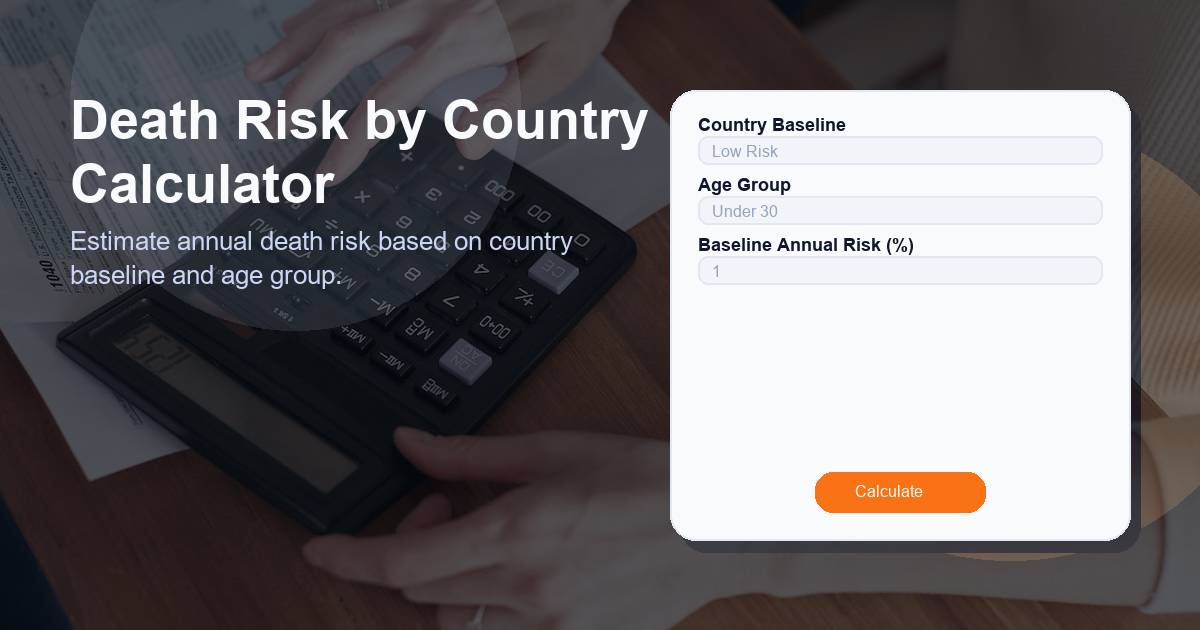
Death Risk by Country Calculator
Description: Estimate annual death risk based on country baseline and age group. This Death Risk by Country Calculator helps you combine a baseline annual risk with country-specific and age-group multipliers to produce an Estimated Annual Risk for a defined population or individual.
What this Death Risk by Country Calculator calculator does
The Death Risk by Country Calculator provides a simple, transparent way to estimate an individual or cohort’s annual likelihood of death by combining three inputs:
- Country Baseline (a relative multiplier reflecting national-level mortality differences compared to a reference)
- Age Group (a relative multiplier representing age-related risk differences)
- Baseline Annual Risk (%) (the baseline probability of death per year expressed as a percentage)
Using these inputs, the calculator computes:
Estimated Annual Risk = baseline_annual_risk × country_risk × age_group
The tool is intended for comparative, planning, and illustrative purposes — not as a clinical diagnosis. It gives a quick, model-based estimate so users can compare scenarios, test sensitivities, and communicate risk differences clearly.
How to use the Death Risk by Country Calculator calculator
Follow these steps to produce a meaningful estimate:
- Choose a Baseline Annual Risk (%) — this is typically a reference probability (for example, a global average or a cohort baseline). If you have an annual death rate of 1.0%, enter 1.0 (see conversion notes below).
- Select a Country Baseline multiplier — this multiplier adjusts the baseline to reflect country-level mortality differences (for example, 0.9 for lower-than-reference mortality, 1.3 for higher-than-reference mortality).
- Select an Age Group multiplier — choose the multiplier representing the relative risk for the age group (for example, 0.5 for a young adult age group relative to baseline, 2.0 for older adults).
- Apply the formula to compute the result labeled Estimated Annual Risk.
Conversion tip: If you enter the Baseline Annual Risk as a percent (for example 1.0%), convert to a decimal for calculation (1.0% → 0.01). After computing, convert back to percent for reporting (0.018 → 1.8%). Many implementations accept percent values and perform this conversion automatically; ensure you know which convention your tool uses.
How the Death Risk by Country Calculator formula works
The formula is intentionally simple and multiplicative:
Estimated Annual Risk = baseline_risk × country_risk × age_group
Where:
- baseline_risk — the baseline annual risk expressed as a decimal (baseline annual rate ÷ 100). Example: 1.0% → 0.01.
- country_risk — a dimensionless multiplier capturing national-level differences (for instance, healthcare access, prevalence of chronic disease, injury rates, and environmental risks).
- age_group — a dimensionless multiplier capturing the relative risk attributable to a specific age group.
Example calculation:
- Baseline Annual Risk: 1.0% → 0.01
- Country Baseline multiplier: 1.2 (20% higher than the reference)
- Age Group multiplier: 1.5 (50% higher than the reference age category)
- Estimated Annual Risk = 0.01 × 1.2 × 1.5 = 0.018 → convert to percent = 1.8%
This multiplicative approach assumes the effects are proportional and independent. It’s straightforward, easy to communicate, and useful for sensitivity analysis, but remember this is a simplified model — see limitations below.
Use cases for the Death Risk by Country Calculator
The Death Risk by Country Calculator supports a variety of practical applications:
- Public health planning — compare how different countries or age groups contribute to expected mortality, useful for allocating resources or modeling intervention impact.
- Insurance underwriting and actuarial analysis — create scenario-based estimates to evaluate pricing or reserve needs when detailed population tables are unavailable.
- Travel and relocation planning — provide comparative perspectives on baseline mortality risk when considering long-term moves or expatriate assignments (as one of many factors to weigh).
- Academic or policy research — run sensitivity analyses, demonstrate how changing multipliers affects outcomes, or present simplified risk scenarios.
- Education and communication — help non-experts visualize the relative importance of country-level and age-related risk differences.
Other factors to consider when calculating death risk
While the calculator is a helpful first step, real-world mortality is influenced by many additional variables. Consider these factors before drawing firm conclusions:
- Comorbidities and individual health — chronic diseases, disability, and health behaviors (smoking, diet, exercise) greatly influence individual risk and are not captured by simple country/age multipliers.
- Socioeconomic status — income, education, and employment affect access to care and exposure to hazards.
- Healthcare system capacity — quality, accessibility, and emergency response change outcomes, especially for preventable or treatable conditions.
- Environmental and occupational hazards — air quality, natural disasters, workplace safety, and violence can introduce substantial variation not captured by a single country multiplier.
- Data quality and baseline definition — baseline annual risk depends on the source, timeframe, and population. Always document the reference used (calendar year, age-adjusted, cohort-specific).
- Time horizon and temporal trends — mortality can change over time (pandemics, health interventions, economic shifts). Use recent data or conduct time-series modeling if needed.
- Interaction effects — the multiplicative model assumes independence. In reality, interactions (e.g., age × comorbidity × country health system) can be significant.
Because of these factors, the calculator is best used for comparative and exploratory purposes. For clinical or high-stakes decisions, consult detailed epidemiological models or domain experts.
FAQ — Death Risk by Country Calculator
How accurate is the Death Risk by Country Calculator?
The calculator provides an approximate estimate based on simple multipliers. Accuracy depends on the quality of your inputs (baseline risk, country and age multipliers) and whether the multiplicative assumptions hold. Use it for comparative and illustrative purposes, not as a definitive forecast.
What should I use for the baseline annual risk (%)?
Choose a baseline that matches the population you want to model: a global average, a regional rate, or a cohort-specific rate. Ensure you document the source and convert percent to decimal for calculation (1.0% → 0.01). If unsure, test multiple baseline values in sensitivity analysis.
Where do I get reasonable country and age multipliers?
Possible sources include national vital statistics, WHO and UN mortality databases, and peer-reviewed studies. If these are unavailable, you can use provisional multipliers (for example, 0.8–1.2 for small deviations) and clearly label them as assumptions. Always validate against published mortality tables when possible.
Can I include other risk factors in the calculator?
Yes — you can extend the model by adding additional multiplicative factors (for comorbidities, socioeconomic status, etc.). For example: estimated_risk = baseline × country × age × comorbidity_factor. Just ensure each factor is justified and sourced. Be cautious about overfitting with many uncertain multipliers.
Is this tool suitable for individual medical decisions?
No. The calculator provides population-level or cohort-level estimates and should not replace clinical judgment. For individual risk assessment, consult healthcare professionals and use detailed medical evaluation and validated clinical risk tools.
Final note: The Death Risk by Country Calculator is a flexible, easy-to-understand model for exploring relative mortality scenarios. Use clear input documentation, perform sensitivity checks, and combine this tool with domain-specific data for more reliable planning and communication.