Death Risk by Occupation Calculator
What this Death Risk by Occupation Calculator calculator does
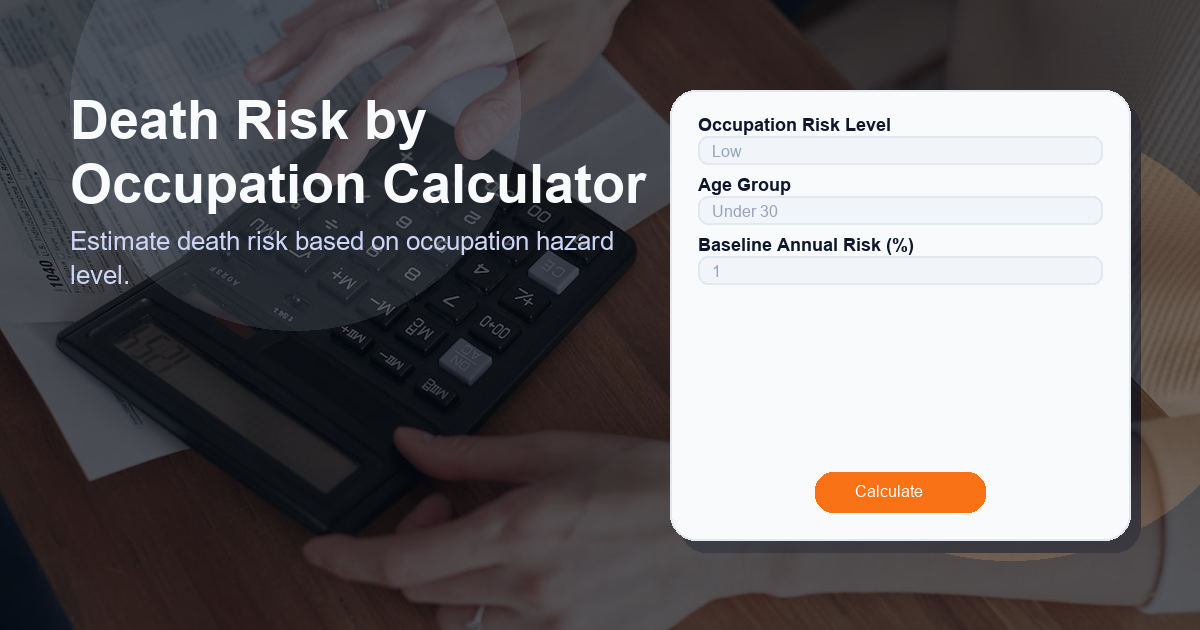
The Death Risk by Occupation Calculator is a simple, transparent tool designed to help users estimate the relative annual risk of death associated with different job hazard levels and age groups. It combines a baseline annual risk (%) with two multipliers — an Occupation Risk Level and an Age Group multiplier — to produce an Estimated Annual Risk.
This calculator is not a medical or legal instrument; it provides an illustrative risk estimate based on three inputs that you can adjust to reflect industry data, published statistics, or organizational risk assessments. The outcome helps with
- Comparative risk analysis between occupations
- Workplace safety planning and prioritization
- Personal decision-making about career risk
- Communication of relative risk to stakeholders
How to use the Death Risk by Occupation Calculator calculator
Using the Death Risk by Occupation Calculator is straightforward. Provide three inputs, apply the formula, and read the result labeled Estimated Annual Risk. Follow these steps:
- Select an Occupation Risk Level — this should be a numeric multiplier that represents the relative hazard of the occupation compared with the baseline (for example, 0.5 for lower-than-baseline risk, 1.0 for baseline, 2.0 for double the baseline).
- Choose an Age Group — enter an age-group multiplier that reflects how risk changes with age (for example, 0.8 for younger groups, 1.0 for an average adult group, 1.5 or higher for older adults).
- Enter Baseline Annual Risk (%) — this is the base probability of death per year expressed as a percentage (for example, 0.10% = 0.10). The calculator converts it internally to a decimal for computation.
- Compute — the calculator multiplies the three values using the formula below and displays the Estimated Annual Risk as a percentage.
Quick tips:
- When entering Baseline Annual Risk (%), be clear whether you’re entering a percent (e.g., 0.10 for 0.10%) or a decimal (0.001). The expected input for this calculator is percent, which it will convert to decimal internally.
- Use occupation and age multipliers based on published statistics, industry tables, or reasonable assumptions if exact values are unknown.
How the Death Risk by Occupation Calculator formula works
The calculation behind the Death Risk by Occupation Calculator is intentionally simple and multiplicative. The formula is:
Estimated Annual Risk = baseline_risk * occupation_risk * age_group
Where:
- baseline_risk = baseline annual risk converted from percent to decimal (example: 0.10% => 0.001)
- occupation_risk = numeric multiplier representing occupational hazard relative to the baseline (unitless)
- age_group = numeric multiplier representing age-related change in risk (unitless)
Example 1 — Low hazard job, young worker:
- Baseline annual risk = 0.10% (entered as 0.10)
- Occupation Risk Level = 0.6 (60% of baseline)
- Age Group = 0.8 (younger age reduces risk)
- Calculation: 0.001 (decimal) * 0.6 * 0.8 = 0.00048 → Estimated Annual Risk = 0.048%
Example 2 — High hazard job, older worker:
- Baseline annual risk = 0.10%
- Occupation Risk Level = 2.5 (2.5 times baseline)
- Age Group = 1.5
- Calculation: 0.001 * 2.5 * 1.5 = 0.00375 → Estimated Annual Risk = 0.375%
These examples illustrate how multipliers amplify or reduce the baseline risk to produce an easy-to-compare annual estimate.
Use cases for the Death Risk by Occupation Calculator
This calculator is useful in multiple contexts where a simple, communicable risk estimate is required. Typical use cases include:
- Occupational safety programs — prioritize interventions by comparing estimated risk across job categories.
- Human resources and benefits planning — inform life insurance, wellness programs, or retirement planning with relative risk estimates.
- Policy and research — create rough comparative tables when high-resolution data are unavailable.
- Public education — provide context to workers or community members about how age and job hazard affect annual risk.
- Scenario analysis — simulate how changes in job conditions or demographics could influence population-level risk.
Benefits of using this tool:
- Transparent inputs and formula make it easy to explain and reproduce results.
- Flexible — multipliers can be adjusted as better data becomes available.
- Actionable — results support prioritization and communication efforts in safety and health planning.
Other factors to consider when calculating x
The heading above purposely uses x to emphasize that the simple multiplicative model does not capture every nuance of mortality risk. When using the Death Risk by Occupation Calculator, keep these important limitations and additional factors in mind:
- Comorbidities and health status: Individual health conditions (cardiovascular disease, respiratory illnesses, etc.) strongly influence risk and are not captured by a single age multiplier.
- Exposure duration and intensity: The tool assumes consistent annual exposure. Part-time work, seasonality, or episodic high-risk tasks change real-world risk.
- Safety measures: Use of protective equipment, training, and safety culture can reduce occupation risk below nominal multipliers.
- Socioeconomic and environmental factors: Access to healthcare, commuting risks, and community hazards may increase or decrease real risk beyond occupation and age.
- Data quality: The accuracy of the estimate depends entirely on quality inputs. Use published occupational mortality rates and validated age-risk relationships when possible.
- Statistical uncertainty: Small sample sizes or rare events produce high uncertainty. Treat single-point estimates as indicative rather than definitive.
In short, treat the calculator as a starting point. For formal risk assessments, combine this tool with epidemiological data, expert analysis, and stakeholder consultation.
Frequently Asked Questions (FAQ)
Q1: What is the unit of the result “Estimated Annual Risk”?
A1: The Estimated Annual Risk is expressed as a percentage per year. The calculator converts the entered Baseline Annual Risk (%) to a decimal internally, multiplies by the occupation and age multipliers, then converts back to a percent for display.
Q2: How do I choose occupation and age multipliers?
A2: Multipliers should reflect relative risk compared to your chosen baseline. Use published occupational fatality rates or industry tables when available. If those are not available, use conservative estimates (e.g., 0.5–0.8 for lower-than-average risk, 1.0 for baseline, 1.5–3.0+ for higher-risk roles) and document your assumptions.
Q3: Can this calculator give an exact probability of death for an individual?
A3: No. The calculator provides an estimate based on simplified assumptions. Individual risk depends on many additional factors such as medical history, lifestyle, and specific working conditions. Use it for comparative and illustrative purposes, not definitive individual predictions.
Q4: Is the formula flexible if I want to include more variables?
A4: Yes. The current formula is intentionally simple: baseline_risk * occupation_risk * age_group. You can extend it by multiplying additional factors (e.g., health_multiplier, safety_controls_multiplier) as needed, but be transparent about each added assumption.
Q5: Where can I find reliable baseline risk data?
A5: Reliable sources include national vital statistics agencies, occupational safety and health administrations, peer-reviewed epidemiology studies, and actuarial tables from insurance providers. Always cite the source and year for any baseline data used.