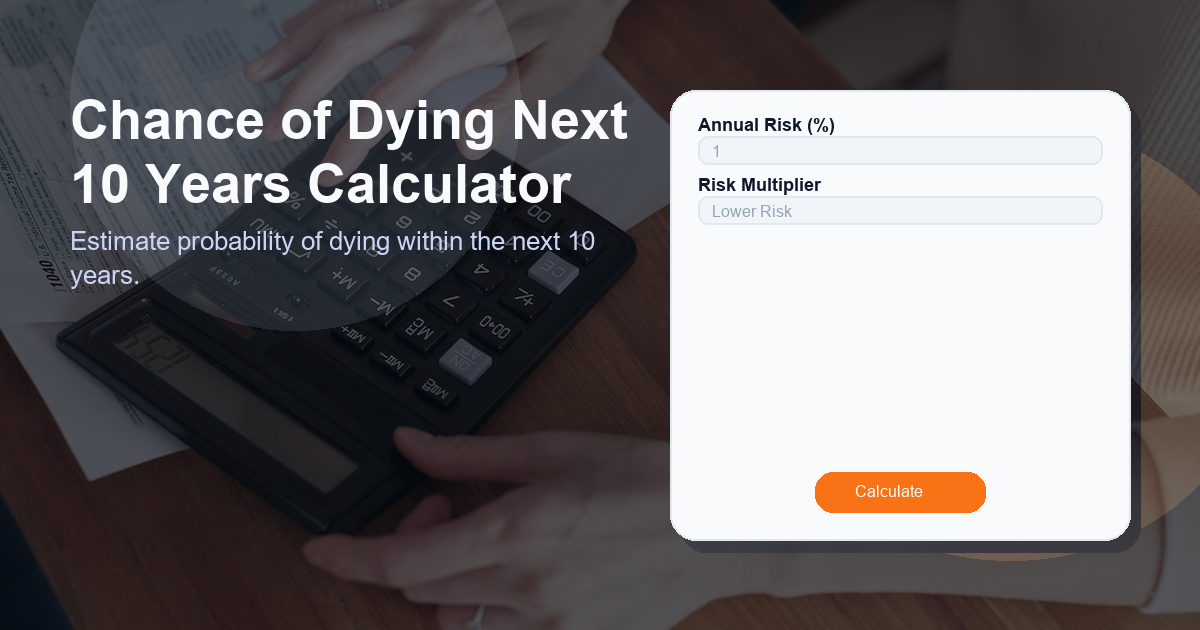
Chance of Dying Next 10 Years Calculator
Description: Estimate probability of dying within the next 10 years using the Chance of Dying Next 10 Years Calculator. This article explains what the calculator does, how to use it, how the formula works, common use cases, and important caveats to consider when interpreting results.
What this Chance of Dying Next 10 Years Calculator calculator does
The Chance of Dying Next 10 Years Calculator provides a straightforward numeric estimate of the probability that an individual will die within the next 10 years based on two inputs:
- Annual Risk (%) — the estimated probability of death in a single year, expressed as a percentage.
- Risk Multiplier — a factor used to adjust the annual risk for individual circumstances (e.g., health conditions, lifestyle, environment).
The calculator applies a statistical formula to combine the annual risk and multiplier across a 10-year period and returns the Chance of Dying in 10 Years as a percentage. This tool is intended for general estimation, scenario modeling, and comparative purposes — not for definitive medical or actuarial determinations.
How to use the Chance of Dying Next 10 Years Calculator calculator
Using the calculator is simple. Follow these steps:
- Enter Annual Risk (%): Provide the baseline annual death risk as a percentage. This may come from population tables, published statistics, or a clinician’s estimate.
- Enter Risk Multiplier: Input a multiplier to reflect personal circumstances. For example, use 1.0 for average risk, 2.0 for double the baseline risk, or 0.5 for half the baseline risk.
- Compute: The calculator applies the formula to estimate the probability of dying within the next 10 years and displays the Chance of Dying in 10 Years percentage.
Inputs summary:
- Annual Risk (%)
- Risk Multiplier
Formula used (JavaScript-style):
(1-Math.pow(1-(annual_risk_percent*risk_multiplier/100),10))*100
Result label: Chance of Dying in 10 Years
Example: If the annual risk is 1% and the risk multiplier is 1.5, calculate:
- Adjusted annual risk = 1% * 1.5 = 1.5%
- Probability of surviving 1 year = 1 – 0.015 = 0.985
- Probability of surviving 10 years = 0.985^10 ≈ 0.8607
- Chance of dying in 10 years = (1 – 0.8607) * 100 ≈ 13.93%
How the Chance of Dying Next 10 Years Calculator formula works
The formula models the 10-year risk as the complement of surviving every one of the ten years. It assumes a constant annual risk (after applying the multiplier) and independence of yearly outcomes. In plain language:
- Compute the adjusted annual risk as (annual_risk_percent * risk_multiplier / 100).
- Compute the annual survival probability as (1 – adjusted annual risk).
- Raise the annual survival probability to the 10th power to get the probability of surviving all 10 years.
- Subtract that survival probability from 1 and multiply by 100 to express as a percentage.
Algebraically: Chance of dying in 10 years = (1 − (1 − r)^10) × 100, where r is the adjusted annual risk as a decimal.
Key assumptions behind this formula:
- Constant risk each year: The formula assumes the same adjusted annual risk applies in each of the 10 years. Real-life risk often changes with age, health events, or interventions.
- Independence across years: It assumes that surviving one year does not change the probability of dying in future years beyond what is captured by the constant r.
Because of these simplifying assumptions, the output is best interpreted as an approximate or illustrative probability rather than a precise forecast. It is well-suited for comparing scenarios (e.g., with and without an intervention) or doing sensitivity analysis by varying inputs.
Use cases for the Chance of Dying Next 10 Years Calculator
This calculator is useful in several practical contexts. Common use cases include:
- Personal planning: Individuals can compare how lifestyle changes (smoking cessation, exercise) or medical interventions might change their estimated 10-year mortality risk.
- Scenario modeling: Compare outcomes under different risk multipliers to see how much a change in relative risk affects 10-year probability.
- Insurance and finance (informal): As an informal tool to understand how short-term mortality risk affects life planning, though not a substitute for actuarial tables or professional advice.
- Public health communication: Demonstrate the effect of population-level risk reductions (e.g., vaccination, pollution control) on 10-year mortality probability.
- Educational purposes: Teach principles of survival probability and the compounding effect of annual risks over multiple years.
Other factors to consider when calculating x
When using the Chance of Dying Next 10 Years Calculator you should consider several important real-world factors that the simple formula does not capture directly:
- Age-related changes: Annual mortality risk typically increases with age. A constant annual risk may understate or overstate actual 10-year risk for people at the extremes of age.
- Comorbidities and health events: Major health events (heart attack, cancer) can drastically change future risk profiles; a single multiplier may not capture these dynamics.
- Competing risks: Specific causes of death may interact; the model treats all-cause mortality as a single risk and does not model cause-specific competition.
- Data quality: Ensure the baseline annual risk comes from reliable sources (national life tables, published studies). Garbage in, garbage out — inaccurate inputs produce misleading outputs.
- Behavior changes and interventions: Medical treatment, surgery, medications, and lifestyle changes can reduce or increase risk over time; consider re-calculating with updated inputs.
- Short-term variability: The model smooths risk across 10 years. For short-term decisions (weeks or months), different methodologies may be more appropriate.
Always treat estimates from this calculator as informative but not definitive. For clinical, legal, or actuarial decisions, consult qualified professionals and use detailed models appropriate to the domain.
FAQ
How accurate is the Chance of Dying Next 10 Years Calculator?
The calculator provides an approximate estimate based on the inputs and model assumptions (constant annual risk, independence). Accuracy depends heavily on the quality and relevance of the input Annual Risk (%) and the appropriateness of the Risk Multiplier. For precise assessments, use detailed actuarial tables or consult a professional.
Can I use different time horizons (e.g., 5 or 20 years)?
Yes. The same mathematical approach works for other time horizons by replacing the exponent 10 with the desired number of years n: (1 − (1 − r)^n) × 100. The calculator as described is specifically configured for a 10-year horizon.
What does the Risk Multiplier represent?
The Risk Multiplier adjusts baseline annual risk to reflect individual circumstances. For example, 1.0 means baseline risk, 2.0 doubles baseline risk, and 0.5 halves it. Choose multipliers based on clinical judgment, relative risk estimates from studies, or scenario testing.
Is this a substitute for life insurance or medical advice?
No. This calculator is an educational and planning tool. It does not replace professional medical evaluation, actuarial analysis, or insurance underwriting.
How should I interpret a high result (e.g., >50%)?
A high estimated Chance of Dying in 10 Years indicates substantial short-term mortality risk under the model’s assumptions. Review the inputs for plausibility, consider whether risks are changing over time, and seek professional advice to understand actionable steps.