Probability of Death by Age Calculator
Description: Estimate probability of death over a period by age group. Use the Probability of Death by Age Calculator to quickly approximate the cumulative chance of death over a specified number of years based on an annual risk, adjusted for an age group factor.
What this Probability of Death by Age Calculator calculator does
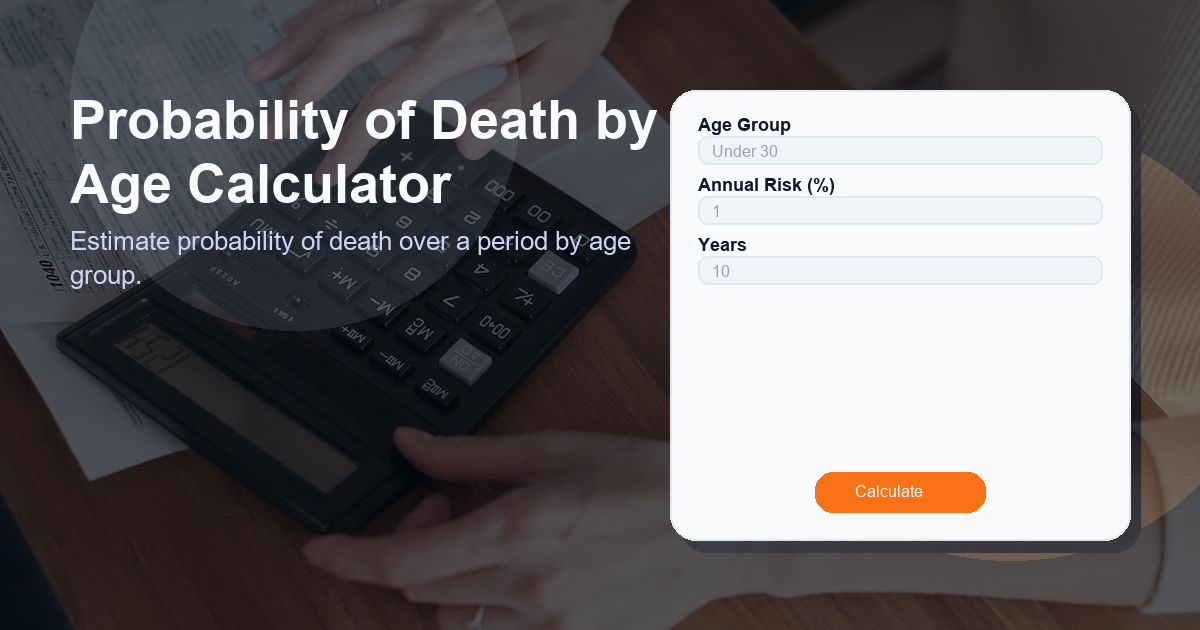
The Probability of Death by Age Calculator converts a simple yearly risk into a multi-year cumulative probability that at least one death event occurs during the chosen period. It is designed for quick scenario analysis and high-level planning rather than precise actuarial valuation. The tool accepts three inputs:
- Age Group — a factor or index representing how risk scales for the selected age cohort (see guidance below on how to choose or interpret this value).
- Annual Risk (%) — the baseline annual probability of death expressed as a percentage for the reference population or baseline group.
- Years — the number of years over which you want to estimate the cumulative probability.
The output is shown as Probability of Death, representing the percent chance that at least one death occurs in the specified period for someone in the selected age group given the annual risk.
How to use the Probability of Death by Age Calculator calculator
Using the calculator is simple. Follow these steps:
- Select or enter an Age Group value. This is typically a multiplier indicating how risk changes with age relative to a baseline. For example, you might use:
- 0.5 for young adults (lower-than-baseline risk)
- 1.0 for the baseline adult group
- 1.5–3.0 for older age groups depending on mortality increases
- Enter the Annual Risk (%). Put the base annual death risk as a percentage (e.g., 0.2 for 0.2% per year).
- Enter the number of Years. Choose the duration for the cumulative calculation (e.g., 5, 10, or 30 years).
- Read the Probability of Death. The calculator returns a percentage that estimates the likelihood of death at least once during the specified period for the age group selected.
Tip: If you are unsure about the Age Group multiplier, consult published life tables or epidemiological studies for approximate relative risks by age band and convert those to multipliers. Always document the assumptions used so results can be interpreted correctly.
How the Probability of Death by Age Calculator formula works
The calculator uses the following formula to compute the cumulative probability over multiple years:
(1-Math.pow(1-(annual_risk_percent*age_group/100),years))*100
Breaking this down:
- annual_risk_percent*age_group/100 converts the input annual percentage and age group multiplier into a per-year probability (a decimal probability between 0 and 1).
- 1 – (annual probability) gives the probability of surviving a single year (i.e., not experiencing death in that year).
- Math.pow(1 – annualProbability, years) computes the probability of surviving every year for the full period — the chance of surviving all years without the event.
- 1 – Math.pow(…) converts survival probability into the probability that the event (death) occurs at least once during the period.
- *100 expresses the final result as a percentage for readability, labeled in the tool as Probability of Death.
Example calculation:
- Age Group multiplier = 1.5
- Annual Risk (%) = 0.3 (which is 0.3% per year)
- Years = 10
Step-by-step:
- annual probability = 0.3 * 1.5 / 100 = 0.0045 (or 0.45% per year)
- survival over 10 years = (1 – 0.0045)^10 ≈ 0.9565
- Probability of Death = (1 – 0.9565) * 100 ≈ 4.35%
So, in this scenario the calculator estimates about a 4.35% Probability of Death over 10 years for the selected age group and annual risk.
Use cases for the Probability of Death by Age Calculator
The Probability of Death by Age Calculator can be useful in many non-clinical and planning contexts where a quick estimate of multi-year mortality risk is needed:
- Personal planning: Estimate risk for retirement planning, long-term care considerations, or estate planning.
- Insurance illustrations: Provide rough scenario comparisons when evaluating term coverage durations or listing sensitivity analyses.
- Public health communication: Illustrate changes in cumulative risk when annual risks change or differ by age cohort.
- Risk communication & education: Help explain how small annual risks accumulate over time to non-technical audiences.
- Scenario modeling: Quickly test “what-if” scenarios where age-specific multipliers and changing annual risks produce different cumulative outcomes.
Remember: This calculator is intended for high-level estimates and scenario exploration, not for replacing full actuarial or clinical risk models.
Other factors to consider when calculating probability
When using the Probability of Death by Age Calculator, keep these important limitations and considerations in mind:
- Time-varying risks: The formula assumes a constant annual risk (after applying the age multiplier) for every year. In real life, risks often change with age, health events, or interventions.
- Independence assumption: The calculation treats each year as an independent trial with the same risk. This may not hold if prior events change future risk.
- Age Group definition: The tool expects you to choose or supply a sensible Age Group multiplier. Incorrect multipliers can produce misleading results. Prefer using published relative risks or life-table ratios if available.
- Comorbidities and behaviors: Smoking, chronic disease, socioeconomic status, and medical care access materially change mortality risk but are not explicitly modeled here.
- Population vs. individual risk: Inputs often reflect population averages; individual risk can be substantially different.
- Confidence intervals: This calculator provides point estimates only. For robust planning, consider uncertainty and ranges of inputs.
For critical decisions, consult actuaries, epidemiologists, or clinicians and use detailed life tables or multivariate models that account for time-varying hazards and covariates.
FAQ
Q: What does the Age Group input represent?
A: The Age Group input is a multiplier that scales the baseline annual risk to reflect relative risk for the chosen age cohort. It is not the age in years. Use published relative risk values or life table ratios to choose this multiplier when possible.
Q: Can I use different annual risks for different years?
A: Not with the single-formula calculator described here. This version assumes a constant adjusted annual risk across all years. For year-specific risks, perform a year-by-year survival multiplication or use a more advanced model that accepts varying annual probabilities.
Q: Is the result the same as life table probabilities?
A: Not necessarily. Life tables derive age-specific probabilities from observed mortality data and often vary year-by-year. This calculator offers a simple approximation and can differ from life table results, especially over long horizons or with non-constant risk.
Q: How should I interpret the Probability of Death output?
A: The output is the estimated percent chance that death occurs at least once during the specified period, given the inputs and assumptions. It is a probabilistic estimate—not a prediction—for planning and comparison purposes.
Q: Can I use this for insurance pricing or clinical decision-making?
A: Use caution. This tool is for rough estimates and scenario analysis. For underwriting, pricing, or clinical decisions, use professional actuarial models, validated clinical risk calculators, or consult qualified professionals.